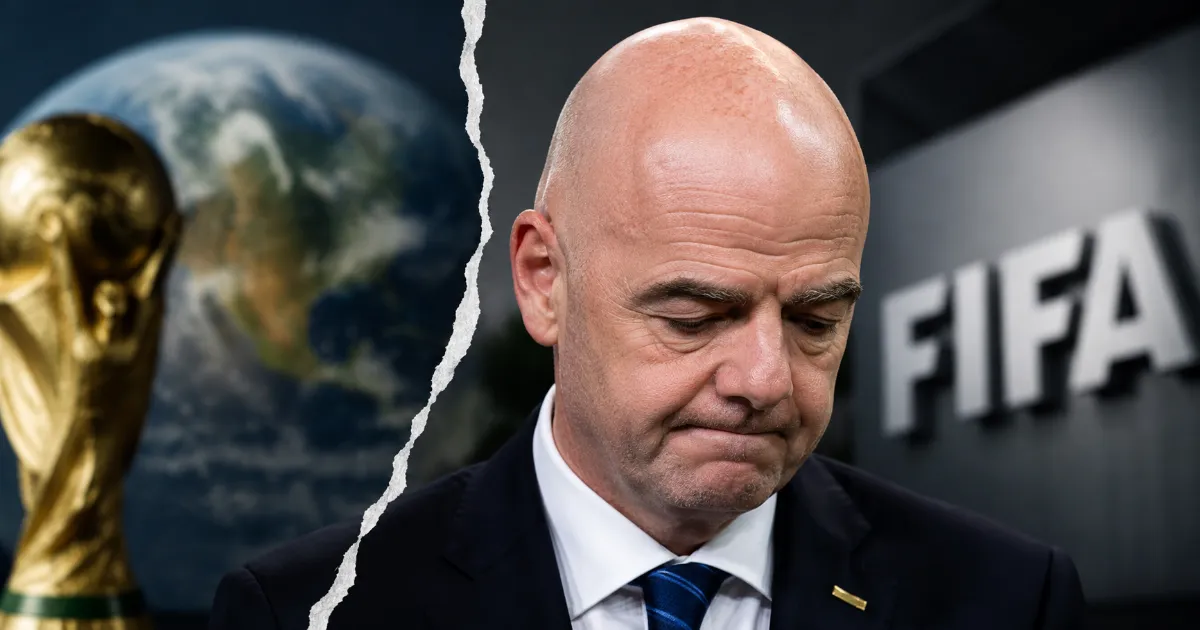
 FIFA President Gianni Infantino’s World Cup Sell-Off Plan has been withdrawn, but the controversy surrounding the proposal may have created a much bigger problem for FIFA.
The plan was presented as a way to unlock billions of dollars for global soccer development. Instead, it triggered a political storm inside the sport, angered UEFA and other powerful football organizations, and raised questions about transparency, private investment and the future of Infantino’s leadership.
The proposal would have brought private investment into a new FIFA commercial structure connected to the organization’s competitions. FIFA said outside investors would hold only a minority stake and that FIFA would retain control over sporting decisions and governance. The organization was targeting billions in new funding through the project.
But the reaction was fierce.
After days of escalating opposition, Infantino abandoned the project. Reuters reported that the proposal had been permanently withdrawn and that Infantino apologized for the way it had divided the soccer community.
The bigger question now is not simply what happened to the proposal. It is whether the World Cup sell-off controversy has fundamentally changed the balance of power inside FIFA.
Infantino’s FIFA Presidency: The Numbers, the Controversies, and the Legacy
FIFA World Cup Bidding Process: How Host Countries Are Chosen
Why Fans Love Daemon Targaryen in House of the Dragon: The Character Who Stole Every Scene
What Was Gianni Infantino’s World Cup Sell-Off Plan ?
The phrase “World Cup sell-off” can make the proposal sound like FIFA was literally selling the World Cup. That is not what the plan involved.
Instead, FIFA proposed creating a new commercial entity that would be connected to its competitions and could raise substantial private investment. FIFA said the outside investors would receive only a minority stake, while FIFA would continue to control competitions, governance and sporting decisions.
The project became associated with the name FIFA Forward Enterprise.
Infantino’s argument was straightforward: FIFA could use private capital to increase the amount of money flowing into football development around the world.
According to reporting on the proposal, FIFA was seeking around $4.2 billion through the new commercial structure. The broader objective was to increase development funding available to FIFA’s 211 member associations.
That financial argument became central to the debate.
Supporters could point to the potential for additional investment in soccer infrastructure, youth programs and grassroots development. Critics, however, questioned why FIFA needed outside investment and whether such a fundamental financial change could be made without wider consultation.
Why Did FIFA Want Private Investment?
FIFA has an enormous global commercial operation, with the World Cup at its center.
The tournament generates huge revenues through broadcasting, sponsorship, licensing and other commercial agreements. Infantino’s proposal attempted to turn some of that commercial strength into additional capital for FIFA’s development programs.
The plan was therefore not simply about raising money for FIFA’s headquarters.
Its stated selling point was development.
FIFA’s existing Forward program provides financial support to its member associations. The proposed structure was promoted as a mechanism that could potentially increase the amount available to national federations.
The Guardian reported that Infantino had claimed the proposal could increase Forward payments from $8 million to $20 million over the next four-year cycle, alongside a one-time bonus for associations that supported the scheme.
That immediately created a political dimension.
For smaller football nations, additional FIFA funding can represent a significant resource. For larger federations, the question was whether those benefits justified changing how FIFA’s commercial assets were structured.
Why Did UEFA Oppose the Plan?
UEFA’s response transformed the issue from a financial proposal into a major governance crisis.
European soccer’s governing body strongly criticized the process surrounding the project and argued that FIFA had crossed a line by attempting to bring outside investors into an entity connected to the World Cup and other competitions.
UEFA subsequently demanded a fundamental review of FIFA’s governance and said it had lost confidence in Infantino’s leadership.
The criticism was particularly damaging because UEFA represents some of the most powerful soccer markets in the world.
European national teams and clubs provide an enormous portion of the global football economy. A serious dispute between FIFA and UEFA therefore carries consequences far beyond the boardroom.
UEFA also objected to what it described as a lack of transparency and consultation.
That became one of the defining issues of the entire controversy.
The Proposal Was Withdrawn — But the Damage Remained
Infantino eventually backed away from the plan.
That should have ended the immediate commercial dispute.
Instead, the withdrawal intensified questions about FIFA’s leadership.
Reuters reported on Aug. 4 that the crisis had deepened even after the proposal was abandoned, with influential FIFA figures distancing themselves from the project and several national associations withdrawing support for Infantino’s re-election.
FIFA Secretary General Mattias Grafstrom reportedly described the sequence of events as deeply troubling in an internal message to staff.
Former Arsenal manager Arsène Wenger, who serves as FIFA’s Chief of Global Football Development, also said he was not involved in the proposal and had learned about it through media reports.
Wenger supported the decision to withdraw the project, saying an independent and transparent FIFA was essential.
That was significant because Wenger is one of the most recognizable football figures working within FIFA.
A New Problem: Infantino’s Re-Election
The biggest consequence may be political.
Infantino has been FIFA president since 2016 and had been expected to face little serious opposition in the next presidential election.
That assumption has now been challenged.
Reuters reported that five European national associations, including England’s Football Association, had withdrawn support for his re-election, while Germany and the Netherlands also publicly distanced themselves from his leadership.
The Guardian reported that Infantino had already collected more than 200 letters of support from member associations, although those endorsements can be withdrawn. The deadline for potential candidates to announce their intention to stand is Nov. 18.
This creates a fascinating political battle.
FIFA has 211 member associations, meaning Infantino’s strength depends on maintaining support across regions rather than simply winning over Europe’s major football nations.
Why Smaller Nations Matter So Much
This is perhaps the most important part of the story for understanding FIFA politics.
Infantino has traditionally built considerable support outside Europe’s wealthier football nations.
For smaller federations, FIFA funding can be enormously important. Development money can finance fields, academies, coaching programs, national-team infrastructure and youth competitions.
The proposed Forward Enterprise was reportedly presented to some associations with the possibility of significant additional payments.
Reuters reported that promises included potential dividends of $20 million to $40 million for each national body backing the scheme.
That creates an unusual political situation.
European opposition may be growing, but Infantino does not necessarily need overwhelming European support to remain powerful.
His challenge is maintaining enough support across Africa, Asia, North America, Central America, the Caribbean, Oceania and other regions while repairing relationships with FIFA’s major football institutions.
Jordan FA Accuses FIFA of ‘Blackmail’
The controversy became even more serious when Jordan Football Association president Ali bin Hussein publicly accused FIFA of “blackmail.”
Bin Hussein alleged that FIFA offered to help address problems facing Jordan in exchange for support for Infantino.
He said Jordan had not supported Infantino previously and would not do so now. Reuters reported that FIFA had been contacted for comment on the allegation.
This is an allegation, not an established finding.
That distinction matters.
The accusation nevertheless demonstrates how far the dispute has moved beyond questions about a commercial investment proposal. The issue is now touching FIFA’s internal political relationships and the way its leadership operates.
UEFA and CONCACAF Want More Than an Explanation
UEFA was not alone in demanding changes.
CONCACAF, which governs soccer across North America, Central America and the Caribbean, also called for a full review of FIFA’s leadership and governance.
That development is particularly important for American soccer fans.
The United States is one of the world’s largest sports markets and hosted a major share of the 2026 World Cup. The U.S. Soccer Federation is part of CONCACAF, meaning the debate over FIFA’s leadership has direct relevance to the North American soccer landscape.
The issue is therefore bigger than a European dispute with FIFA.
It has become a global governance question.
What Does This Mean for the World Cup?
For fans, the immediate answer is: the World Cup itself is not being sold.
The controversy centered on a proposed commercial structure and the potential sale of a minority interest connected to FIFA’s commercial activities.
The tournament remains under FIFA’s control.
However, the controversy could have longer-term implications for how the World Cup is financed and commercialized.
Private investment in major sports properties is becoming increasingly common. Investors want access to global audiences, media rights and long-term commercial opportunities.
FIFA’s challenge is balancing that financial opportunity with the argument that the World Cup is not simply another commercial asset.
It is the world’s most important soccer tournament.
That distinction explains why the proposal generated such a powerful reaction.
Could FIFA Try Something Similar Again?
That remains one of the most interesting questions.
The current proposal has been abandoned, but the financial problem it attempted to address has not disappeared.
FIFA still wants to expand football development globally.
National associations still want more funding.
Private investors remain interested in sports.
And FIFA continues to possess some of the most valuable commercial rights in global sports.
The question is whether future efforts would be structured differently, with greater consultation and transparency, or whether the political backlash makes similar proposals almost impossible.
UEFA has already indicated that it wants changes to FIFA’s governance system to prevent a similar episode from happening again.
Infantino’s Support Base Is Now Being Tested
Infantino’s political survival will likely depend on what happens next.
Reuters reported that his immediate concern could include avoiding an Extraordinary Congress, which would require formal written requests from at least 43 FIFA member associations. Beyond that, he has months to rebuild relationships before the next presidential election process develops further.
There are still federations publicly supporting him.
Qatar, Morocco, Kuwait, Lebanon and Sri Lanka have been among those expressing support, according to Reuters. The African football community has also produced messages of support, although CAF itself had not taken a formal position at the time of the report.
That shows why writing Infantino off would be premature.
His European support may have weakened, but FIFA politics have never been determined solely in Europe.
The Real Battle Is Over Who Controls FIFA’s Future
The World Cup sell-off plan may be dead, but the argument behind it has opened a much larger debate.
How much private investment should enter FIFA?
How should World Cup revenue be distributed?
Who should decide how FIFA’s commercial assets are used?
How much authority should the FIFA president have?
And how transparent should the organization be when making billion-dollar decisions?
Those questions will not disappear because one proposal has been withdrawn.
In fact, they may become central to FIFA’s next presidential election.
What Happens Next?
For Infantino, the immediate task is rebuilding trust.
That will require more than simply abandoning the proposal.
UEFA and CONCACAF have already called for deeper governance reform. Several national associations have withdrawn support. Influential figures inside FIFA have publicly distanced themselves from the project.
At the same time, Infantino retains supporters and a substantial political network across FIFA’s membership.
The coming months will determine whether the World Cup sell-off controversy becomes a temporary crisis or the beginning of a serious challenge to his presidency.
One thing is already clear: the proposal that was supposed to unlock billions for football development has instead unlocked a much more uncomfortable conversation about who controls the world’s game.
The World Cup was not sold. But FIFA’s leadership has been put under a microscope.
🔹🔹🔹🔹
About the Author