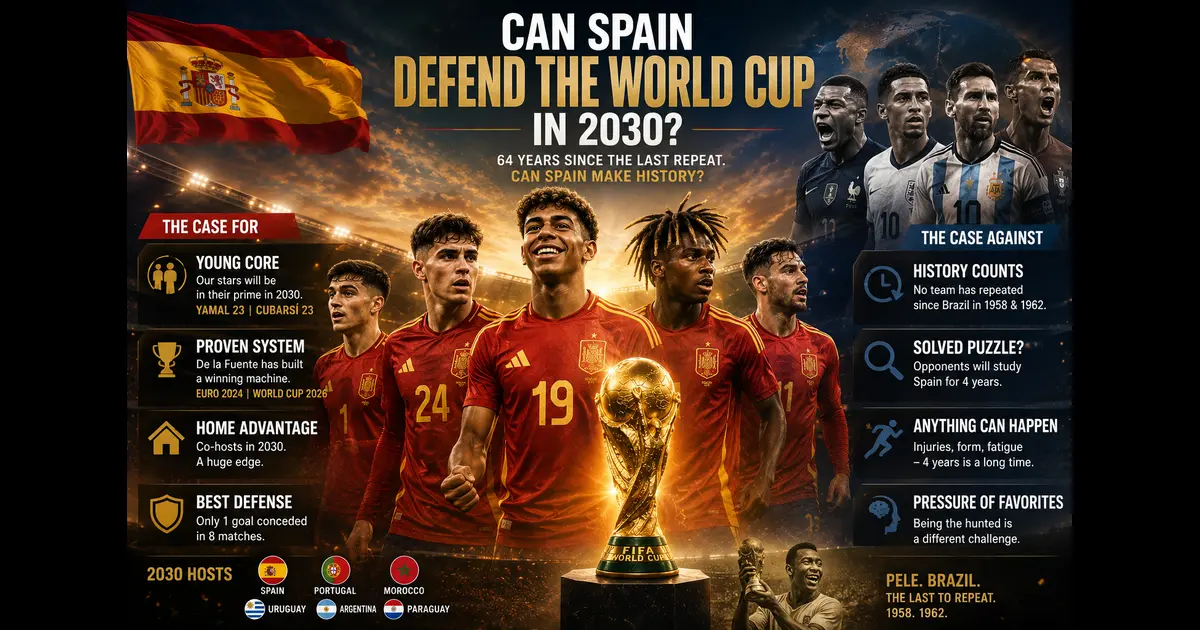
 No nation has successfully defended the World Cup since Brazil managed it in 1958 and 1962, under Pelé. That drought — 64 years and counting by the time 2030 arrives — is the single biggest number hanging over any conversation about Spain’s chances of going back-to-back. Can Spain defend the World Cup on home soil in four years’ time? Here’s the case for, and the case against.
The Case For: An Age Curve No Champion Has Ever Had
Start with the number that has bookmakers installing Spain as outright favorites barely a day after this year’s final: the average age of their core group of contributors. Lamine Yamal will be 23 in 2030. Pau Cubarsí, this year’s Best Young Player, will also be 23. Pedri and Gavi will both still be in what should be the prime years of their careers. Nico Williams, Dani Olmo and Ferran Torres will all still be under 30. This isn’t a squad that needs a rebuild — it’s a squad that, on paper, should simply be better in 2030 than it was this summer, having added four more years of experience to a group that just won the World Cup with the meanest defensive record the tournament has ever produced.
That’s a genuinely unusual position for a defending champion to be in. Most World Cup winners are built around a golden generation entering the back half of its prime, which is precisely why successful defenses are so rare — by the time the next tournament arrives, key contributors have aged out, retired, or simply lost the sharpness that won the trophy in the first place. Spain’s title-winning core skews so young that the more relevant question for 2030 may not be whether they can still compete, but whether they’ll be even more dominant than they were this summer.
The Case For: Hosting Advantage, and a Coach Who’s Already Proven It Works
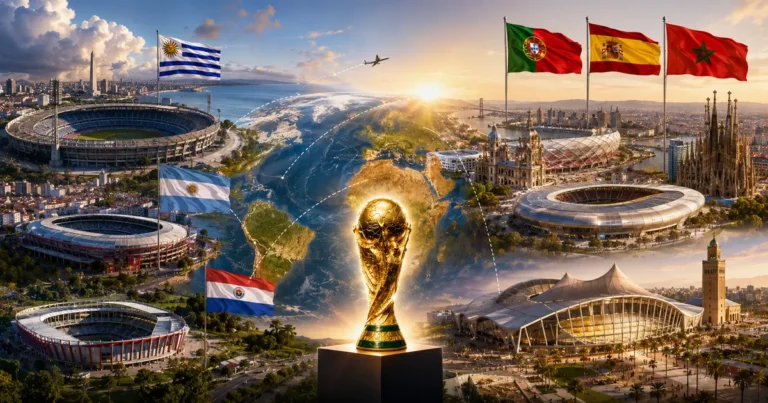
Spain will co-host the 2030 tournament alongside Portugal and Morocco, making them the first defending champion in World Cup history to also host the following edition. Home advantage has historically been a significant factor in tournament football — hosts have won six of the twenty-two previous World Cups — and Spain will get to combine that advantage with a manager, Luis de la Fuente, who has now won a European Championship without dropping a single match and a World Cup with the fewest goals conceded by any champion in the tournament’s history. There’s no coaching uncertainty to navigate, no philosophical rebuild required. De la Fuente’s system is proven, his squad is young, and his federation has every incentive to keep the current setup intact for as long as possible.
The Case Against: History Isn’t Kind to Confidence
For all the structural reasons to like Spain’s chances, the historical record offers a genuine note of caution. Since Brazil’s back-to-back titles in 1958 and 1962, no fewer than six different World Cup winners have subsequently failed to defend their title, and several — Italy in 2010, Spain themselves in 2014, France in 2022 — didn’t just fail to defend, they crashed out at the group stage entirely. The reasons vary each time: complacency, fatigue, opposition scouting a known quantity more effectively the second time around, or simply the extraordinary difficulty of sustaining peak form and squad chemistry across a full four-year cycle. Spain’s youth mitigates some of these risks, but it doesn’t eliminate the fundamental challenge every champion faces: everyone else spends the next four years specifically studying how to beat you.
The Case Against: The Rest of the World Won’t Stand Still
Spain’s title-winning defensive record — a single goal conceded across eight matches this summer — was built partly on a system opponents hadn’t fully solved yet. By 2030, every major footballing nation will have had four full years to study exactly how De la Fuente’s press-and-possession structure works, where its vulnerabilities lie, and how to exploit them. France’s deep pool of attacking talent, England’s continued investment in developing a golden generation of their own, and Argentina’s eventual post-Messi rebuild will all be aimed, at least in part, at solving the exact puzzle Spain just presented to the world. Tactical innovations that look unbeatable in one cycle have a well-documented history of being reverse-engineered by the next.
The Case Against: Fitness, Form and the Unpredictability of Four Years
It’s also worth acknowledging the obvious: predicting any team’s form four years into the future is an inherently uncertain exercise. Injuries to key players — the kind that can derail even the most talented squad — are impossible to forecast. Club-versus-country tensions, burnout from an increasingly congested football calendar, and the simple unpredictability of which teenage prospects actually fulfill their promise all introduce genuine uncertainty into any “Spain are the clear favorites” framing. Yamal and Cubarsí being 23 in 2030 is a structural advantage today; it guarantees nothing about their form, fitness or motivation four years from now.
The Case Against: The Psychological Weight of Being Favorites
There’s a subtler risk worth naming as well. Spain enter this cycle for the first time in the unfamiliar position of being the clear, heavily-backed favorite rather than the ambitious challenger — a role reversal that has undone plenty of talented squads before them. Playing as the hunted rather than the hunter changes the psychology of a tournament campaign in ways that are difficult to quantify but well documented across football history, from Spain’s own group-stage exit as defending champions in 2014 to France’s shock last-place finish in their group in 2002. Managing that shift in expectation, both from within the squad and from an entire nation anticipating a home triumph, will be as much a part of De la Fuente’s job over the next four years as any tactical adjustment.
The Verdict
Spain’s case for defending the World Cup in 2030 is genuinely stronger than almost any recent champion has entered the following cycle with — a young core still years from its ceiling, a proven coaching system, and home advantage all pointing in the same direction. But football’s history is full of favorites who looked similarly unstoppable on paper and still fell short, and the sheer rarity of a successful title defense — not managed by anyone since Brazil over six decades ago — should temper any assumption that this is close to a formality. Spain have given themselves as good a starting position as any nation realistically could. Whether that translates into breaking a 64-year drought is a question that four years of tactical evolution, injuries, and pure competitive unpredictability will ultimately answer.
About the Author