Hard Rock Stadium World Cup 2026: Brazil vs Scotland, a Quarter-Final & the Third-Place Match in Miami’s Tropical Paradise
Seven matches. Brazil. Portugal. Colombia. Uruguay. A quarter-final. And then, on July 18 — the day before the World Cup Final — Miami hosts the most overlooked great match in the entire tournament. Welcome to the city that was made for this.
Miami Was Built for the World
There is a reason Miami was selected as a World Cup host city and there is a reason its fixture list includes some of the tournament’s most prestigious games. The city was selected for its proven track record of hosting global spectacles, having hosted 11 Super Bowls.
Miami is also the most international city in the United States. More than 70% of its population is Hispanic or Latino. Portuguese, Spanish, Haitian Creole, and English are spoken interchangeably in its neighbourhoods. The city’s NFL franchise is owned by the same man who brought Lionel Messi to Inter Miami. Its NBA team plays to a packed arena of Latin American transplants who have created one of the loudest home environments in the league.
When Brazil plays Scotland in Miami on June 24, it will feel less like a neutral-venue fixture and more like a home game — for both nations, but particularly for Brazil, whose enormous South American diaspora has made South Florida a second homeland.
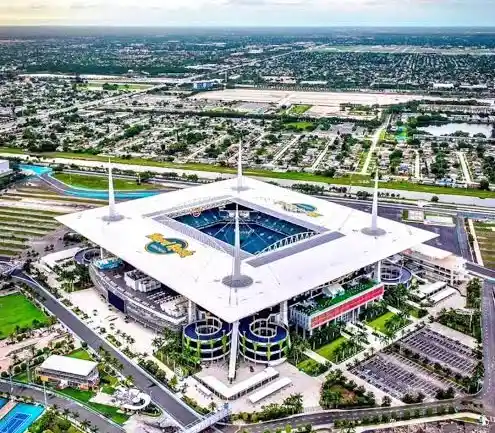
Miami is set to host seven 2026 World Cup matches at Hard Rock Stadium, including Brazil vs Scotland, Portugal vs Colombia, a Round of 32 game on July 3, a quarter-final on July 11, and the third-place play-off on July 18.
Stadium Snapshot
| Official FIFA Name | Miami Stadium |
| Commercial Name | Hard Rock Stadium |
| Location | 347 Don Shula Drive, Miami Gardens, FL 33056 |
| Opened | 1987 (renovated multiple times; major renovation 2016) |
| Home Team | Miami Dolphins (NFL) |
| Standard Capacity | 65,326 |
| World Cup Capacity | ~65,000 |
| Canopy | Open-air sides with overhanging canopy roof — shade but not enclosed |
| World Cup Matches | 7 — four group stage + Round of 32 + Quarter-Final + Third-Place Match |
| Third-Place Match | July 18, 2026 — 5:00 PM ET |
| Notable WC History | Hosted 8 matches at FIFA Club World Cup 2025 |
| Parking | Nearly 27,000 car spaces — largest parking capacity of any WC venue |
The Match Schedule at Miami Stadium
Hard Rock Stadium will host four group stage matches on June 15, 21, 24, and 27, a Round of 32 match on July 3, a quarterfinal on July 11, and the third-place match on July 18.
| Round | Date | Time (ET) | Confirmed Match |
|---|---|---|---|
| Group H | June 15, 2026 | TBC | Saudi Arabia vs Cape Verde |
| Group H | June 21, 2026 | TBC | Uruguay vs Cape Verde |
| Group C | June 24, 2026 | TBC | Brazil vs Scotland |
| Group K | June 27, 2026 | TBC | Portugal vs Colombia |
| Round of 32 | July 3, 2026 | TBC | TBC |
| Quarter-Final | July 11, 2026 | TBC | TBC |
| Third-Place Match | July 18, 2026 | 5:00 PM ET | TBC |
Brazil vs Scotland in Miami is the group-stage fixture most certain to produce an extraordinary atmosphere. Portugal vs Colombia could decide the Group K winner. The quarter-final and third-place match make Hard Rock Stadium one of the most significant late-tournament venues outside of the two Final cities.San Francisco Bay Area World Cup 2026 Guide — Levi’s Stadium, Golden Gate & 30+ Free Fan Zones
Getting There: The Brightline Revolution
Miami’s transport story for the World Cup has been transformed by one development: the Brightline intercity rail service, which connects Miami to Fort Lauderdale, Boca Raton, West Palm Beach, and beyond, now with a stop at Aventura — followed by a free shuttle to Hard Rock Stadium.
Fans can travel from Miami, West Palm Beach, Boca Raton, Fort Lauderdale, or Orlando to Brightline Aventura Station on the Brightline intercity rail service. Ten minutes after arrival at Aventura, fans depart on a free shuttle to the stadium.
This is the most innovative transport solution at any World Cup 2026 venue. From Downtown Miami: Brightline to Aventura (~15 minutes) + free shuttle to stadium (~10 minutes) = a 25-minute, seamless, air-conditioned journey from the heart of the city.
From Miami Beach: Take the free Miami Beach Connector to Downtown Miami, then Brightline to Aventura. Allow 45–55 minutes total.
By Car: Hard Rock Stadium is situated at 347 Don Shula Drive, near the I-95 interstate highway and Florida’s Turnpike. With parking for nearly 27,000 cars on site, driving is genuinely viable — but post-match exit congestion on I-95 can hold vehicles for 45–90 minutes. Pre-purchased parking passes only.
From Miami International Airport (MIA): Brightline from MIA Station to Aventura (~25 minutes) + free shuttle to stadium. Or rideshare direct (~30–45 minutes depending on traffic).
From Fort Lauderdale Airport (FLL): Brightline from Fort Lauderdale to Aventura (~15 minutes) + free shuttle. FLL is arguably the most convenient airport for this venue.
Miami: The World’s Playground
Miami does not do things at half volume. It is a city of maximum colour, maximum heat, maximum humidity, and maximum energy — and in the summer of 2026, with the World Cup in town, it will turn everything up further still.
The Beach
South Beach (SoBe) The most famous beach in the Americas and one of the most famous in the world. Powdery white sand, the turquoise Atlantic, Ocean Drive’s Art Deco hotels, and a promenade that runs eight miles from South Beach to Bal Harbour. In June and July, the beach opens at dawn and the city does not go quiet until 4 AM.
The Art Deco Historic District on Ocean Drive — pastel-coloured 1930s buildings illuminated at night by neon — is unique in American architecture and one of the world’s great urban pedestrian experiences at dusk.
Key Biscayne Ten minutes by car south of South Beach: calmer water, fewer crowds, and the Bill Baggs Cape Florida State Park with 1.25 miles of pristine beach and a lighthouse built in 1825. The best beach experience within the Miami city limits for those who find South Beach overwhelming.
The Neighbourhoods
Wynwood Miami’s arts district: former warehouses covered floor to ceiling in commissioned murals by the world’s greatest street artists. The Wynwood Walls — a curated outdoor museum of 80+ massive murals — is the anchor of what has become one of the great arts neighbourhoods in the Americas. Every café, bar, and restaurant in Wynwood has its own mural. Gallery openings happen every weekend.
During the World Cup, Wynwood will be the epicentre of the city’s fan culture — watch party zones, pop-up fan events, and the natural gathering point for the creative, international community that calls Miami home.
Little Havana The Cuban neighbourhood that has defined Miami’s cultural identity since the 1960s. Calle Ocho (SW 8th Street) is the main artery: Cuban cafés serving cortadito (espresso with steamed milk), cigar rollers working in open shop fronts, dominoes being played at the Máximo Gómez Park, and the kind of street energy that has not changed in forty years.
Little Haiti One of the largest Haitian communities outside Haiti itself: vibrant, colourful, with Haitian and Caribbean restaurants, art galleries, and the Caribbean Marketplace built in a style modelled on Port-au-Prince’s famous Iron Market.
Coral Gables The city’s most elegant neighbourhood: Mediterranean Revival architecture, banyan-lined streets, the Venetian Pool (a public swimming pool built inside a quarry in 1923 — one of the most beautiful in the world), and the main campus of the University of Miami.
Miami Food: A Latin Feast with Global Accents
Miami’s food culture is defined by the sea and by Latin America — an intersection that produces some of the finest, most energetic eating in the United States.
Cuban Food The single most important cuisine in Miami’s culinary history. A Cuban sandwich — roasted pork, ham, Swiss cheese, pickles, and mustard pressed in Cuban bread — is the city’s signature street food. Versailles Restaurant on Calle Ocho has been the community’s living room since 1971 and makes the definitive version. El Rey de las Fritas makes the fritanga (Cuban hamburger) that Miami considers a birthright.
Stone Crab Florida stone crab claws are harvested sustainably between October and May — by June and July the season has technically closed, but frozen claws from premium suppliers are available across the city. Joe’s Stone Crab in South Beach has been Miami’s most legendary restaurant since 1913. Pre-book weeks in advance.
Ceviche and Seafood Miami’s Latin American community (Peruvian, Colombian, Venezuelan, Ecuadorian) gives the city an outstanding ceviche culture. La Mar by Gastón Acurio in the Mandarin Oriental brings the Peruvian maestro’s Lima-style ceviche to Brickell Key. More accessible: Ceviche 105 in Downtown Miami serves a dozen varieties for $12–$18.
Haitian Food Griot (fried pork) with pikliz (fiery pickled cabbage) and rice and beans is the national dish of Haiti and available throughout Little Haiti. Tap Tap Haitian Restaurant in South Beach makes it accessible and excellent in a restaurant covered floor to ceiling in Haitian folk art.
Brazilian Churrasco Miami’s large Brazilian community gives the city extraordinary Brazilian steakhouses. Texas de Brazil and Fogo de Chão are the national chains; for the real thing, the Brazilian-owned restaurants of Doral (a suburb with the highest Brazilian population density in the US) serve rodízio-style beef carved tableside at prices that bear no relation to the quality.
Cafecito Miami’s answer to espresso: a tiny cup of sweet, thick Cuban coffee sold at ventanitas (walk-up windows) throughout the city for approximately $1. You will need this to keep up with Miami’s schedule.
The Third-Place Match: July 18, 2026
The third-place play-off is football’s most underrated spectacle. Hard Rock Stadium hosts the 2026 bronze final on Saturday, July 18 at 5:00 PM ET — the day before the World Cup Final at MetLife Stadium in New Jersey.
The match is contested between two of the four best teams in the world — the two semi-final losers — who, despite their elimination from the final, come to Miami for one last battle. It is typically a more open, attacking match than the final itself, played by teams with nothing to lose and everything to prove to their nations.
Miami on July 18 — with the beach, the nightlife, the Brazilian and Portuguese diaspora already gathered from the group stage — will be one of the great settings for this match in World Cup history.
What to Wear in Miami
June and July are peak summer. Expect 90°F (32°C) with high humidity. Stay hydrated. Rain: “Tropical showers” are common in the afternoon — they are usually brief but intense. Sun Protection: The Florida sun is unforgiving. Wear SPF 50+ even if it looks cloudy.
- Stadium canopy provides shade but the venue is not enclosed — afternoon matches in direct sun can be punishing.
- Beach days: Swimwear, flip-flops, waterproof SPF. The Atlantic water in June is a warm 80°F (27°C).
- Nightlife: Miami’s after-dark dress code is elevated. Smart casual is the floor. Many clubs and restaurants on South Beach enforce a dress code. Pack at least one outfit that is not a football shirt.
- Miami style note: This is one of the world’s great fashion capitals. The summer World Cup street-fashion in Miami — national kits mixed with designer accessories, Caribbean colours, Latin American festival dress — will be extraordinary. Participate.
About the Author