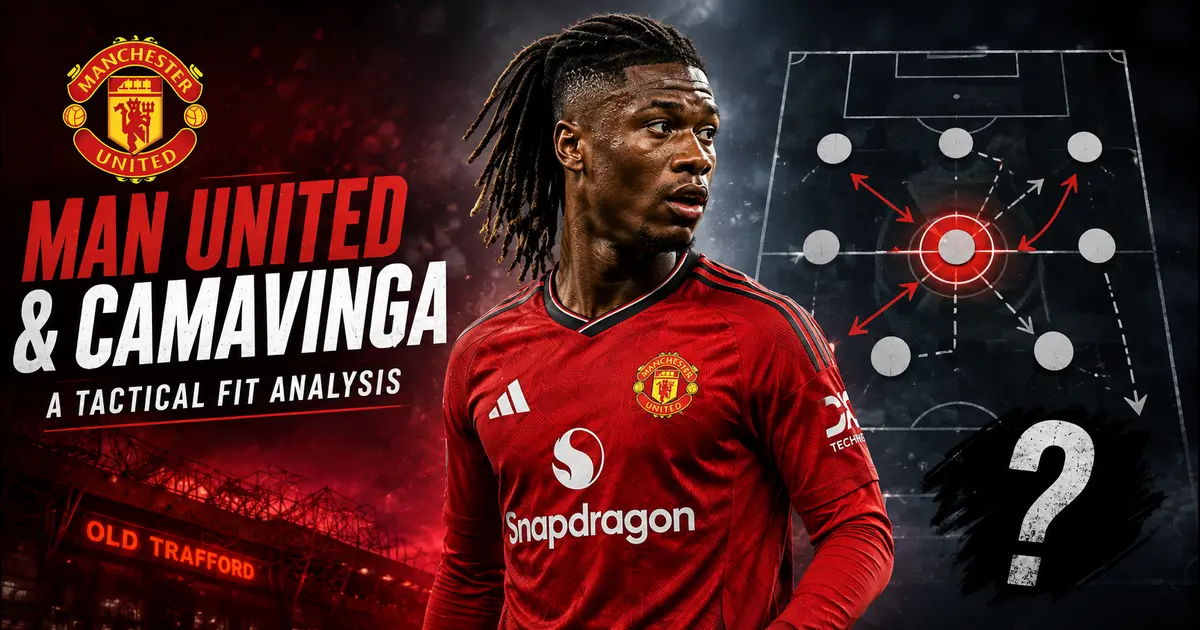
 Man United and Camavinga: A Tactical Fit Analysis
Transfer speculation tends to focus on fees, valuations and who’s said what to which journalist — and the Camavinga-to-Old-Trafford rumor has had plenty of all three. What’s had less attention is a more basic question: even if Manchester United got their man, would Eduardo Camavinga actually fix the specific problem their midfield has right now? The answer is more complicated than his reputation alone would suggest.
The Problem United Are Actually Trying to Solve
Michael Carrick’s midfield has lost its defensive foundation this summer. Casemiro’s departure removed the kind of experienced, positionally disciplined screening presence that shielded United’s back four for several seasons, and Manuel Ugarte — signed in part to eventually succeed him in that exact role — is now facing a serious long-term injury of his own. That leaves a specific, well-defined gap: United need a midfielder capable of sitting in front of the back line, breaking up opposition attacks, and giving the rest of the team a platform to play through, rather than simply another technically gifted body in the engine room.
This matters because it’s not automatically the role Camavinga is best suited to fill.
What Kind of Player Camavinga Actually Is
For all the “utility man” framing that’s followed Camavinga at Real Madrid — filling in across midfield and occasionally at left-back — his best individual performances have tended to come as a box-to-box, ball-carrying midfielder rather than a specialist defensive screen. He’s quick over the ground, comfortable driving with the ball into space, and disruptive in transition moments, qualities that made him such an exciting teenage prospect when he first broke through at Rennes. What he isn’t, at least not primarily, is the kind of deep-lying, positionally conservative presence that Casemiro represented for United, or that a player like Rodri represents for Spain and Manchester City.
That’s not a criticism of Camavinga’s quality — it’s a question of fit. Real Madrid have generally used him in a midfield that already includes more defensively minded partners, allowing his more dynamic instincts to flourish around that protection. Ask him to be the primary defensive shield in a struggling United midfield, without that same surrounding structure, and the profile mismatch becomes a genuine tactical risk rather than a minor adjustment.
Why United Might Be Targeting Him Anyway
There’s a reasonable counter-argument here, and it starts with recognizing that United aren’t only chasing Camavinga — they’ve also been in contact with Roma’s Manu Koné, a player with a more explicitly defensive profile, alongside interest in Brighton’s Carlos Baleba and Fulham’s Sander Berge. Pursuing several midfield targets simultaneously, each with a slightly different profile, suggests Carrick and United’s recruitment team may be thinking about squad balance rather than a single like-for-like Casemiro replacement. In that context, Camavinga wouldn’t need to single-handedly solve the defensive-midfield problem; he’d need to complement whoever else arrives, offering ball progression and physical intensity alongside a more purely defensive partner.
There’s also the matter of age and value. At 23, Camavinga would arrive with several prime years ahead of him and a release-valve valuation — reportedly in the £42 million to £51 million range — that looks reasonable relative to his ceiling, even if he’s not a perfect positional match on day one. Elite clubs regularly sign talented players first and figure out the exact system fit second, banking on adaptability over a rigid profile match.
The Bigger Tactical Question
Ultimately, whether Camavinga “solves” United’s problem depends entirely on what else happens around him. Signed as a standalone addition to an otherwise unchanged midfield, he risks papering over the exact gap Casemiro’s exit created rather than filling it. Signed alongside a more specialized defensive midfielder — whether that’s Koné or another target entirely — he could become a genuinely valuable, dynamic complement to a more balanced double pivot, closer to how Real Madrid have often used him at his best.
The Bottom Line
The Camavinga rumor deserves more scrutiny than a simple “star midfielder available, big club interested” framing suggests. He’s a talented, proven performer at the highest level, but he’s not a direct tactical replacement for what United actually lost when Casemiro departed. Whether this move ends up looking smart or misjudged twelve months from now will likely hinge less on Camavinga’s individual quality — which isn’t really in question — and more on whether United build the right midfield structure around him, rather than assuming his talent alone will paper over a positional gap he wasn’t really built to fill.
How FIFA World Cup 2026 Changed International Football
🔹🔹 follow us on facebook 🔹🔹
About the Author