Mexico El Tri, the Curse, and the Last Chance: Can Aguirre’s Mexico Finally Break the Fifth-Game Barrier in 2026 ?
Let us begin with the number that defines Mexican football more than any trophy, any striker, any legendary goal. The number is seven. Seven consecutive World Cups — 1994 through 2018 — in which El Tri reached the Round of 16 and no further. Seven tournaments where a nation of 130 million football-obsessed people watched their team arrive, perform adequately, and depart at the precise same juncture with mathematical predictability.
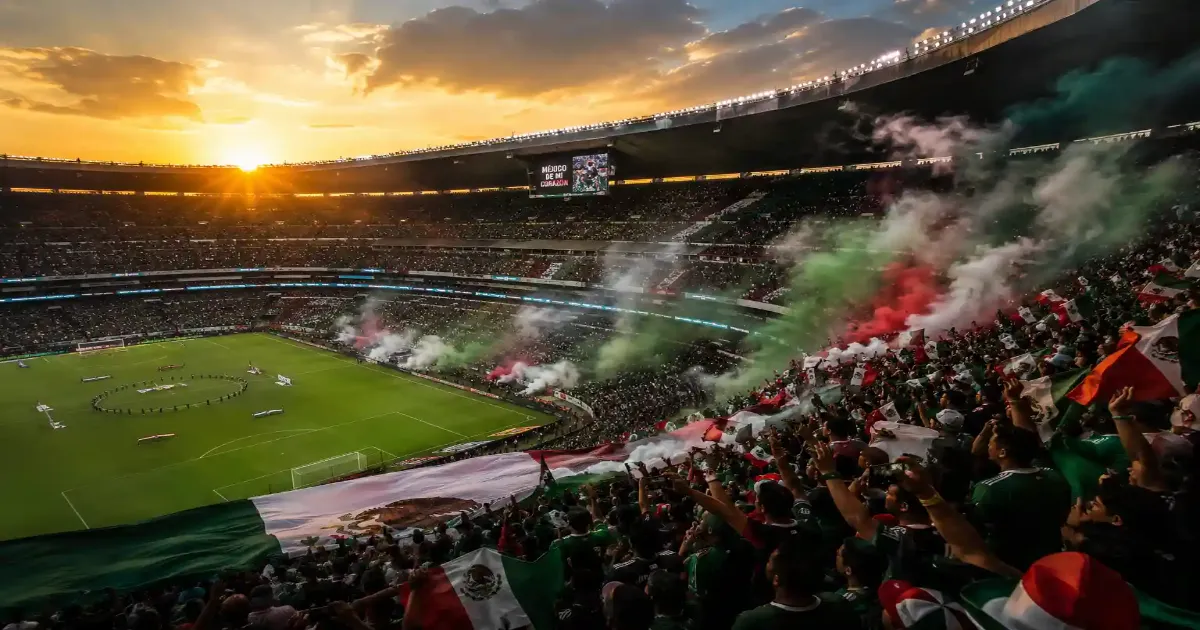
The Mexicans have a name for this: El Quinto Partido. The Fifth Game. The quarter-final that El Tri perpetually fail to reach. It is not merely a sporting statistic. It is a national wound, reopened every four years with surgical precision.
In 2022, El Tri didn’t even make it that far. For the first time since 1994, they failed to advance from their group in Qatar — a humiliation that shook the federation, changed the coaching staff, and forced a reckoning with a programme that had mistaken mid-table mediocrity for progress.
Now it is 2026. Mexico is, for the third time in history, a World Cup host nation — the first country ever to achieve that feat. The Estadio Azteca opens the entire tournament on June 11. One hundred and twelve thousand seats. The greatest footballing cauldron in Latin America. And Javier Aguirre’s squad will walk onto that pitch needing, more than a win, a statement.
The question is whether they have the players to deliver one.
The Curse That Haunts a Football Nation
Context matters when analysing Mexico’s 2026 squad, because context is what separates cold roster analysis from genuine football criticism. El Tri are not simply a national team preparing for a tournament. They are a programme carrying four decades of failed promise into the most consequential football occasion their country has ever staged.
Their only quarterfinal appearances came in 1970 and 1986 — both times as hosts. Coach Aguirre is aware of this data point. “Home advantage is priceless,” he told his players. “England was champion playing at home, and never again.” This is a man reaching for psychological ammunition wherever it exists, and he is not wrong to do so. The correlation between hosting and Mexico’s best results is not coincidental. The Azteca crowd, the altitude, the familiar training grounds — these are real advantages.
But advantages must be converted by players. Let us examine whether Aguirre’s 26 actually have the quality to do so.
Javier Aguirre — The Old General Returns for One Final Battle
Javier Aguirre is 67 years old and in his third stint as Mexico head coach. His previous two World Cup campaigns — 2002 and 2010 — both ended in the Round of 16. He lost to the United States in 2002. He lost to Argentina in 2010. Both exits came with tactical arguments raging in the Mexican press about whether he had deployed his resources correctly.
His return in July 2024, following Mexico’s catastrophic Qatar campaign, was partly a conservative choice by a federation that needed stability and tactical coherence more than revolutionary ideas. Aguirre delivered two consecutive CONCACAF titles — the Gold Cup and the Nations League — and restored organisational credibility to a squad that had lost faith in itself.
His preferred formation is a 4-3-3 built around defensive compactness, Edson Álvarez as the single pivot, and fast, wide transitions designed to exploit the pace of his forwards. It is a pragmatic system — efficient, disciplined, built for counter-attack rather than territorial dominance. Against South Korea, Czech Republic, and South Africa in Group A, it may prove entirely sufficient. Against a European heavyweight in the knockouts, sufficiency becomes insufficient.
The strategic concern critics raise is valid: Aguirre’s Mexico is designed not to be beaten rather than designed to win. Those are functionally different objectives, and the distinction becomes fatal in knockout football.
Raúl Jiménez and Guillermo Ochoa — Legends or Liabilities?
Two players dominate Mexico’s squad discussion more than any others, and both deserve honest scrutiny rather than the nostalgic reverence that too often surrounds veteran internationals.
Raúl Jiménez is 35. The Fulham striker has 44 international goals, making him second only to Jared Borgetti on Mexico’s all-time list. He scored nine Premier League goals for Fulham in 2025-26, which represents a productive season for a 35-year-old centre forward. He brings tactical intelligence — his ability to link play, create space, and serve as a reference point for teammates — that no other Mexican striker can replicate.
But Jiménez has never scored a World Cup goal in five appearances across previous tournaments. He arrives at 2026 carrying that personal burden alongside the weight of an ageing body that requires careful management across a 90-minute, 48-team tournament. Santiago Giménez, the AC Milan striker who endured a difficult 2025-26 season with just six goal contributions, is the designated alternative. At 23, Armando González from Guadalajara arrives in strong domestic form and may outperform the AC Milan man for minutes.
Guillermo Ochoa is the more contentious selection. The 40-year-old goalkeeper — who will actually turn 41 during the tournament — makes his sixth World Cup appearance after first-choice Luis Malagón suffered a torn ACL that ended his tournament before it began. Ochoa as Plan A rather than emergency option is a structural vulnerability. His reflexes remain sharp, his experience invaluable, but fielding a 40-year-old goalkeeper in World Cup group matches is a risk that no amount of veteran charisma fully offsets.
The Squad in Cold Numbers — What Aguirre Actually Has
Strip sentiment from the analysis and Mexico’s squad presents a specific profile. Twelve Liga MX players feature — five from Guadalajara alone — reflecting the domestic league’s continued central role in El Tri’s recruitment. This is both a strength (familiar style, cultural cohesion) and a weakness (limited exposure to elite European club football’s intensity and tactical variety).
Edson Álvarez captains the side. The West Ham United midfielder — a genuine Premier League presence — is the squad’s most complete player and the linchpin of everything Aguirre builds. His single-pivot role requires him to be simultaneously Mexico’s defensive first line and their creative second line. When Álvarez is dominant, Mexico function. When he is overrun, the entire system stalls.
Álvaro Fidalgo, who moved from Club América to Real Betis, emerges as a player Aguirre can task with controlling the tempo of matches. His vision and passing range give Mexico a genuinely technical option in midfield, and his ability to attract pressure and release teammates may prove critical in tight, low-scoring group stage encounters.
Seventeen-year-old Gilberto Mora’s inclusion — the squad’s youngest name — signals that Aguirre sees beyond 2026, even while preparing for it. This is an astute piece of squad selection: giving the teenager tournament experience without pressuring him with starter’s minutes.
The Chucky Lozano Omission: Brave or Reckless?
The most debated decision in Mexico’s preparation has been the exclusion of Hirving “Chucky” Lozano from even the preliminary squad. The former PSV and Napoli winger — a player who scored the goal that eliminated Germany at the 2018 World Cup — was left out due to reportedly inconsistent playing time and unspecified issues at San Diego FC.
Critically minded observers are divided. One school argues Aguirre showed necessary ruthlessness: a player not contributing at club level, regardless of reputation, has no place at a World Cup. The other school notes that Lozano at 60% provides a dynamic, technically gifted forward option that Mexico’s current wide forwards cannot match for creativity and individual brilliance. His 2018 winner against Germany remains the defining Mexican World Cup goal of the modern era. Leaving him out is a gamble on youth and form over peak-quality experience.
History will determine who is right. If Julián Quiñones and Roberto Alvarado deliver, Aguirre looks like a decisive, forward-thinking manager. If Mexico’s attack goes tepid at a critical moment, the Lozano question will haunt post-mortems for years.
Group A — The Opening Match at the Azteca Will Define This Team
Mexico’s opening Group A fixture is also the tournament’s opening match: South Africa at the Estadio Azteca on June 11. The symbolism is enormous. A hundred and twelve thousand people. The first goal of the 2026 World Cup. The energy of a nation that has waited seven years to exhale since Qatar’s disaster.
The tactical reality is that South Africa, South Korea, and Czech Republic represent a group Mexico should navigate. Three wins, or two wins and a draw, should be achievable given the squad quality available. Home advantage — the altitude, the crowd, the familiar training environment — narrows the margins further in El Tri’s favour.
The critical variable is momentum. If Mexico win the opening match convincingly — if Jiménez scores, if Álvarez controls, if the Azteca roars — then the psychological runway for the knockouts is laid. If they labour to a narrow win or, worse, drop points against South Africa, the curse’s shadow falls before the group stage is even complete.
The Hard Verdict — Can El Tri Break Their Curse On Home Soil?
The answer, honestly, is yes — and also, possibly not.
Mexico in 2026 have the home conditions, the group draw, and the squad structure to reach a quarterfinal for the first time since 1986. Aguirre’s tactical discipline, Álvarez’s engine, Jiménez’s intelligence, and a roaring Azteca crowd give them the platform to do what seven consecutive tournaments denied them.
But the squad has genuine limitations. A 40-year-old goalkeeper. A 35-year-old lead striker who has never scored at a World Cup. A reliance on domestic league players whose quality drops sharply against elite European opposition. A coach whose two previous World Cup stints with Mexico ended at the exact barrier he is now trying to breach.
El Quinto Partido is not a curse. It is a pattern. And patterns, in football, require not just talent to break — they require the right moment, the right squad, and the right fortune at the right time.
Whether 2026 is that moment for Mexico will be one of this tournament’s defining narratives. And unlike 2022, unlike Qatar, unlike the disaster that preceded Aguirre’s return — this time, they get to play in front of their own people.
If El Tri cannot break the curse at home, with 112,000 singing them on against South Africa under the Azteca lights, it may never be broken at all.
Joško Gvardiol FIFA World Cup 2026: Profile, Stats & Career | StrikerReport
Manuel Neuer FIFA World Cup 2026: Profile, Stats & Career | StrikerReport
StrikerReport.com — World Cup 2026 Criticism & Analysis | El Tri Special
About the Author






2 thoughts on “Mexico El Tri 2026 World Cup: The Fifth Game Problem That Still Haunts El Tri”