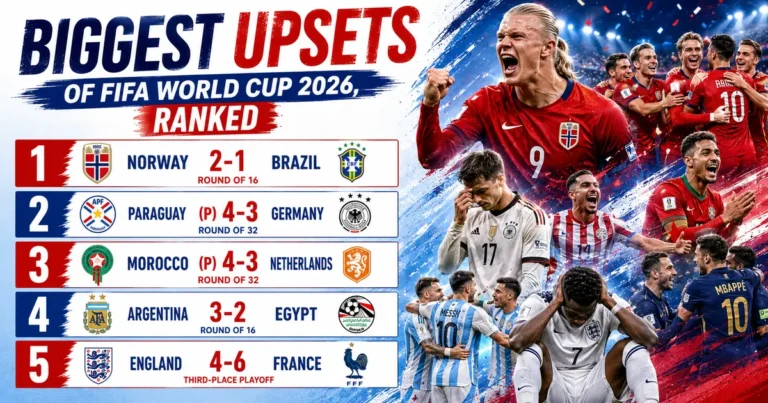
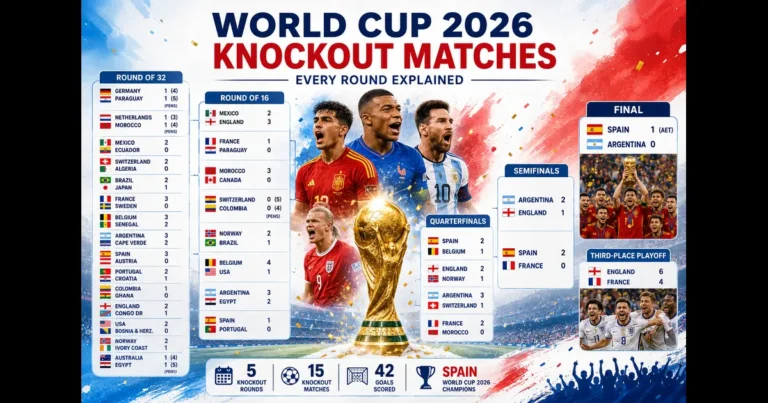
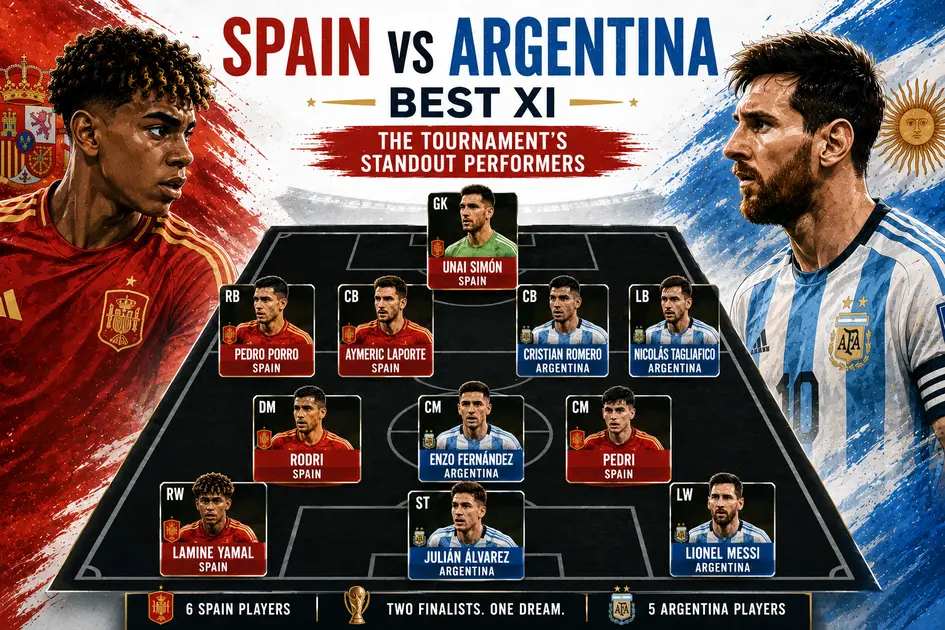
 Picking a combined XI from two World Cup finalists always invites an argument, and this one is no different — Spain’s near-perfect defensive record and Argentina’s knack for producing match-winning moments make for two very different kinds of case file. This selection is built strictly on what’s actually happened across the tournament so far, not reputation or career achievement, position by position.
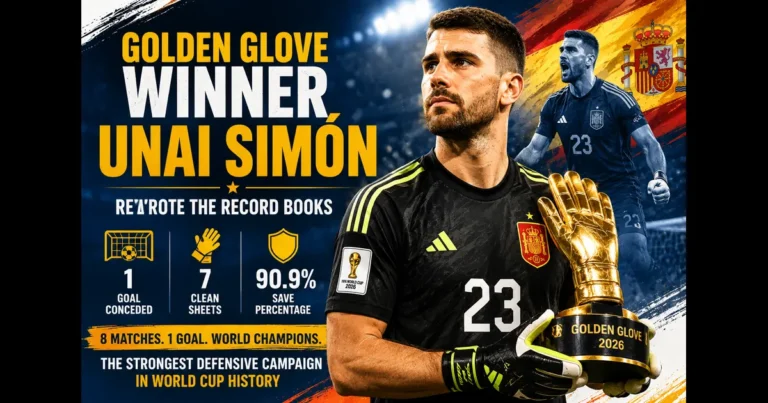
Goalkeeper: Unai Simón (Spain)
There’s no real debate here. Simón has conceded exactly once across five knockout matches, a goal against Belgium in the quarterfinal that remains the only blemish on an otherwise spotless record. Compare that to Emiliano Martínez’s tournament — a save percentage more than 13 points below his club form, and one of the three worst shot-stopping rates from inside the box of any keeper at the World Cup — and the selection makes itself.
Right-Back: Pedro Porro (Spain)
Porro has scored in the round of 32 against Austria and again in the semifinal against France, offering an attacking outlet from full-back that neither of Argentina’s right-sided options — Nahuel Molina or Gonzalo Montiel — have come close to matching going forward, while also avoiding the defensive exposure that’s plagued Argentina’s own full-back positions all tournament.
Center-Back: Aymeric Laporte (Spain)
Composed, rarely beaten in the air, and the anchor of a Spanish defence that’s been breached only once in five knockout matches. Laporte’s reading of the game has allowed Spain to play an expansive, high defensive line without regularly being exposed in behind — no minor achievement given how aggressively Spain push bodies forward.
Center-Back: Cristian Romero (Argentina)
Argentina’s defensive numbers as a team have been shaky, but Romero’s individual combativeness and willingness to put his body on the line have been a consistent thread through four knockout matches that have all, in different ways, asked Argentina’s back line difficult questions. He gets the nod as the pairing’s contrast in styles — Laporte’s calm alongside Romero’s aggression.
Left-Back: Nicolás Tagliafico (Argentina)
The most defensively reliable of Argentina’s rotating cast of full-back options this tournament, Tagliafico gets in ahead of Spain’s left-back options on the balance of a generally sturdier defensive tournament, even accounting for Argentina’s broader wide-area vulnerabilities.
Defensive Midfield: Rodri (Spain)
A Ballon d’Or winner arriving at the tournament in career-best form, Rodri’s platform underneath Spain’s expansive attacking shape has been central to almost everything the team has done well — dictating tempo, organizing the rest-defence structure that allows Spain to commit numbers forward, and rarely giving the ball away in dangerous areas.
Central Midfield: Enzo Fernández (Argentina)
Fernández’s brace against England in the semifinal — both assisted by Messi, both arriving from a central midfielder making late runs into the box — was the signature individual midfield performance of the knockout rounds for either finalist, and it capped a tournament in which he’s combined defensive work rate with genuine goal-scoring output.
Central Midfield: Pedri (Spain)
Spain’s other midfield names have had moments in the spotlight, but Pedri’s ability to receive under pressure and progress the ball into dangerous areas has been the connective tissue of Spain’s build-up play all tournament, even when Fabián Ruiz has occasionally taken the more eye-catching creative role.
Right Wing: Lamine Yamal (Spain)
Still 18, and already the tournament’s most-watched attacking threat. Yamal leads the competition in successful dribbles, draws fouls in dangerous areas as consistently as any player left in the tournament, and was named player of the match in Spain’s quarterfinal win over Belgium. His statistical output over the last month puts him comfortably ahead of Argentina’s wide options on raw end-product alone.
Left Wing: Lionel Messi (Argentina)
Messi’s individual goal tally doesn’t fully capture his tournament, but his creative output does — two assists in the biggest six minutes of Argentina’s campaign against England, and a gravitational influence on every match he’s played that’s impossible to quantify in a single stat. At 39, he’s still the player defenses have to account for above anyone else on the pitch, and that alone earns him a place in this XI regardless of position label.
Striker: Julián Álvarez (Argentina)
Álvarez edges Spain’s Mikel Oyarzabal and Argentina’s own Lautaro Martínez for the central striking spot based on his combination of movement, finishing variety, and involvement in build-up play across four knockout matches that have all needed a different kind of goal to solve.
The Verdict
Six Spain players, five Argentina players — a split that broadly mirrors the tournament’s underlying story. Spain have been the more complete, more statistically dominant side across the knockout rounds, and that shows up in a back line and midfield platform that dominates this combined XI. But Argentina’s attacking core — Messi, Fernández, Álvarez — has provided the kind of decisive, match-winning moments that no set of underlying numbers fully captures, and that’s exactly the dynamic Sunday’s final is likely to come down to: Spain’s structural advantage against Argentina’s proven ability to make the moments that matter go their way.
🔹🔹 follow us on facebook 🔹🔹
About the Author