 It takes some effort to find genuine weaknesses in a team that’s gone 37 matches unbeaten and conceded once in five knockout games at this World Cup, but no side is flawless, and Spain’s run to the final hasn’t been entirely without its warning signs. Here’s where the cracks actually are, and why Argentina — for all their own defensive problems — might be precisely the kind of opponent built to find them.
Spain Won the FIFA World Cup 2026: How La Roja Conquered the World Again
Complete FIFA World Cup 2026 Awards List: Every Winner
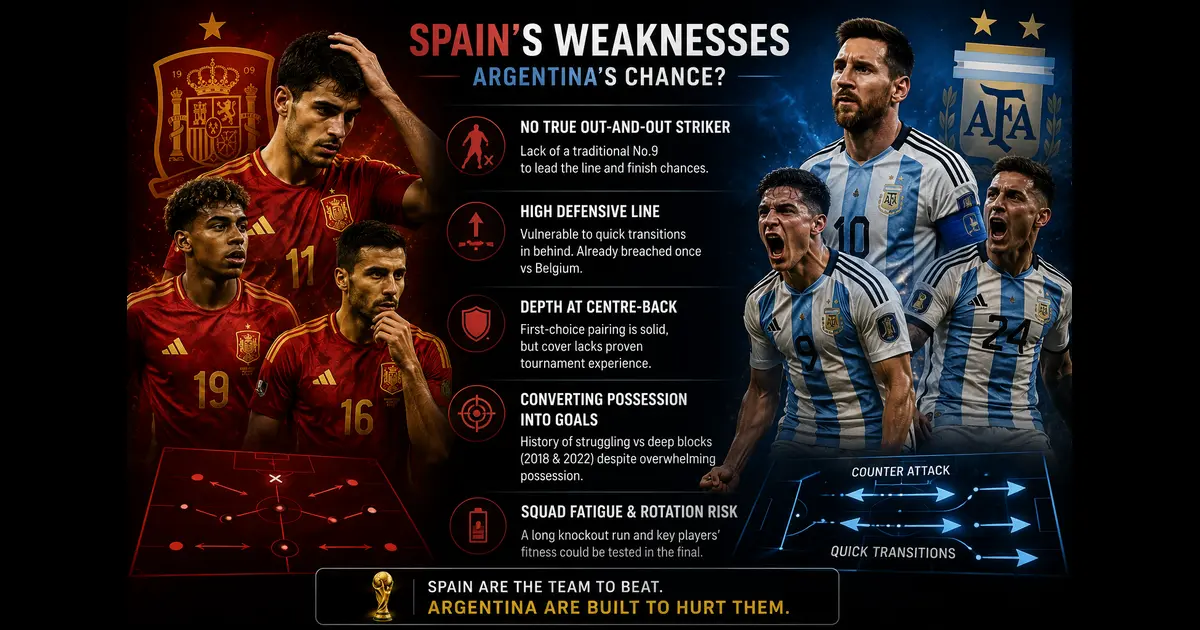
No True Out-and-Out Striker
Spain’s front line is built around movement and combination play rather than a conventional, penalty-box-dominant number nine, and it’s a structural choice that’s occasionally invited criticism even in tournaments Spain went on to win. Mikel Oyarzabal leads the side with five goals this World Cup — a genuinely excellent tally, level with David Villa’s mark from the 2010-winning campaign — but Oyarzabal isn’t the kind of physical, ever-present focal point that some opponents are built to defend against more easily than a fluid, rotating front three. Analysts have flagged this as Spain’s clearest structural gap heading into the tournament: a lack of a guaranteed, traditional central goal threat, relying instead on movement between the lines to create space for wide players.
That approach has worked because Spain’s overall control has been so dominant that they’ve rarely needed a moment of pure individual center-forward brilliance to unlock matches. Against a final opponent capable of sitting deeper and inviting pressure — exactly the kind of approach that troubled Spain at the 2018 and 2022 World Cups — the absence of an old-fashioned target man to change the picture late in a tense match remains a fair, if narrow, concern.
A High Defensive Line That’s Been Breached Once
Spain’s expansive, front-foot approach under Luis de la Fuente depends on pushing numbers forward and defending with a notably high line, trusting Aymeric Laporte’s positioning and the team’s rest-defence structure to deal with anything played in behind. It’s worked to devastating effect for five knockout matches — but it wasn’t flawless. Belgium’s goal in the quarterfinal remains the only blemish on Spain’s defensive record this tournament, and it came from precisely the kind of transition moment that a high line is always vulnerable to conceding.
That’s a relevant data point heading into Sunday, given how much of Argentina’s own knockout success has been built around exploiting exactly this kind of moment — quick, direct transitions that catch an organized defence still readjusting. Spain have shown, across an otherwise pristine defensive tournament, that the one time they were breached came from a passage of play stylistically similar to what Argentina do best.
Squad Depth at Centre-Back
Spain’s first-choice central defensive pairing has performed superbly, but the position hasn’t always been an area of obvious depth for the national team in recent tournament cycles, a pattern that’s shown up at senior and youth level alike in Spanish football over the past several years. Should Laporte pick up an injury or suspension before or during the final, Spain’s ability to maintain the same defensive solidity without disrupting the balance of their high-line approach is a genuine, if untested, question mark — the kind of scenario that hasn’t been forced upon them yet this tournament, precisely because their first-choice pairing has stayed fit and available throughout.Spain vs Argentina Tactics: Five Key Battles That Will Decide the World Cup Final
Converting Territory Into Goals Under Real Pressure
Spain’s recent World Cup history carries a specific historical scar that’s worth remembering even amid this tournament’s dominant form: at both the 2018 and 2022 World Cups, Spain were eliminated by teams that sat deep, defended in numbers, and forced Spain into long, low-value spells of possession without genuine penetration — over 75% possession and 36 combined shots across those two knockout exits, for a return of just one goal in 240 minutes. De la Fuente’s tactical evolution toward greater verticality was designed specifically to fix that problem, and this tournament’s results suggest it largely has. But Argentina, even playing from a position of relative defensive fragility, have shown throughout their own knockout run a willingness to sit in behind the ball for long stretches and invite pressure before striking on the counter — precisely the profile of opponent that has hurt Spain before.
Squad Fatigue and Rotation Risk
Spain’s knockout run, while dominant, hasn’t been entirely restful. Five knockout matches across a month-long tournament takes a physical toll regardless of the margin of victory, and de la Fuente’s willingness to rotate — starting Fabián Ruiz ahead of Pedri at various points, and rotating his wide options to manage fitness — suggests a coaching staff already conscious of the accumulated load on key players heading into the biggest match of the cycle. Nico Williams’ fitness, limited to a late substitute appearance in the semifinal against France, is a detail worth monitoring specifically, given how central his directness has been to Spain’s attacking identity all tournament.
The Bigger Picture
None of this changes the fact that Spain arrive at Sunday’s final as the more statistically dominant, more defensively secure side by a wide margin. But history has shown that even the most complete-looking Spanish sides have specific, identifiable weaknesses that a well-suited opponent can exploit on the day that matters most — and Argentina, for all their own structural problems this tournament, have built their entire knockout run around doing exactly the kind of thing that’s given Spain trouble before: sitting in, absorbing pressure, and hitting on the counter when patience finally runs out. Whether Spain’s evolved system can finally close that door for good is the clearest remaining question standing between them and a second World Cup title.
🔹🔹 follow us on facebook 🔹🔹
About the Author