 Spain vs Argentina tactics
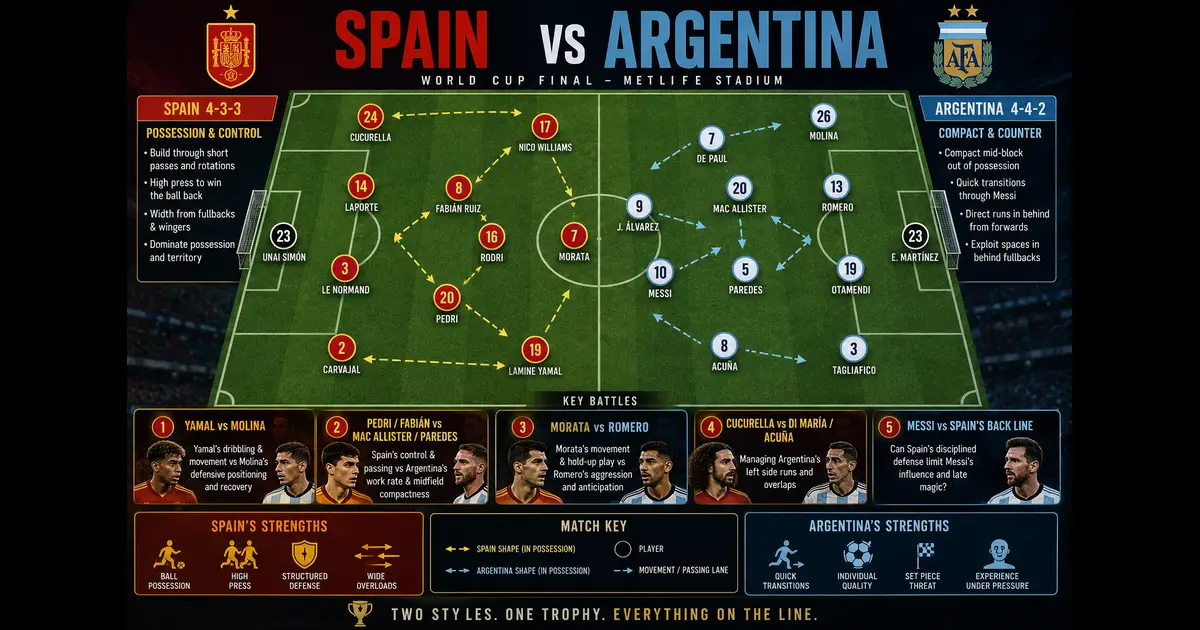 Spain vs Argentina tactics
Strip away the occasion, the history, the two icons at the center of it all, and Sunday’s final comes down to five specific contests across the pitch. Understanding Spain vs Argentina tactics means understanding these five zones, because whichever side wins three of them likely lifts the trophy.
Why Argentina’s Malvinas Banner Has FIFA and the UK Government on Alert
Battle 1: Spain’s High Press vs. Argentina’s Deep Buildup
Spain’s entire defensive identity this tournament has been built on aggressive, coordinated pressing rather than a passive low block. Their semifinal performance held France to just 0.3 expected goals — the worst attacking output recorded by any team in a World Cup match in six decades — largely because Spain denied France clean possession in buildup areas rather than simply defending deeper once France advanced.
Argentina’s response to pressure has generally been patient circulation through Cristian Romero, Lisandro Martínez and a deep-lying Leandro Paredes or Enzo Fernández, trusting their technical quality to play through traffic rather than bypass it long. If Spain’s front line — likely Oyarzabal, Olmo and Yamal in rotation — can replicate the pressing triggers that suffocated France, Argentina may be forced into longer, less controlled buildup than they’ve needed against any opponent so far this tournament.
Battle 2: Rodri vs. Messi in the Half-Spaces
This is arguably the single most important individual matchup of the entire final, even more than the more heavily marketed Messi-Yamal storyline. Rodri’s job is not to man-mark Messi directly — that approach has failed against Messi for two decades — but to control the central zones Messi likes to drop into to collect the ball facing forward. Spain’s semifinal masterclass against France was built on exactly this kind of zonal discipline in central midfield, denying Mbappé service in similar fashion.
The complication for Spain: Messi at 39 doesn’t need to beat a man to hurt you anymore. His influence this tournament has increasingly come through vision and timing rather than dribbling — both of Argentina’s goals in the semifinal against England came from Messi assists delivered from deep, central positions rather than his traditional wide-right cutting-in role.</cite> Rodri denying him time on the ball, even fractionally, may matter more than denying him space.
Battle 3: Spain’s Full-Backs vs. Argentina’s Wide Overloads
Argentina’s attacking shape has repeatedly used width through Nahuel Molina and Nicolás Tagliafico (or Marcos Acuña) to stretch defenses, creating space centrally for Messi and Julián Álvarez to exploit. Spain’s full-backs — Pedro Porro on the right, Marc Cucurella on the left — have been excellent going forward all tournament (Porro scored the killer second goal against France), but that attacking instinct comes with a tradeoff: space in behind when they’re caught upfield.
Given Argentina’s pattern of finding joy in exactly these transition moments late in matches, Spain’s coaching staff will need to carefully manage when Porro and Cucurella are allowed to commit forward, particularly after the hour mark. A repeat of Porro’s marauding semifinal performance would be a huge asset for Spain — but only if it doesn’t leave the space behind him exposed to an Argentina side built to punish exactly that kind of gap.
Battle 4: Spain’s Defensive Discipline vs. Argentina’s Late-Match Surges
This is less a positional battle than a psychological and physical one, but it may be the most statistically significant factor in the entire final. Argentina had scored nine goals after the 75th minute entering the semifinal against England, then found a tenth in stoppage time to complete the win. That is not incidental — it reflects genuine squad depth and a specific pattern of games opening up as opponents tire.
Spain’s counter to this has been remarkable defensive consistency for the full ninety minutes rather than fading late, but they have not yet faced a team as relentlessly effective in exactly this window as Argentina has been. If the match is level or Spain are protecting a narrow lead with twenty minutes to go, this battle — fresh legs, mental resilience, and Scaloni’s substitution timing versus De la Fuente’s — could single-handedly decide the trophy.
Battle 5: Yamal’s One-on-One Threat vs. Argentina’s Left-Sided Defense
However central the Messi-Rodri and Messi-Yamal storylines are to the final’s narrative, the actual tactical matchup that could produce a goal from nothing is Yamal isolated against Argentina’s right-back — likely Molina, who will be pulled between defensive duties and Argentina’s own attacking width. Yamal has drawn a penalty in a World Cup knockout match at 19 years and one day old, the second-youngest player in sixty years to do so, behind only England’s Michael Owen in 1998 against this same Argentina national team.
That historical echo — Yamal drawing fouls against Argentina in the same manner Owen once did — is a reminder that Argentina’s defense, for all its experience, has a specific vulnerability to explosive, direct wide players cutting inside at pace. If Yamal gets isolated in that exact one-on-one scenario repeatedly, it may be Spain’s single most reliable route to breaking Argentina down.
Bonus Angle: The Goalkeepers Nobody’s Talking About Enough
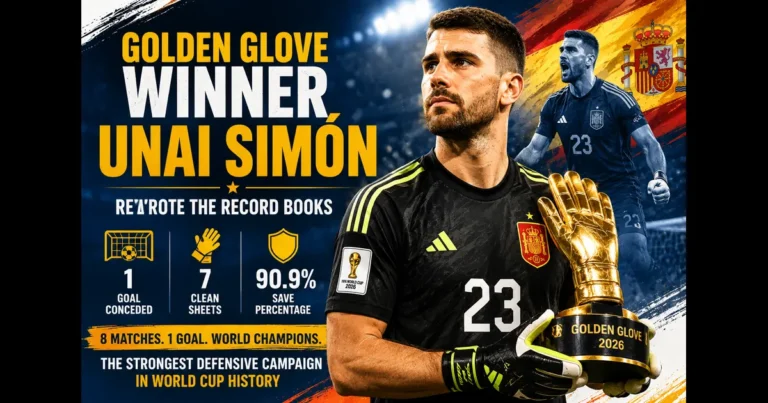
Buried beneath the five battles above is a quieter one that could matter just as much in a tight final: Unai Simón against Emiliano Martínez. Simón set a new World Cup record with six clean sheets this tournament, built on positioning and command of his box rather than spectacular individual saves — a reflection of Spain’s broader defensive structure denying opponents clean sight of goal in the first place. Martínez, by contrast, has been asked to make more genuinely difficult saves across Argentina’s more chaotic knockout run, and his penalty-shootout pedigree (a factor in both Argentina’s 2022 final win and their 2021 Copa América triumph) means Spain absolutely cannot assume this final is decided before a possible shootout.
If either team is nursing a narrow lead into the closing stages, the goalkeeper on the other side becomes disproportionately important — Simón’s calm control of crosses and long-range efforts against Argentina’s more direct, set-piece-reliant attacking approach, versus Martínez’s shot-stopping instincts against a Spain side that has generated most of its danger through open-play combination rather than direct strikes from distance. It’s a battle that rarely gets top billing in final previews, but on the day, it could easily decide who’s lifting the trophy.
How These Battles Interact
None of these five zones exist independently. If Spain wins the pressing battle (1) and controls Messi’s central influence (2), Argentina’s wide overloads (3) become their primary outlet — which puts even more pressure on Spain’s full-backs to balance attacking instinct with defensive discipline heading into the tiring final stretch (4), precisely the moment Yamal’s individual quality (5) could prove decisive at the other end.
Spain’s path to victory runs through winning battles 1, 2 and 4 — pressing effectively, controlling Messi’s central influence, and holding their defensive discipline late. Argentina’s path runs through forcing chaos in exactly those same three zones, trusting that even a fractional edge in one of them, sustained into the final twenty minutes, has been enough to beat every opponent they’ve faced this tournament. Whoever wins the majority of these five tactical contests on Sunday afternoon at MetLife Stadium will very likely be the team lifting the trophy that evening.
🔹🔹 follow us on facebook 🔹🔹
About the Author


2 thoughts on “Spain vs Argentina Tactics: Five Key Battles That Will Decide the World Cup Final”