 Serie A 2025-26 Season Review: The Scudetto Battle Decided
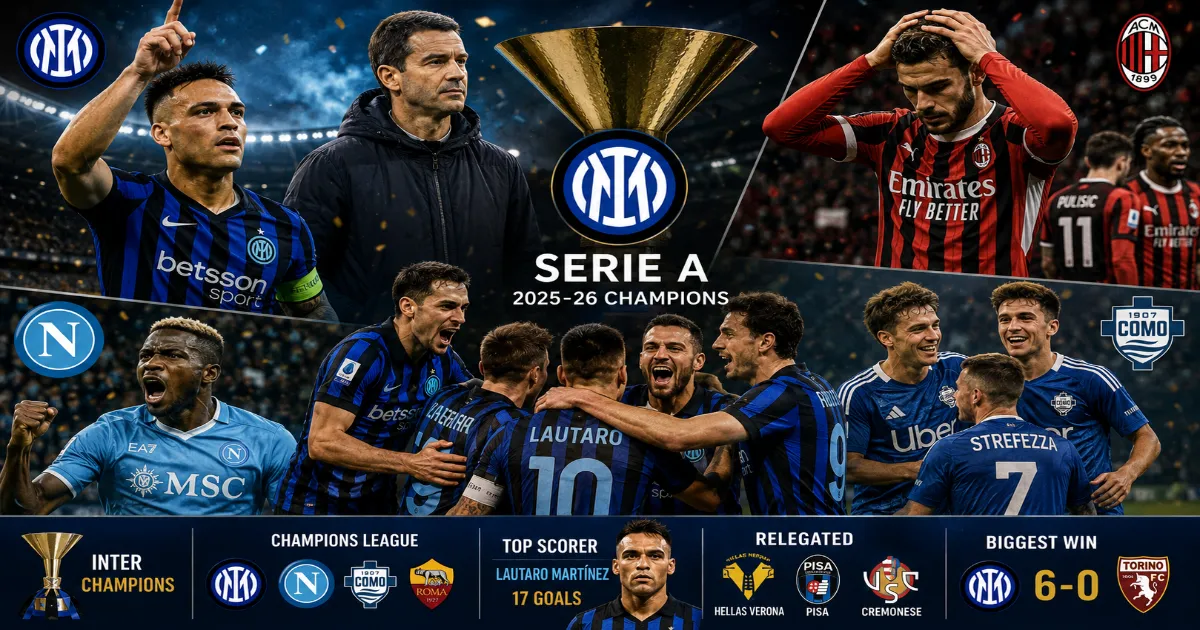
Inter Milan closed out the 2025-26 Serie A season as champions for the 21st time in the club’s history, a genuinely significant response to one of the most painful nights in the club’s recent European history. Less than a year after suffering a crushing Champions League final defeat, Inter turned domestic football into their platform for redemption, doing so under a rookie head coach making the jump directly from the club’s own academy system.
Messi Retires: Inside the Rise, Falls, and Redemption of a Legend
Football’s Greatest Transfers of All Time: From Pele to Neymar to Mbappe
Cristiano Ronaldo Jr.: Club, Lifestyle, Career and Future Prospects
From European Heartbreak to Domestic Triumph
Inter’s 2025-26 campaign carried an unmistakable emotional undercurrent from its very first matches, arriving barely a year removed from a Champions League final humiliation against Paris Saint-Germain, a result widely regarded as one of the most painful nights in the club’s modern history. That defeat prompted a significant summer overhaul, with manager Simone Inzaghi departing to take charge of Saudi Arabia’s Al-Hilal and Inter turning instead to Cristian Chivu, a former Inter academy coach who had only recently begun his senior managerial career at Parma, where he had successfully guided the club to safety from relegation across a brief 13-match caretaker stint.
Chivu’s promotion to Inter’s top job carried genuine risk given his limited senior managerial experience, but the gamble paid off decisively. Inter clinched the title with three matches still to play, sealing the championship with a 2-0 win over Parma, the very club where Chivu had begun his own managerial career just months earlier, a fittingly symbolic conclusion to a genuinely remarkable first season in charge of one of Italian football’s most historically significant institutions.
Napoli’s Sustained Challenge
Napoli, the defending champions under Antonio Conte, mounted a genuine title challenge of their own throughout the campaign, ultimately finishing 11 points behind Inter, a considerably closer margin than that gap might initially suggest given how competitive both clubs’ campaigns looked across large stretches of the season. Napoli’s own Champions League qualification, confirmed the week before the season’s final matches, meant Conte’s side secured a second consecutive strong campaign even without matching the title triumph they’d delivered the previous season, a reasonable outcome given Inter’s own clear determination to reclaim the championship following their European disappointment.
Milan’s Stunning Final-Day Collapse
If Inter’s triumph provided the season’s central storyline, AC Milan’s dramatic final-day collapse offered its most shocking individual moment. Milan entered the season’s concluding weekend in genuine contention for a Champions League place, only to suffer a stunning 2-1 home defeat to Cagliari that dropped the club out of the top four entirely, a result that sent shockwaves through Italian football given how unexpected the specific opponent and scoreline proved to be. That defeat opened the door for both Como and Roma to leapfrog Milan into the Champions League places on the season’s very last day, with Como securing their own qualification through a comprehensive 4-1 away win over regional rivals Cremonese, while Roma sealed their place with a 2-0 victory at Verona’s Stadio Bentegodi.
Milan’s failure to secure Champions League qualification, despite a genuinely impressive 24-match unbeaten run at one stage of the season, the longest such streak recorded by any club in the division, underlined just how unforgiving Serie A’s fight for European qualification places had become across a campaign that ultimately came down to the very final afternoon of fixtures.
Como’s Remarkable Rise
Como’s own Champions League qualification deserves particular recognition as one of the season’s most surprising developments, a genuinely remarkable achievement for a club that had only returned to Serie A relatively recently following a period in the lower divisions. Their emphatic 6-0 demolition of Torino earlier in the season stood as the campaign’s biggest home win, offering an early signal of the attacking quality that would ultimately carry the club into the Champions League places by the time the season concluded, a genuinely significant milestone in the club’s ongoing rebuilding project under considerable recent investment.
Zinedine Zidane’s Greatest Moments: The Career That Defined a Generation
Ronaldo Nazário: Why El Fenómeno Still Has the Greatest Career in Football History
The Relegation Fight and a Chaotic Final Weekend
At the opposite end of the table, Hellas Verona, Pisa, and Cremonese were all relegated back to Serie B, with Pisa enduring a particularly difficult campaign that included a 17-match winless run, one of the longest such streaks in the division that season. Verona’s own struggles included a five-match losing run that ultimately proved decisive in sealing their relegation, closing out a campaign that saw the historically resilient provincial club unable to replicate the survival instincts that had kept them in the top flight during previous difficult seasons.
The season’s final weekend also produced genuine off-field tension, with the derby between Torino and Juventus delayed by an hour following clashes between rival ultras groups outside the stadium, a stark reminder that Italian football’s passionate, occasionally volatile matchday culture remains an ever-present backdrop to the sport’s on-field storylines, regardless of how much a specific fixture’s final league placement might have mattered by that point in the season.
Individual Standouts
Lautaro Martínez finished the season as Serie A’s top scorer with 17 goals, continuing his role as Inter’s central attacking focal point throughout Chivu’s debut campaign as manager. His goalscoring output, combined with sustained contributions from established Inter figures like Federico Dimarco, Alessandro Bastoni, Hakan Çalhanoğlu, and Marcus Thuram, gave Chivu a genuinely experienced core to build his new tactical approach around, a significant advantage for any first-time senior manager taking charge of a squad with genuine title-winning ambitions and expectations.
A Season of Statistical Extremes
Beyond the title race and relegation battle, the 2025-26 campaign produced several notably one-sided results that captured the scale of quality gap present across different tiers of the division. Inter’s own 6-2 demolition of Pisa in January stood as the season’s highest-scoring individual match, while Sassuolo’s 5-0 home defeat to Inter later that same month underlined the champions’ consistent attacking firepower throughout the campaign. The season’s highest single attendance, over 75,000 spectators for Milan’s goalless draw with Juventus in April, reflected the enduring pulling power of Italian football’s most historic fixtures even during a season that, for Milan specifically, would ultimately end in Champions League disappointment.
The Worst World Cup Teams Ever: Historic Thrashings and Total Collapses
Messi’s World Cup Record Streak: Nine Straight Matches and the Milestones Still Falling
What the Season Revealed About Serie A’s Competitive Balance
Taken as a whole, the 2025-26 campaign offered genuine encouragement for those hoping to see Serie A’s competitive balance continue improving beyond its traditional big-three hierarchy of Juventus, Inter, and Milan. Napoli’s sustained title challenge, Como’s surprise Champions League qualification, and Roma’s own late charge into the top four all suggested a division with genuinely broadening competitive depth, even as Inter’s eventual triumph confirmed that the league’s most historically dominant institutions remain capable of reasserting themselves decisively when circumstances, in this case genuine European heartbreak and a bold managerial appointment, align in their favor. For Chivu specifically, delivering a Scudetto in his very first full season as a senior manager represents one of the more remarkable individual coaching achievements Italian football has produced in recent years, instantly establishing him as one of the league’s most closely watched young managerial talents heading into the following campaign.
Chivu’s Tactical Approach Explained
Part of what made Chivu’s rapid success so notable was how directly he built on the foundation left by his predecessor rather than attempting a wholesale tactical overhaul immediately upon taking charge. Having spent years working within Inter’s academy system before his brief but successful stint at Parma, Chivu retained much of the core defensive structure and possession principles that had defined Inzaghi’s own tenure, while gradually introducing subtle adjustments to the team’s pressing triggers and attacking rotations that helped refresh a squad that had appeared visibly drained following the previous season’s Champions League final disappointment. That blend of continuity and incremental innovation, rather than a dramatic system change, is widely credited by Italian football analysts as a key factor in Inter’s ability to translate genuine European heartbreak into renewed domestic hunger so quickly under new management.
What This Means for Next Season
Inter’s triumph sets up a genuinely intriguing following campaign, with Chivu now facing the very different challenge of defending a title as an established, proven manager rather than entering the season as a relative unknown quantity. Napoli’s continued competitiveness under Conte, Milan’s need to bounce back from their painful final-day Champions League miss, and Como’s ongoing development as a genuine European contender all suggest Serie A’s title race and European qualification battle could prove just as compelling heading into 2026-27, particularly with Inter now needing to balance renewed Champions League ambitions against the increased scrutiny and expectation that inevitably follows a title-winning campaign delivered under such emotionally significant circumstances, a challenge that will only intensify once the new season’s fixture list brings Inter back into direct contact with the very competition that defined the emotional backdrop of their entire title-winning campaign in the first place.
🔹🔹 Follow us on Facebook 🔹🔹
The Top 10 Most Expensive Football Transfers in History
Football History’s Most Unforgettable Women’s World Cup Moments
About the Author