Ousmane Dembélé FIFA World Cup 2026: Profile, Stats & Career | StrikerReport
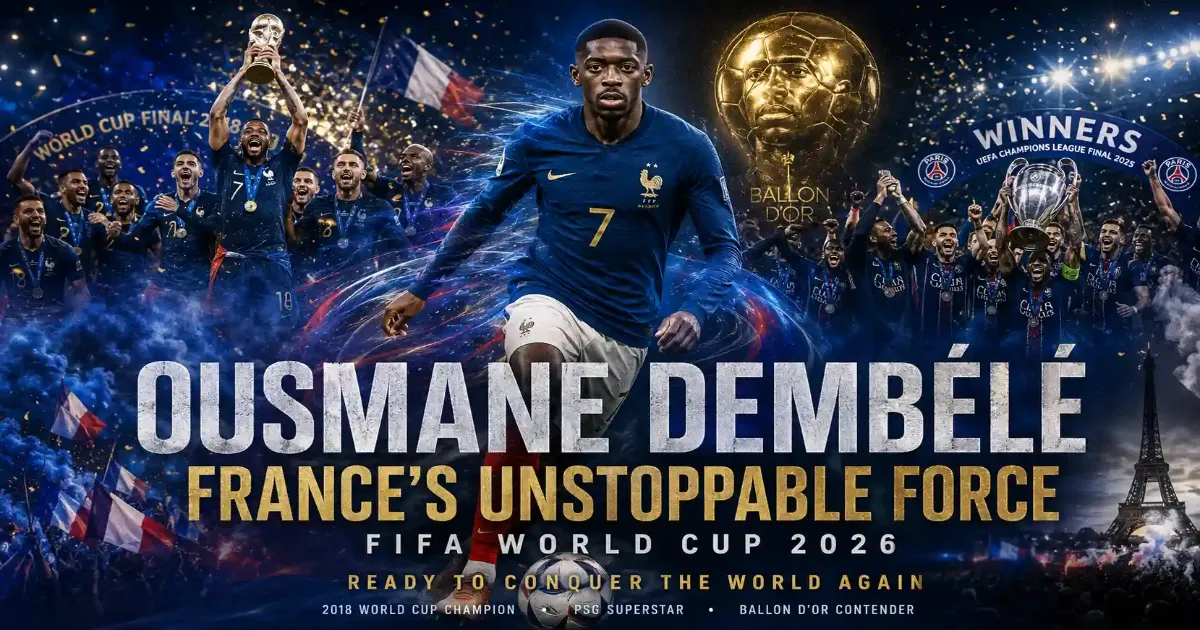
Ousmane Dembélé FIFA World Cup 2026 — France’s Unstoppable Force Is Ready to Conquer the World Again
France | Right Winger / Forward | Age at WC 2026: 29 | Paris Saint-Germain | 2018 World Cup Winner
- 2018 FIFA World Cup winner with France — a champion at just 21 years old
- 35 goals across all competitions for PSG in 2024–25 — top scorer in a Champions League-winning season
- 10 goals and 7 assists in 22 Ligue 1 appearances in 2025–26 — 4th highest goals per 90 in the division
- Ballon d’Or 2025 frontrunner — alongside Lamine Yamal, the most discussed individual award candidate entering 2026
- Market value: approximately €105 million | PSG contract until June 2027 | Annual salary: ~€21 million
Quick Facts — Ousmane Dembélé FIFA World Cup 2026
| Category | Details |
|---|---|
| Full Name | Masour Ousmane Dembélé |
| Date of Birth | 15 May 1997 |
| Age at World Cup 2026 | 29 years old |
| Nationality | French |
| Place of Birth | Vernon, Normandy, France |
| Heritage | Malian (father), Mauritanian-Senegalese (mother) |
| Height | 1.78 m (5 ft 10 in) |
| Preferred Foot | Both (effectively ambidextrous) |
| Current Club | Paris Saint-Germain (Ligue 1) |
| Jersey Number | #10 (PSG) | #7 (France) |
| Position | Right Winger / Forward |
| Transfer Fee (Barcelona to PSG) | €50 million (2023) |
| Transfer Fee (Dortmund to Barcelona) | €105 million (2017, then-record) |
| Market Value (Est.) | €105 million |
| PSG Contract Until | June 2027 |
| Annual Salary (Est.) | ~€21 million per year |
| Wife | Rima Edbouche (married December 2021) |
| Children | One daughter (born September 2022) |
| Net Worth (Est.) | $35–40 million USD |
| Religion | Islam |
Ousmane Dembélé FIFA World Cup 2026 — The Electric Frenchman at the Peak of His Powers
For years, the conversation about Ousmane Dembélé began and ended in the same frustrating place: the injury table. Every time the football world settled in to watch what this player was truly capable of — every time the pace, the dribbling, the ambidextrous finishing began to produce the kind of sustained brilliance that made scouts write superlatives into reports — another hamstring, another muscle, another surgery would arrive to interrupt the story. He became the most talented broken promise in European football: a winger of such rare natural gifts that Barcelona paid €105 million to bring him from Dortmund at the age of twenty, only to spend the next five seasons managing his absences as much as his appearances.
And then something changed. The move to Paris Saint-Germain in 2023 marked not merely a change of club but a change of condition, of management, of momentum. Under Luis Enrique’s high-intensity, technically demanding system at PSG, Dembélé found something he had been searching for across an entire career: fitness, consistency, and the sustained opportunity to show the world what had always been there beneath the injury reports. In 2024–25, he was PSG’s top scorer across all competitions with 35 goals — the central figure in a Champions League-winning campaign, a man playing at a level that had observers reaching for the most flattering comparisons in the game.
He arrives at the Ousmane Dembélé FIFA World Cup 2026 as a 29-year-old at the absolute summit of his powers — a World Cup winner from 2018 who never got to fully express himself on the biggest international stage, who played through the 2022 final with injuries that limited his influence, and who now stands in North America with a fully fit body, a Champions League winners’ medal around his neck, and a desire to finally, definitively, show the world what Ousmane Dembélé at his best looks like across a full tournament. France are favourites. Dembélé is their spark. And the world is watching.
Biography — From Vernon to the Pinnacle of World Football
Ousmane Dembélé was born on 15 May 1997 in Vernon, a quiet town in the Normandy region of northern France. His parents — his father from Mali, his mother of Mauritanian-Senegalese heritage — had relocated to France in search of better opportunities, and they raised Ousmane as the eldest of three children in a household defined by faith, family, and the particular resilience of people who have built something new in an unfamiliar country. His mother, Fatimata, played a central and often celebrated role in his early football journey: it was she who took him to the city of Rennes to meet his uncle and begin the serious pursuit of football, sacrificing comfort and convenience to give her son the best possible start.
Dembélé took his very first footballing steps at Madeleine Évreux, a local club in the town of Évreux not far from Vernon, joining at the age of seven in 2004. He spent five seasons there from 2004 to 2009, sharpening his instincts on modest grass pitches with modest resources, developing the close control and directness of movement that would later command nine-figure transfer fees. He then moved to Évreux FC 27 for a single season before the moment that changed everything: his admission to the youth academy of Stade Rennais in 2010, at thirteen years old. The Rennes academy is one of the most respected in French football, and Dembélé’s five years within it gave him the technical foundation — the structured positional understanding, the discipline of tactical organisation around his natural freedom — that transformed his gifts from raw to refined.
He made his senior debut for Rennes’ reserve side in the Championnat de France Amateur in September 2014, scoring his first goal that November and completing his first senior hat-trick by May 2015. His first-team debut for Rennes in Ligue 1 came in September 2015, off the bench against Angers — a brief cameo that barely hinted at what was coming. By the end of that season, Borussia Dortmund had seen enough. For a player who had taken his first professional steps less than a year earlier, the speed of ascent was breathtaking. And it was only just beginning.
Club Career Highlights — From Dortmund Sensation to PSG Champion
Dembélé arrived at Borussia Dortmund in the summer of 2016 for €35 million and immediately demonstrated that the fee was a fraction of his value. In a single season in the Bundesliga he became the most talked-about young winger in European football — his pace, his two-footedness, his ability to take on defenders in either direction and finish from either side left opposition coaches searching desperately for answers that their full-backs could not provide. He won the Bundesliga Rookie of the Season award in 2016–17, scored the winning goal in the DFB-Pokal final to deliver a trophy to Dortmund, and helped the club reach the UEFA Champions League quarter-finals. Thirteen goals and 21 assists across all competitions in a single season at twenty years old. Barcelona arrived in the summer of 2017 with €105 million and a contract. Dortmund had no choice but to say yes.
The Barcelona years are the most complex chapter of Dembélé’s story — a period of extraordinary moments and extraordinary frustrations in roughly equal measure. He arrived as the joint-second most expensive footballer in history at that point, alongside compatriot Paul Pogba, and the weight of that fee followed him through every injury setback, every absence, every match where he was brilliant for forty minutes and unavailable for the next six weeks. He won La Liga twice, two Copa del Rey titles, and a Supercopa de España with Barcelona, and in his finest individual performances — the Copa del Rey final goal in 2017–18, the stretches in 2021–22 when he was genuinely one of the best players in the world — he offered conclusive proof that the ability had always been there. The body, under Barcelona’s medical and fitness management, simply could not keep pace with the demand his talent placed upon it.
The transfer to PSG in August 2023 for €50 million was, for many, a fresh start wrapped in scepticism. Another elite club, another optimistic medical assessment, another set of high expectations that injuries might again interrupt. What followed silenced every doubt. Under Luis Enrique’s meticulous, physically demanding system at the Parc des Princes, Dembélé was transformed. He played more minutes across 2023–24 than in any season of his career. He scored and assisted more prolifically than ever before. And in 2024–25, he was PSG’s most important attacking player across their historic Champions League-winning campaign — finishing the season with 35 goals in all competitions, earning the club’s top scorer award, and producing the kind of consistent, match-winning performances that made the Ballon d’Or conversation feel not merely plausible but legitimate. In 2025–26, with PSG competing across all fronts again, Dembélé has picked up where he left off: 10 goals and 7 assists in 22 Ligue 1 appearances alone, consistently among the most productive attacking performers in European football.
International Career — World Cup Winner, Unfinished Story — Ousmane Dembélé FIFA World Cup 2026
Ousmane Dembélé made his senior international debut for France in 2016 and quickly established himself as a fixture in Les Bleus’ attacking options under Didier Deschamps. His greatest international moment arrived early: at the 2018 FIFA World Cup in Russia, a twenty-one-year-old Dembélé was part of the French squad that lifted the trophy in Moscow, defeating Croatia 4–2 in the final. His role in that tournament was not headline-defining — he came off the bench in several matches — but as a World Cup winner’s medal at that age, it is a foundation that most footballers could spend an entire career chasing and never reach.
The tournaments that followed were more complicated. Euro 2020 saw him delay surgery on a knee injury to make the squad, which limited his effectiveness and contributed to France’s disappointing quarter-final exit. At the 2022 FIFA World Cup in Qatar, Dembélé featured in every match of France’s run to the final — a final that became one of the most dramatic in tournament history before Argentina won it on penalties. He provided two assists across the campaign but conceded the penalty that helped unsettle France’s composure in the final against Argentina, and was withdrawn after 41 minutes as Deschamps sought to rescue the match. France lost. It was a painful conclusion to a tournament where Dembélé had never quite been at his absolute best, and the hunger it created for a different ending in 2026 has been visible in every interview he has given since.
Under France’s current setup heading into World Cup 2026, Dembélé occupies the right attacking position in what is one of the deepest, most technically gifted international squads in the tournament. Alongside Kylian Mbappé, Antoine Griezmann, and a midfield of exceptional quality, Dembélé’s role is to provide the width, the pace behind defensive lines, and the direct one-versus-one quality that stretches opposition defences and creates the space that France’s central players exploit. He has accumulated 50+ senior caps and carries into this tournament a level of club form — and a level of personal motivation — that makes him one of the most dangerous players in the entire World Cup field. At 29, he has never been better. At 29, the timing has never been more right.
Career Timeline — Ousmane Dembélé FIFA World Cup 2026 Journey
📅 2015 — Ligue 1 Debut at Rennes, Age 18
Dembélé made his first-team debut for Stade Rennais in September 2015, coming off the bench against Angers. In the season that followed, he played 26 league matches, scored 12 goals, and registered 8 assists — numbers so extraordinary for an eighteen-year-old that it made his €35 million transfer to Dortmund the following summer look like a modest valuation rather than an extravagant one.
📅 2017 — DFB-Pokal Winner at Dortmund and Record Barcelona Transfer
Dembélé’s single season at Borussia Dortmund produced some of the most eye-catching individual performances by a teenager in Bundesliga history. He scored the winning goal in the DFB-Pokal final in May 2017, delivered 13 goals and 21 assists across all competitions, and forced Barcelona into paying €105 million — the joint-second highest transfer fee in football history at the time — to bring him to the Camp Nou before his twenty-first birthday.
📅 2018 — FIFA World Cup Winner with France, Age 21
At twenty-one years old, Ousmane Dembélé became a World Cup winner in Russia. France’s 4–2 victory over Croatia in the final in Moscow wrote his name permanently into football history — regardless of anything that happened before or after, that medal belongs to him. For a boy who grew up kicking a ball in Normandy with parents who had travelled from West Africa to give their children a better life, the moment carried a weight of meaning that went far beyond sport.
📅 2022 — World Cup Final Appearance with France in Qatar
Dembélé started every match of France’s run to the 2022 World Cup final in Qatar, featuring in one of the most dramatic finals in the tournament’s history. Despite France’s eventual defeat to Argentina on penalties, his presence across the whole campaign demonstrated that he had become a genuinely indispensable part of the French setup — and his determination to reach and win a second final has been the motivating force behind everything since.
📅 2023 — Transfer to PSG: The Rebirth
The €50 million move to Paris Saint-Germain in August 2023 marked the beginning of what most observers now describe as the best sustained period of Dembélé’s career. Under Luis Enrique, he found the fitness management, the tactical framework, and the personal confidence to perform consistently at the highest level for the first time. Everything that had been promised by the transfer fees and the occasional brilliant performances was now being delivered week after week.
📅 2025 — Champions League Winner and PSG’s Top Scorer
The 2024–25 season was the finest of Dembélé’s career. He was PSG’s top scorer across all competitions with 35 goals, the central figure in their UEFA Champions League triumph — the club’s first European crown — and the player most widely credited with transforming PSG from a collection of individuals into a genuine team. By the end of that season, the Ballon d’Or conversation had his name at or near the top of every credible list.
📅 2026 — Ousmane Dembélé FIFA World Cup 2026 — Peak, Purpose, and the Final Stage
Fully fit, playing the best football of his life, and carrying a Champions League winners’ medal alongside his 2018 World Cup gold, Dembélé arrives at the FIFA World Cup 2026 in North America at 29 — the age when the greatest wide forwards in football history have typically produced their most devastating performances. France are favourites. Dembélé is their electricity. The stage has never been bigger, and he has never been more ready for it.
2025–26 Season Statistics — Ousmane Dembélé FIFA World Cup 2026
Club Statistics — Paris Saint-Germain
| Competition | Apps | Goals | Assists | Avg Rating |
|---|---|---|---|---|
| Ligue 1 2025–26 | 22 | 10 | 7 | 7.52 |
| Coupe de France | 2 | 1 | 0 | 7.3 |
| UEFA Champions League | 3 | 1 | 0 | 7.1 |
| Trophée des Champions | 1 | 0 | 1 | 7.4 |
| Total 2025–26 | 28 | 12 | 8 | 7.45 |
International Statistics — France
| Competition | Apps | Goals | Assists | Note |
|---|---|---|---|---|
| WC 2026 Qualifying (UEFA) | 6 | 3 | 4 | France qualified unbeaten |
| UEFA Nations League 2024–25 | 5 | 2 | 3 | Strong creative displays |
| World Cup 2022 (Qatar) | 7 | 0 | 2 | Runner-up |
| Senior Career Totals | 55+ | 18+ | 25+ | 2018 WC Winner |
Playing Style Breakdown — Ousmane Dembélé FIFA World Cup 2026
1. Attacking Qualities
Ousmane Dembélé’s attacking qualities are built on a foundation that is almost unique in world football: he is genuinely, functionally ambidextrous. He shoots, dribbles, crosses, and cuts with both his right and his left foot at a level that makes defending against him a problem with no clean solution. A right-footed winger who cuts inside creates one set of defensive challenges. A left-footed winger who attacks the byline creates another. Dembélé playing on the right flank with the ability to go in either direction with equal conviction and equal quality creates a defensive problem that full-backs across world football have spent years failing to solve. His finishing from both feet inside the penalty area is sharp and accurate. His ability to shoot first-time off the dribble — to take a touch and hit the ball in the same movement, before a goalkeeper can set — has produced some of the most technically impressive goals in European football across the past three seasons.
2. Technical Skills and Dribbling
The dribbling is what separates Dembélé from almost everyone in the world at his position. His close control at pace — the ability to maintain the ball at his feet while accelerating through or around defenders — is among the elite in world football. He combines this with an exceptional range of feints and body movements that make him extraordinarily difficult to read: he can go inside, go outside, cut back, accelerate, or stop, and he makes these decisions in the instant of contact without telegraphing the direction. His dribble success rate in Ligue 1 is consistently among the highest in the division, and in the Champions League he has repeatedly dismantled elite defensive structures through individual quality alone. He has taken 45 shots in 22 Ligue 1 matches this season — a frequency that reflects how often he arrives in positions to shoot — and his shooting accuracy of 40% is strong for a player who attempts so many from distance and difficult angles.
3. Physical Attributes
Dembélé’s physical profile is that of the archetypal modern wide forward: 1.78 metres, 67 kilograms, with a low centre of gravity that makes him almost impossible to knock off the ball in tight spaces and an acceleration burst that regularly leaves defenders in his wake over the first five to ten yards. His top speed — recorded at 30.93 km/h in Champions League data this season — places him among the fastest attacking players in the tournament field. The critical development under Luis Enrique at PSG has been the dramatic improvement in his physical durability: the hamstring problems that defined his Barcelona years have been managed away through a combination of improved conditioning protocols, more intelligent training load management, and, as Dembélé himself has noted in interviews, a greater personal commitment to the lifestyle choices that support elite physical performance. He arrives at World Cup 2026 with the best injury record of his career across the past two seasons.
4. Tactical Intelligence
This is the dimension of Dembélé’s game that received the least credit during the injury-interrupted Barcelona years and has received the most recognition since his move to PSG. Under Luis Enrique’s demands, Dembélé has developed into a genuinely tactically sophisticated wide forward — one who understands when to press defensively, when to drift centrally to overload the midfield, when to stay wide to pin the full-back and create space for the overlapping runner, and when to cut inside and demand the ball to feet in a central channel. His defensive contributions have improved significantly: the tracking back, the press from the front, the interceptions that his Barcelona coaches often lamented were absent. He has become, at PSG, the complete wide forward that his ability always suggested was possible if the tactical framework and the personal discipline arrived simultaneously. In North America, that version of Dembélé will be the one France’s opponents face.
5. Areas to Watch / Weaknesses
The obvious area to monitor at World Cup 2026 is injury risk. Despite the dramatically improved fitness record of the past two years, Dembélé’s history means that every France medical update across the tournament will attract intense scrutiny. The physical demands of seven matches across five weeks in North American summer conditions — heat, humidity, and the compressed schedule of a knockout tournament — will test every squad’s fitness management. The other consideration is consistency of decision-making in the final third. At his best, Dembélé’s choices when one-on-one are devastating. In less optimal moments, he can over-dribble — attempting one extra touch where the pass or shot was already available. Against the elite defensive structures of the knockout stage, the difference between the decisive touch and the extra dribble can be the difference between a goal and a counter-attack.
Skill Ratings — Ousmane Dembélé FIFA World Cup 2026
| Skill | Rating |
|---|---|
| Finishing | 88 / 100 |
| Pace | 95 / 100 |
| Dribbling | 96 / 100 |
| Passing | 82 / 100 |
| Physicality | 76 / 100 |
| Vision | 84 / 100 |
| Movement / Positioning | 87 / 100 |
| Defensive Work | 78 / 100 |
| Leadership | 80 / 100 |
Records & Milestones — Ousmane Dembélé FIFA World Cup 2026
🏆 2018 FIFA World Cup Winner — Age 21
Dembélé became a World Cup champion in Russia in 2018 at just 21 years old, part of the French squad that defeated Croatia 4–2 in the final in Moscow. At the time of winning, he was the third-youngest member of the French squad to collect a winners’ medal. It remains the foundation of his international legacy and the marker against which everything else in his career is measured. Achieved: July 2018.
🏆 PSG All-Competitions Top Scorer — 35 Goals in 2024–25
In the 2024–25 season, Dembélé finished as PSG’s top scorer across all competitions with 35 goals — the most productive single season of his career and a figure that made him not only PSG’s most dangerous forward but one of the top six or seven goal-scorers across all of European football that year. He achieved this during the season PSG won the UEFA Champions League for the first time in their history. Achieved: 2024–25 season.
🏆 UEFA Champions League Winner with PSG — 2024–25
Dembélé was a central figure in PSG’s Champions League triumph in 2024–25, contributing goals and decisive moments throughout the knockout rounds. The medal confirmed his status as a winner at the club level across two different European leagues and added the most prestigious prize in club football to a collection that already included a World Cup gold. Achieved: May 2025.
🏆 €105 Million Transfer to Barcelona — Then Joint-Second Most Expensive Player Ever
When Barcelona paid Borussia Dortmund €105 million for Dembélé in August 2017, he became the joint-second most expensive footballer in history at the time, alongside compatriot Paul Pogba. The fee, which remains one of the largest ever paid for a wide forward, was a statement of belief in a twenty-year-old’s potential that few clubs have ever made so emphatically. Achieved: August 2017.
🏆 Bundesliga Rookie of the Season — 2016–17
In his single season at Borussia Dortmund, Dembélé won the Bundesliga Rookie of the Season award after delivering 13 goals and 21 assists across all competitions. He was twenty years old. It remains one of the most impactful debut seasons by a wide forward in Bundesliga history and established the benchmark that the rest of his career has spent trying to consistently meet. Achieved: 2016–17 season.
🏆 Top Scorer in Ligue 1 2024–25 — 21 League Goals
Dembélé scored 21 Ligue 1 goals in the 2024–25 season — the top scorer in the French top flight — becoming the first PSG forward to achieve that milestone since the club’s financial transformation. It was a statistical landmark that underscored the completeness of his transformation from injury-prone Barcelona winger to consistent, elite-level finisher at PSG. Achieved: 2024–25 season.
World Cup 2026 Preview — Can Dembélé Power France to Back-to-Back Crowns? — Ousmane Dembélé FIFA World Cup 2026
France arrive at the FIFA World Cup 2026 as the pre-tournament favourites in the eyes of many analysts — a squad so deep, so technically complete, and so experienced at the highest levels of the game that the question of whether they can win is less pressing than the question of whether they will. And within that squad, which bristles with quality at every position, Ousmane Dembélé occupies a unique and irreplaceable role. He is the player who most directly threatens opposition full-backs. He is the forward who, when in full flow, operates at a pace and an angle of approach that even the best individual defenders in the world find impossible to contain without conceding free kicks or penalties. He is France’s electricity — the short-circuit that turns a patient passing sequence into a moment of instant, decisive danger.
Didier Deschamps’ France are expected to operate in their familiar 4-3-3 or 4-2-3-1 formation, with Dembélé in his natural position on the right side of the attack. The interplay with Kylian Mbappé — who typically gravitates toward the left and the central channel — creates a dynamic that forces opposition defensive lines to cover enormous amounts of horizontal ground. When Mbappé drives inside from the left and Dembélé attacks the right channel simultaneously, the central defensive pairing faces a choice of two equally dangerous threats with no clean answer. It is one of the most feared attacking combinations at this tournament, and France’s ability to sustain that combination across seven matches — keeping both players fit and motivated — will be the single most important variable in their chances of lifting the trophy.
The group stage should present France with comfortable opportunities to establish rhythm and manage minutes across their most important players. The knockout rounds will be where Dembélé’s individual quality is most tested and most decisive. Against Brazil, Argentina, or Spain — the teams most likely to meet France in the quarter-finals or beyond — the ability to win a one-versus-one duel at pace, to create a shot from nothing, or to deliver the cross that a goal arrives from will be the currency that determines who advances. Dembélé, in his current form and at his current age, is among the best three or four players in the world at producing exactly that kind of moment.
The tournament prediction for France is a semi-final minimum, with a genuine and widely shared expectation that they will reach the final. Whether Dembélé can deliver the kind of tournament-defining individual campaign that writes his name permanently into World Cup folklore — rather than the collective winner’s role he played in 2018 or the peripheral finalist’s position of 2022 — is the personal storyline running through every match he plays. He has never been better. He has never been more ready. And in North America, on the biggest stage the sport provides, Ousmane Dembélé will finally have the platform his talent has always deserved.
Head-to-Head: Ousmane Dembélé FIFA World Cup 2026 vs Vinícius Jr. (Brazil)
| Attribute | Ousmane Dembélé (France) | Vinícius Jr. (Brazil) |
|---|---|---|
| Age at WC 2026 | 29 | 25 |
| Club | Paris Saint-Germain | Real Madrid |
| 2024–25 Goals (All Comps) | 35 | 28+ |
| World Cup Winner | Yes (2018) | No |
| Champions League Winner | Yes (PSG, 2025) | Yes (Real Madrid, multiple) |
| Market Value (Est.) | €105 million | €180 million |
| Preferred Foot | Both (ambidextrous) | Left |
| Dribbling Rating | 96 / 100 | 95 / 100 |
| Pace Rating | 95 / 100 | 96 / 100 |
| Threat Rating 2026 | 9.2 / 10 | 9.4 / 10 |
The Case for Dembélé
At 29, Dembélé is playing the best football of his career with the benefit of experience, consistency, and hard-won fitness that his twenties could not provide simultaneously. The ambidextrous quality — the genuine ability to be equally dangerous going right or left — gives him a dimension that even Vinícius cannot match. His goal return for PSG in 2024–25 was higher than anything Vinícius produced in the same period, and his Champions League winners’ medal reflects a team contribution and a performance standard across a full nine-month season that earns legitimate comparison with the very best wide forwards of the current era. In a one-versus-one duel with a defending full-back, there are perhaps two or three players in the world as difficult to stop as Dembélé in his current form. Vinícius is one of them. But the gap between them is narrower than the market value difference suggests.
The Case for Vinícius Jr.
Vinícius Jr. at 25 is at a different stage of his career arc — still ascending, still adding new tools to an arsenal that is already elite, and representing a Brazil side whose entire World Cup hopes rest almost entirely on his ability to produce decisive moments in knockout football. His record at Real Madrid across multiple Champions League campaigns has established him as one of the most dangerous match-winners in world football. His pace is fractionally superior to Dembélé’s. His left foot is one of the most potent weapons at this tournament. And his desire to deliver Brazil a first World Cup since 2002 is a motivational force that will not be underestimated in North America.
Verdict
This is the most evenly matched head-to-head comparison at World Cup 2026 among wide forwards. On current form in 2025–26, Dembélé edges it narrowly — his goal numbers, his Champions League winner’s medal, and his ambidextrous quality give him a fractional advantage over Vinícius who, while younger and potentially higher-ceiling, has not matched Dembélé’s output in the most recent completed season. If they meet in the knockout stage — a scenario that seems entirely plausible — it will be one of the defining individual matchups of the tournament. Dembélé versus Vinícius, wide attacker versus wide attacker, ambidextrous Frenchman versus devastating left foot. Football does not offer better theatre than this.
Fun Facts & Personal Life — The Man Behind the Magic
Ousmane Dembélé is a practising Muslim, and his faith is a consistent thread through everything he has said publicly about the pressures and privileges of professional football. He has spoken about the grounding that his religion provides — the structure, the perspective, the ability to process both success and setback without losing equilibrium. Those around him at PSG describe a man who carries his faith quietly and practically, using it as a source of inner stability rather than public declaration.
He married Rima Edbouche, a Moroccan TikTok content creator, in a traditional Moroccan ceremony in December 2021 — a celebration that reflected both his Islamic faith and the West African and North African cultural connections that run through his family. The couple welcomed their first child, a daughter, in September 2022. Dembélé has spoken warmly about fatherhood in the interviews he has given since, noting that having a child has sharpened his focus and clarified his priorities in ways that have contributed directly to the improvement in his professionalism and his physical management.
He is famously devoted to video games — a passion he developed in his youth and has never abandoned. His teammates at both Barcelona and PSG have described him as one of the most dedicated gamers in any dressing room they have been part of, spending hours between training sessions on consoles and competing with the same seriousness he brings to football. It is one of the details about him that humanises the superstar — the young man from Normandy who became one of the most expensive footballers in history and still relaxes exactly the way he did in Évreux at fourteen.
Dembélé is known for an extravagant and confident sense of personal style — fashion choices that his teammates have described as everything from bold to bewildering — and has been involved in partnerships with major sportswear and fashion brands. His Instagram, followed by tens of millions of people, is a window into a personality that is warmer, more playful, and more self-aware than the injury-prone cautionary tale his Barcelona years sometimes made him appear. He has grown into his public role with a confidence that mirrors his growth as a footballer.
His parents — both of West African origin, both of whom relocated to France before his birth — remain a central and deeply cherished part of his life. He has spoken in multiple interviews about the sacrifices they made, the support they gave, and the particular pride his mother takes in a journey that began with her taking him from Vernon to Rennes to meet an uncle and start a football career. From that car journey to a World Cup medal to a Champions League trophy to the FIFA World Cup 2026 in North America — it is a distance that no map can fully measure, and Dembélé has never pretended otherwise.
StrikerReport Verdict — Ousmane Dembélé FIFA World Cup 2026
StrikerReport Rating: 9.4 / 10
The career of Ousmane Dembélé has been, in many ways, the most suspenseful story in European football across the past decade. The extraordinary talent was never in question — not when Dortmund paid €35 million for a teenager, not when Barcelona paid €105 million for a twenty-year-old, not when the injury reports accumulated and the frustration grew. The question was always whether the talent and the availability would ever arrive in the same place at the same time, for long enough, to show the world what Ousmane Dembélé at full throttle across a full season looked like. Paris Saint-Germain have provided the answer. It looks like 35 goals in a Champions League-winning campaign. It looks like the Ballon d’Or conversation. It looks like the best wide forward in Ligue 1 and one of the five most dangerous attacking players in world football.
He arrives at the Ousmane Dembélé FIFA World Cup 2026 at 29 — the precise age at which the combination of natural ability, physical peak, and accumulated experience converges to produce the highest level of performance a footballer can sustain. He is a World Cup winner. He is a Champions League winner. He is France’s most electric forward. And in North America, across a tournament that will be watched by more people than any sporting event in human history, he will finally have the stage, the fitness, and the form to write the individual chapter that his talent has always been building toward.
The boy from Vernon. The son of parents who crossed continents for better lives. The winger who cost more than almost anyone in history and spent years making the football world wonder if he was worth it. He is worth it. He always was. And at FIFA World Cup 2026, the world is about to see exactly that — in full, magnificent, unstoppable detail.
This is Ousmane Dembélé FIFA World Cup 2026. And his greatest story is still being written.
Ousmane Dembélé FIFA World Cup 2026 — France’s Unstoppable Force Is Ready to Conquer the World Again
France | Right Winger / Forward | Age at WC 2026: 29 | Paris Saint-Germain | 2018 World Cup Winner
- 2018 FIFA World Cup winner with France — a champion at just 21 years old
- 35 goals across all competitions for PSG in 2024–25 — top scorer in a Champions League-winning season
- 10 goals and 7 assists in 22 Ligue 1 appearances in 2025–26 — 4th highest goals per 90 in the division
- Ballon d’Or 2025 frontrunner — alongside Lamine Yamal, the most discussed individual award candidate entering 2026
- Market value: approximately €105 million | PSG contract until June 2027 | Annual salary: ~€21 million
Quick Facts — Ousmane Dembélé FIFA World Cup 2026
| Category | Details |
|---|---|
| Full Name | Masour Ousmane Dembélé |
| Date of Birth | 15 May 1997 |
| Age at World Cup 2026 | 29 years old |
| Nationality | French |
| Place of Birth | Vernon, Normandy, France |
| Heritage | Malian (father), Mauritanian-Senegalese (mother) |
| Height | 1.78 m (5 ft 10 in) |
| Preferred Foot | Both (effectively ambidextrous) |
| Current Club | Paris Saint-Germain (Ligue 1) |
| Jersey Number | #10 (PSG) | #7 (France) |
| Position | Right Winger / Forward |
| Transfer Fee (Barcelona to PSG) | €50 million (2023) |
| Transfer Fee (Dortmund to Barcelona) | €105 million (2017, then-record) |
| Market Value (Est.) | €105 million |
| PSG Contract Until | June 2027 |
| Annual Salary (Est.) | ~€21 million per year |
| Wife | Rima Edbouche (married December 2021) |
| Children | One daughter (born September 2022) |
| Net Worth (Est.) | $35–40 million USD |
| Religion | Islam |
Ousmane Dembélé FIFA World Cup 2026 — The Electric Frenchman at the Peak of His Powers
For years, the conversation about Ousmane Dembélé began and ended in the same frustrating place: the injury table. Every time the football world settled in to watch what this player was truly capable of — every time the pace, the dribbling, the ambidextrous finishing began to produce the kind of sustained brilliance that made scouts write superlatives into reports — another hamstring, another muscle, another surgery would arrive to interrupt the story. He became the most talented broken promise in European football: a winger of such rare natural gifts that Barcelona paid €105 million to bring him from Dortmund at the age of twenty, only to spend the next five seasons managing his absences as much as his appearances.
And then something changed. The move to Paris Saint-Germain in 2023 marked not merely a change of club but a change of condition, of management, of momentum. Under Luis Enrique’s high-intensity, technically demanding system at PSG, Dembélé found something he had been searching for across an entire career: fitness, consistency, and the sustained opportunity to show the world what had always been there beneath the injury reports. In 2024–25, he was PSG’s top scorer across all competitions with 35 goals — the central figure in a Champions League-winning campaign, a man playing at a level that had observers reaching for the most flattering comparisons in the game.
He arrives at the Ousmane Dembélé FIFA World Cup 2026 as a 29-year-old at the absolute summit of his powers — a World Cup winner from 2018 who never got to fully express himself on the biggest international stage, who played through the 2022 final with injuries that limited his influence, and who now stands in North America with a fully fit body, a Champions League winners’ medal around his neck, and a desire to finally, definitively, show the world what Ousmane Dembélé at his best looks like across a full tournament. France are favourites. Dembélé is their spark. And the world is watching.
Biography — From Vernon to the Pinnacle of World Football
Ousmane Dembélé was born on 15 May 1997 in Vernon, a quiet town in the Normandy region of northern France. His parents — his father from Mali, his mother of Mauritanian-Senegalese heritage — had relocated to France in search of better opportunities, and they raised Ousmane as the eldest of three children in a household defined by faith, family, and the particular resilience of people who have built something new in an unfamiliar country. His mother, Fatimata, played a central and often celebrated role in his early football journey: it was she who took him to the city of Rennes to meet his uncle and begin the serious pursuit of football, sacrificing comfort and convenience to give her son the best possible start.
Dembélé took his very first footballing steps at Madeleine Évreux, a local club in the town of Évreux not far from Vernon, joining at the age of seven in 2004. He spent five seasons there from 2004 to 2009, sharpening his instincts on modest grass pitches with modest resources, developing the close control and directness of movement that would later command nine-figure transfer fees. He then moved to Évreux FC 27 for a single season before the moment that changed everything: his admission to the youth academy of Stade Rennais in 2010, at thirteen years old. The Rennes academy is one of the most respected in French football, and Dembélé’s five years within it gave him the technical foundation — the structured positional understanding, the discipline of tactical organisation around his natural freedom — that transformed his gifts from raw to refined.
He made his senior debut for Rennes’ reserve side in the Championnat de France Amateur in September 2014, scoring his first goal that November and completing his first senior hat-trick by May 2015. His first-team debut for Rennes in Ligue 1 came in September 2015, off the bench against Angers — a brief cameo that barely hinted at what was coming. By the end of that season, Borussia Dortmund had seen enough. For a player who had taken his first professional steps less than a year earlier, the speed of ascent was breathtaking. And it was only just beginning.
Club Career Highlights — From Dortmund Sensation to PSG Champion
Dembélé arrived at Borussia Dortmund in the summer of 2016 for €35 million and immediately demonstrated that the fee was a fraction of his value. In a single season in the Bundesliga he became the most talked-about young winger in European football — his pace, his two-footedness, his ability to take on defenders in either direction and finish from either side left opposition coaches searching desperately for answers that their full-backs could not provide. He won the Bundesliga Rookie of the Season award in 2016–17, scored the winning goal in the DFB-Pokal final to deliver a trophy to Dortmund, and helped the club reach the UEFA Champions League quarter-finals. Thirteen goals and 21 assists across all competitions in a single season at twenty years old. Barcelona arrived in the summer of 2017 with €105 million and a contract. Dortmund had no choice but to say yes.
The Barcelona years are the most complex chapter of Dembélé’s story — a period of extraordinary moments and extraordinary frustrations in roughly equal measure. He arrived as the joint-second most expensive footballer in history at that point, alongside compatriot Paul Pogba, and the weight of that fee followed him through every injury setback, every absence, every match where he was brilliant for forty minutes and unavailable for the next six weeks. He won La Liga twice, two Copa del Rey titles, and a Supercopa de España with Barcelona, and in his finest individual performances — the Copa del Rey final goal in 2017–18, the stretches in 2021–22 when he was genuinely one of the best players in the world — he offered conclusive proof that the ability had always been there. The body, under Barcelona’s medical and fitness management, simply could not keep pace with the demand his talent placed upon it.
The transfer to PSG in August 2023 for €50 million was, for many, a fresh start wrapped in scepticism. Another elite club, another optimistic medical assessment, another set of high expectations that injuries might again interrupt. What followed silenced every doubt. Under Luis Enrique’s meticulous, physically demanding system at the Parc des Princes, Dembélé was transformed. He played more minutes across 2023–24 than in any season of his career. He scored and assisted more prolifically than ever before. And in 2024–25, he was PSG’s most important attacking player across their historic Champions League-winning campaign — finishing the season with 35 goals in all competitions, earning the club’s top scorer award, and producing the kind of consistent, match-winning performances that made the Ballon d’Or conversation feel not merely plausible but legitimate. In 2025–26, with PSG competing across all fronts again, Dembélé has picked up where he left off: 10 goals and 7 assists in 22 Ligue 1 appearances alone, consistently among the most productive attacking performers in European football.
International Career — World Cup Winner, Unfinished Story — Ousmane Dembélé FIFA World Cup 2026
Ousmane Dembélé made his senior international debut for France in 2016 and quickly established himself as a fixture in Les Bleus’ attacking options under Didier Deschamps. His greatest international moment arrived early: at the 2018 FIFA World Cup in Russia, a twenty-one-year-old Dembélé was part of the French squad that lifted the trophy in Moscow, defeating Croatia 4–2 in the final. His role in that tournament was not headline-defining — he came off the bench in several matches — but as a World Cup winner’s medal at that age, it is a foundation that most footballers could spend an entire career chasing and never reach.
The tournaments that followed were more complicated. Euro 2020 saw him delay surgery on a knee injury to make the squad, which limited his effectiveness and contributed to France’s disappointing quarter-final exit. At the 2022 FIFA World Cup in Qatar, Dembélé featured in every match of France’s run to the final — a final that became one of the most dramatic in tournament history before Argentina won it on penalties. He provided two assists across the campaign but conceded the penalty that helped unsettle France’s composure in the final against Argentina, and was withdrawn after 41 minutes as Deschamps sought to rescue the match. France lost. It was a painful conclusion to a tournament where Dembélé had never quite been at his absolute best, and the hunger it created for a different ending in 2026 has been visible in every interview he has given since.
Under France’s current setup heading into World Cup 2026, Dembélé occupies the right attacking position in what is one of the deepest, most technically gifted international squads in the tournament. Alongside Kylian Mbappé, Antoine Griezmann, and a midfield of exceptional quality, Dembélé’s role is to provide the width, the pace behind defensive lines, and the direct one-versus-one quality that stretches opposition defences and creates the space that France’s central players exploit. He has accumulated 50+ senior caps and carries into this tournament a level of club form — and a level of personal motivation — that makes him one of the most dangerous players in the entire World Cup field. At 29, he has never been better. At 29, the timing has never been more right.
Career Timeline — Ousmane Dembélé FIFA World Cup 2026 Journey
📅 2015 — Ligue 1 Debut at Rennes, Age 18
Dembélé made his first-team debut for Stade Rennais in September 2015, coming off the bench against Angers. In the season that followed, he played 26 league matches, scored 12 goals, and registered 8 assists — numbers so extraordinary for an eighteen-year-old that it made his €35 million transfer to Dortmund the following summer look like a modest valuation rather than an extravagant one.
📅 2017 — DFB-Pokal Winner at Dortmund and Record Barcelona Transfer
Dembélé’s single season at Borussia Dortmund produced some of the most eye-catching individual performances by a teenager in Bundesliga history. He scored the winning goal in the DFB-Pokal final in May 2017, delivered 13 goals and 21 assists across all competitions, and forced Barcelona into paying €105 million — the joint-second highest transfer fee in football history at the time — to bring him to the Camp Nou before his twenty-first birthday.
📅 2018 — FIFA World Cup Winner with France, Age 21
At twenty-one years old, Ousmane Dembélé became a World Cup winner in Russia. France’s 4–2 victory over Croatia in the final in Moscow wrote his name permanently into football history — regardless of anything that happened before or after, that medal belongs to him. For a boy who grew up kicking a ball in Normandy with parents who had travelled from West Africa to give their children a better life, the moment carried a weight of meaning that went far beyond sport.
📅 2022 — World Cup Final Appearance with France in Qatar
Dembélé started every match of France’s run to the 2022 World Cup final in Qatar, featuring in one of the most dramatic finals in the tournament’s history. Despite France’s eventual defeat to Argentina on penalties, his presence across the whole campaign demonstrated that he had become a genuinely indispensable part of the French setup — and his determination to reach and win a second final has been the motivating force behind everything since.
📅 2023 — Transfer to PSG: The Rebirth
The €50 million move to Paris Saint-Germain in August 2023 marked the beginning of what most observers now describe as the best sustained period of Dembélé’s career. Under Luis Enrique, he found the fitness management, the tactical framework, and the personal confidence to perform consistently at the highest level for the first time. Everything that had been promised by the transfer fees and the occasional brilliant performances was now being delivered week after week.
📅 2025 — Champions League Winner and PSG’s Top Scorer
The 2024–25 season was the finest of Dembélé’s career. He was PSG’s top scorer across all competitions with 35 goals, the central figure in their UEFA Champions League triumph — the club’s first European crown — and the player most widely credited with transforming PSG from a collection of individuals into a genuine team. By the end of that season, the Ballon d’Or conversation had his name at or near the top of every credible list.
📅 2026 — Ousmane Dembélé FIFA World Cup 2026 — Peak, Purpose, and the Final Stage
Fully fit, playing the best football of his life, and carrying a Champions League winners’ medal alongside his 2018 World Cup gold, Dembélé arrives at the FIFA World Cup 2026 in North America at 29 — the age when the greatest wide forwards in football history have typically produced their most devastating performances. France are favourites. Dembélé is their electricity. The stage has never been bigger, and he has never been more ready for it.
2025–26 Season Statistics — Ousmane Dembélé FIFA World Cup 2026
Club Statistics — Paris Saint-Germain
| Competition | Apps | Goals | Assists | Avg Rating |
|---|---|---|---|---|
| Ligue 1 2025–26 | 22 | 10 | 7 | 7.52 |
| Coupe de France | 2 | 1 | 0 | 7.3 |
| UEFA Champions League | 3 | 1 | 0 | 7.1 |
| Trophée des Champions | 1 | 0 | 1 | 7.4 |
| Total 2025–26 | 28 | 12 | 8 | 7.45 |
International Statistics — France
| Competition | Apps | Goals | Assists | Note |
|---|---|---|---|---|
| WC 2026 Qualifying (UEFA) | 6 | 3 | 4 | France qualified unbeaten |
| UEFA Nations League 2024–25 | 5 | 2 | 3 | Strong creative displays |
| World Cup 2022 (Qatar) | 7 | 0 | 2 | Runner-up |
| Senior Career Totals | 55+ | 18+ | 25+ | 2018 WC Winner |
Playing Style Breakdown — Ousmane Dembélé FIFA World Cup 2026
1. Attacking Qualities
Ousmane Dembélé’s attacking qualities are built on a foundation that is almost unique in world football: he is genuinely, functionally ambidextrous. He shoots, dribbles, crosses, and cuts with both his right and his left foot at a level that makes defending against him a problem with no clean solution. A right-footed winger who cuts inside creates one set of defensive challenges. A left-footed winger who attacks the byline creates another. Dembélé playing on the right flank with the ability to go in either direction with equal conviction and equal quality creates a defensive problem that full-backs across world football have spent years failing to solve. His finishing from both feet inside the penalty area is sharp and accurate. His ability to shoot first-time off the dribble — to take a touch and hit the ball in the same movement, before a goalkeeper can set — has produced some of the most technically impressive goals in European football across the past three seasons.
2. Technical Skills and Dribbling
The dribbling is what separates Dembélé from almost everyone in the world at his position. His close control at pace — the ability to maintain the ball at his feet while accelerating through or around defenders — is among the elite in world football. He combines this with an exceptional range of feints and body movements that make him extraordinarily difficult to read: he can go inside, go outside, cut back, accelerate, or stop, and he makes these decisions in the instant of contact without telegraphing the direction. His dribble success rate in Ligue 1 is consistently among the highest in the division, and in the Champions League he has repeatedly dismantled elite defensive structures through individual quality alone. He has taken 45 shots in 22 Ligue 1 matches this season — a frequency that reflects how often he arrives in positions to shoot — and his shooting accuracy of 40% is strong for a player who attempts so many from distance and difficult angles.
3. Physical Attributes
Dembélé’s physical profile is that of the archetypal modern wide forward: 1.78 metres, 67 kilograms, with a low centre of gravity that makes him almost impossible to knock off the ball in tight spaces and an acceleration burst that regularly leaves defenders in his wake over the first five to ten yards. His top speed — recorded at 30.93 km/h in Champions League data this season — places him among the fastest attacking players in the tournament field. The critical development under Luis Enrique at PSG has been the dramatic improvement in his physical durability: the hamstring problems that defined his Barcelona years have been managed away through a combination of improved conditioning protocols, more intelligent training load management, and, as Dembélé himself has noted in interviews, a greater personal commitment to the lifestyle choices that support elite physical performance. He arrives at World Cup 2026 with the best injury record of his career across the past two seasons.
4. Tactical Intelligence
This is the dimension of Dembélé’s game that received the least credit during the injury-interrupted Barcelona years and has received the most recognition since his move to PSG. Under Luis Enrique’s demands, Dembélé has developed into a genuinely tactically sophisticated wide forward — one who understands when to press defensively, when to drift centrally to overload the midfield, when to stay wide to pin the full-back and create space for the overlapping runner, and when to cut inside and demand the ball to feet in a central channel. His defensive contributions have improved significantly: the tracking back, the press from the front, the interceptions that his Barcelona coaches often lamented were absent. He has become, at PSG, the complete wide forward that his ability always suggested was possible if the tactical framework and the personal discipline arrived simultaneously. In North America, that version of Dembélé will be the one France’s opponents face.
5. Areas to Watch / Weaknesses
The obvious area to monitor at World Cup 2026 is injury risk. Despite the dramatically improved fitness record of the past two years, Dembélé’s history means that every France medical update across the tournament will attract intense scrutiny. The physical demands of seven matches across five weeks in North American summer conditions — heat, humidity, and the compressed schedule of a knockout tournament — will test every squad’s fitness management. The other consideration is consistency of decision-making in the final third. At his best, Dembélé’s choices when one-on-one are devastating. In less optimal moments, he can over-dribble — attempting one extra touch where the pass or shot was already available. Against the elite defensive structures of the knockout stage, the difference between the decisive touch and the extra dribble can be the difference between a goal and a counter-attack.
Skill Ratings — Ousmane Dembélé FIFA World Cup 2026
| Skill | Rating |
|---|---|
| Finishing | 88 / 100 |
| Pace | 95 / 100 |
| Dribbling | 96 / 100 |
| Passing | 82 / 100 |
| Physicality | 76 / 100 |
| Vision | 84 / 100 |
| Movement / Positioning | 87 / 100 |
| Defensive Work | 78 / 100 |
| Leadership | 80 / 100 |
Records & Milestones — Ousmane Dembélé FIFA World Cup 2026
🏆 2018 FIFA World Cup Winner — Age 21
Dembélé became a World Cup champion in Russia in 2018 at just 21 years old, part of the French squad that defeated Croatia 4–2 in the final in Moscow. At the time of winning, he was the third-youngest member of the French squad to collect a winners’ medal. It remains the foundation of his international legacy and the marker against which everything else in his career is measured. Achieved: July 2018.
🏆 PSG All-Competitions Top Scorer — 35 Goals in 2024–25
In the 2024–25 season, Dembélé finished as PSG’s top scorer across all competitions with 35 goals — the most productive single season of his career and a figure that made him not only PSG’s most dangerous forward but one of the top six or seven goal-scorers across all of European football that year. He achieved this during the season PSG won the UEFA Champions League for the first time in their history. Achieved: 2024–25 season.
🏆 UEFA Champions League Winner with PSG — 2024–25
Dembélé was a central figure in PSG’s Champions League triumph in 2024–25, contributing goals and decisive moments throughout the knockout rounds. The medal confirmed his status as a winner at the club level across two different European leagues and added the most prestigious prize in club football to a collection that already included a World Cup gold. Achieved: May 2025.
🏆 €105 Million Transfer to Barcelona — Then Joint-Second Most Expensive Player Ever
When Barcelona paid Borussia Dortmund €105 million for Dembélé in August 2017, he became the joint-second most expensive footballer in history at the time, alongside compatriot Paul Pogba. The fee, which remains one of the largest ever paid for a wide forward, was a statement of belief in a twenty-year-old’s potential that few clubs have ever made so emphatically. Achieved: August 2017.
🏆 Bundesliga Rookie of the Season — 2016–17
In his single season at Borussia Dortmund, Dembélé won the Bundesliga Rookie of the Season award after delivering 13 goals and 21 assists across all competitions. He was twenty years old. It remains one of the most impactful debut seasons by a wide forward in Bundesliga history and established the benchmark that the rest of his career has spent trying to consistently meet. Achieved: 2016–17 season.
🏆 Top Scorer in Ligue 1 2024–25 — 21 League Goals
Dembélé scored 21 Ligue 1 goals in the 2024–25 season — the top scorer in the French top flight — becoming the first PSG forward to achieve that milestone since the club’s financial transformation. It was a statistical landmark that underscored the completeness of his transformation from injury-prone Barcelona winger to consistent, elite-level finisher at PSG. Achieved: 2024–25 season.
World Cup 2026 Preview — Can Dembélé Power France to Back-to-Back Crowns? — Ousmane Dembélé FIFA World Cup 2026
France arrive at the FIFA World Cup 2026 as the pre-tournament favourites in the eyes of many analysts — a squad so deep, so technically complete, and so experienced at the highest levels of the game that the question of whether they can win is less pressing than the question of whether they will. And within that squad, which bristles with quality at every position, Ousmane Dembélé occupies a unique and irreplaceable role. He is the player who most directly threatens opposition full-backs. He is the forward who, when in full flow, operates at a pace and an angle of approach that even the best individual defenders in the world find impossible to contain without conceding free kicks or penalties. He is France’s electricity — the short-circuit that turns a patient passing sequence into a moment of instant, decisive danger.
Didier Deschamps’ France are expected to operate in their familiar 4-3-3 or 4-2-3-1 formation, with Dembélé in his natural position on the right side of the attack. The interplay with Kylian Mbappé — who typically gravitates toward the left and the central channel — creates a dynamic that forces opposition defensive lines to cover enormous amounts of horizontal ground. When Mbappé drives inside from the left and Dembélé attacks the right channel simultaneously, the central defensive pairing faces a choice of two equally dangerous threats with no clean answer. It is one of the most feared attacking combinations at this tournament, and France’s ability to sustain that combination across seven matches — keeping both players fit and motivated — will be the single most important variable in their chances of lifting the trophy.
The group stage should present France with comfortable opportunities to establish rhythm and manage minutes across their most important players. The knockout rounds will be where Dembélé’s individual quality is most tested and most decisive. Against Brazil, Argentina, or Spain — the teams most likely to meet France in the quarter-finals or beyond — the ability to win a one-versus-one duel at pace, to create a shot from nothing, or to deliver the cross that a goal arrives from will be the currency that determines who advances. Dembélé, in his current form and at his current age, is among the best three or four players in the world at producing exactly that kind of moment.
The tournament prediction for France is a semi-final minimum, with a genuine and widely shared expectation that they will reach the final. Whether Dembélé can deliver the kind of tournament-defining individual campaign that writes his name permanently into World Cup folklore — rather than the collective winner’s role he played in 2018 or the peripheral finalist’s position of 2022 — is the personal storyline running through every match he plays. He has never been better. He has never been more ready. And in North America, on the biggest stage the sport provides, Ousmane Dembélé will finally have the platform his talent has always deserved.
Head-to-Head: Ousmane Dembélé FIFA World Cup 2026 vs Vinícius Jr. (Brazil)
| Attribute | Ousmane Dembélé (France) | Vinícius Jr. (Brazil) |
|---|---|---|
| Age at WC 2026 | 29 | 25 |
| Club | Paris Saint-Germain | Real Madrid |
| 2024–25 Goals (All Comps) | 35 | 28+ |
| World Cup Winner | Yes (2018) | No |
| Champions League Winner | Yes (PSG, 2025) | Yes (Real Madrid, multiple) |
| Market Value (Est.) | €105 million | €180 million |
| Preferred Foot | Both (ambidextrous) | Left |
| Dribbling Rating | 96 / 100 | 95 / 100 |
| Pace Rating | 95 / 100 | 96 / 100 |
| Threat Rating 2026 | 9.2 / 10 | 9.4 / 10 |
The Case for Dembélé
At 29, Dembélé is playing the best football of his career with the benefit of experience, consistency, and hard-won fitness that his twenties could not provide simultaneously. The ambidextrous quality — the genuine ability to be equally dangerous going right or left — gives him a dimension that even Vinícius cannot match. His goal return for PSG in 2024–25 was higher than anything Vinícius produced in the same period, and his Champions League winners’ medal reflects a team contribution and a performance standard across a full nine-month season that earns legitimate comparison with the very best wide forwards of the current era. In a one-versus-one duel with a defending full-back, there are perhaps two or three players in the world as difficult to stop as Dembélé in his current form. Vinícius is one of them. But the gap between them is narrower than the market value difference suggests.
The Case for Vinícius Jr.
Vinícius Jr. at 25 is at a different stage of his career arc — still ascending, still adding new tools to an arsenal that is already elite, and representing a Brazil side whose entire World Cup hopes rest almost entirely on his ability to produce decisive moments in knockout football. His record at Real Madrid across multiple Champions League campaigns has established him as one of the most dangerous match-winners in world football. His pace is fractionally superior to Dembélé’s. His left foot is one of the most potent weapons at this tournament. And his desire to deliver Brazil a first World Cup since 2002 is a motivational force that will not be underestimated in North America.
Verdict
This is the most evenly matched head-to-head comparison at World Cup 2026 among wide forwards. On current form in 2025–26, Dembélé edges it narrowly — his goal numbers, his Champions League winner’s medal, and his ambidextrous quality give him a fractional advantage over Vinícius who, while younger and potentially higher-ceiling, has not matched Dembélé’s output in the most recent completed season. If they meet in the knockout stage — a scenario that seems entirely plausible — it will be one of the defining individual matchups of the tournament. Dembélé versus Vinícius, wide attacker versus wide attacker, ambidextrous Frenchman versus devastating left foot. Football does not offer better theatre than this.
Fun Facts & Personal Life — The Man Behind the Magic
Ousmane Dembélé is a practising Muslim, and his faith is a consistent thread through everything he has said publicly about the pressures and privileges of professional football. He has spoken about the grounding that his religion provides — the structure, the perspective, the ability to process both success and setback without losing equilibrium. Those around him at PSG describe a man who carries his faith quietly and practically, using it as a source of inner stability rather than public declaration.
He married Rima Edbouche, a Moroccan TikTok content creator, in a traditional Moroccan ceremony in December 2021 — a celebration that reflected both his Islamic faith and the West African and North African cultural connections that run through his family. The couple welcomed their first child, a daughter, in September 2022. Dembélé has spoken warmly about fatherhood in the interviews he has given since, noting that having a child has sharpened his focus and clarified his priorities in ways that have contributed directly to the improvement in his professionalism and his physical management.
He is famously devoted to video games — a passion he developed in his youth and has never abandoned. His teammates at both Barcelona and PSG have described him as one of the most dedicated gamers in any dressing room they have been part of, spending hours between training sessions on consoles and competing with the same seriousness he brings to football. It is one of the details about him that humanises the superstar — the young man from Normandy who became one of the most expensive footballers in history and still relaxes exactly the way he did in Évreux at fourteen.
Dembélé is known for an extravagant and confident sense of personal style — fashion choices that his teammates have described as everything from bold to bewildering — and has been involved in partnerships with major sportswear and fashion brands. His Instagram, followed by tens of millions of people, is a window into a personality that is warmer, more playful, and more self-aware than the injury-prone cautionary tale his Barcelona years sometimes made him appear. He has grown into his public role with a confidence that mirrors his growth as a footballer.
His parents — both of West African origin, both of whom relocated to France before his birth — remain a central and deeply cherished part of his life. He has spoken in multiple interviews about the sacrifices they made, the support they gave, and the particular pride his mother takes in a journey that began with her taking him from Vernon to Rennes to meet an uncle and start a football career. From that car journey to a World Cup medal to a Champions League trophy to the FIFA World Cup 2026 in North America — it is a distance that no map can fully measure, and Dembélé has never pretended otherwise.
StrikerReport Verdict — Ousmane Dembélé FIFA World Cup 2026
StrikerReport Rating: 9.4 / 10
The career of Ousmane Dembélé has been, in many ways, the most suspenseful story in European football across the past decade. The extraordinary talent was never in question — not when Dortmund paid €35 million for a teenager, not when Barcelona paid €105 million for a twenty-year-old, not when the injury reports accumulated and the frustration grew. The question was always whether the talent and the availability would ever arrive in the same place at the same time, for long enough, to show the world what Ousmane Dembélé at full throttle across a full season looked like. Paris Saint-Germain have provided the answer. It looks like 35 goals in a Champions League-winning campaign. It looks like the Ballon d’Or conversation. It looks like the best wide forward in Ligue 1 and one of the five most dangerous attacking players in world football.
He arrives at the Ousmane Dembélé FIFA World Cup 2026 at 29 — the precise age at which the combination of natural ability, physical peak, and accumulated experience converges to produce the highest level of performance a footballer can sustain. He is a World Cup winner. He is a Champions League winner. He is France’s most electric forward. And in North America, across a tournament that will be watched by more people than any sporting event in human history, he will finally have the stage, the fitness, and the form to write the individual chapter that his talent has always been building toward.
The boy from Vernon. The son of parents who crossed continents for better lives. The winger who cost more than almost anyone in history and spent years making the football world wonder if he was worth it. He is worth it. He always was. And at FIFA World Cup 2026, the world is about to see exactly that — in full, magnificent, unstoppable detail.
This is Ousmane Dembélé FIFA World Cup 2026. And his greatest story is still being written.
Ousmane Dembélé FIFA World Cup 2026 — France’s Unstoppable Force Is Ready to Conquer the World Again
France | Right Winger / Forward | Age at WC 2026: 29 | Paris Saint-Germain | 2018 World Cup Winner
- 2018 FIFA World Cup winner with France — a champion at just 21 years old
- 35 goals across all competitions for PSG in 2024–25 — top scorer in a Champions League-winning season
- 10 goals and 7 assists in 22 Ligue 1 appearances in 2025–26 — 4th highest goals per 90 in the division
- Ballon d’Or 2025 frontrunner — alongside Lamine Yamal, the most discussed individual award candidate entering 2026
- Market value: approximately €105 million | PSG contract until June 2027 | Annual salary: ~€21 million
Quick Facts — Ousmane Dembélé FIFA World Cup 2026
| Category | Details |
|---|---|
| Full Name | Masour Ousmane Dembélé |
| Date of Birth | 15 May 1997 |
| Age at World Cup 2026 | 29 years old |
| Nationality | French |
| Place of Birth | Vernon, Normandy, France |
| Heritage | Malian (father), Mauritanian-Senegalese (mother) |
| Height | 1.78 m (5 ft 10 in) |
| Preferred Foot | Both (effectively ambidextrous) |
| Current Club | Paris Saint-Germain (Ligue 1) |
| Jersey Number | #10 (PSG) | #7 (France) |
| Position | Right Winger / Forward |
| Transfer Fee (Barcelona to PSG) | €50 million (2023) |
| Transfer Fee (Dortmund to Barcelona) | €105 million (2017, then-record) |
| Market Value (Est.) | €105 million |
| PSG Contract Until | June 2027 |
| Annual Salary (Est.) | ~€21 million per year |
| Wife | Rima Edbouche (married December 2021) |
| Children | One daughter (born September 2022) |
| Net Worth (Est.) | $35–40 million USD |
| Religion | Islam |
Ousmane Dembélé FIFA World Cup 2026 — The Electric Frenchman at the Peak of His Powers
For years, the conversation about Ousmane Dembélé began and ended in the same frustrating place: the injury table. Every time the football world settled in to watch what this player was truly capable of — every time the pace, the dribbling, the ambidextrous finishing began to produce the kind of sustained brilliance that made scouts write superlatives into reports — another hamstring, another muscle, another surgery would arrive to interrupt the story. He became the most talented broken promise in European football: a winger of such rare natural gifts that Barcelona paid €105 million to bring him from Dortmund at the age of twenty, only to spend the next five seasons managing his absences as much as his appearances.
And then something changed. The move to Paris Saint-Germain in 2023 marked not merely a change of club but a change of condition, of management, of momentum. Under Luis Enrique’s high-intensity, technically demanding system at PSG, Dembélé found something he had been searching for across an entire career: fitness, consistency, and the sustained opportunity to show the world what had always been there beneath the injury reports. In 2024–25, he was PSG’s top scorer across all competitions with 35 goals — the central figure in a Champions League-winning campaign, a man playing at a level that had observers reaching for the most flattering comparisons in the game.
He arrives at the Ousmane Dembélé FIFA World Cup 2026 as a 29-year-old at the absolute summit of his powers — a World Cup winner from 2018 who never got to fully express himself on the biggest international stage, who played through the 2022 final with injuries that limited his influence, and who now stands in North America with a fully fit body, a Champions League winners’ medal around his neck, and a desire to finally, definitively, show the world what Ousmane Dembélé at his best looks like across a full tournament. France are favourites. Dembélé is their spark. And the world is watching.
Biography — From Vernon to the Pinnacle of World Football
Ousmane Dembélé was born on 15 May 1997 in Vernon, a quiet town in the Normandy region of northern France. His parents — his father from Mali, his mother of Mauritanian-Senegalese heritage — had relocated to France in search of better opportunities, and they raised Ousmane as the eldest of three children in a household defined by faith, family, and the particular resilience of people who have built something new in an unfamiliar country. His mother, Fatimata, played a central and often celebrated role in his early football journey: it was she who took him to the city of Rennes to meet his uncle and begin the serious pursuit of football, sacrificing comfort and convenience to give her son the best possible start.
Dembélé took his very first footballing steps at Madeleine Évreux, a local club in the town of Évreux not far from Vernon, joining at the age of seven in 2004. He spent five seasons there from 2004 to 2009, sharpening his instincts on modest grass pitches with modest resources, developing the close control and directness of movement that would later command nine-figure transfer fees. He then moved to Évreux FC 27 for a single season before the moment that changed everything: his admission to the youth academy of Stade Rennais in 2010, at thirteen years old. The Rennes academy is one of the most respected in French football, and Dembélé’s five years within it gave him the technical foundation — the structured positional understanding, the discipline of tactical organisation around his natural freedom — that transformed his gifts from raw to refined.
He made his senior debut for Rennes’ reserve side in the Championnat de France Amateur in September 2014, scoring his first goal that November and completing his first senior hat-trick by May 2015. His first-team debut for Rennes in Ligue 1 came in September 2015, off the bench against Angers — a brief cameo that barely hinted at what was coming. By the end of that season, Borussia Dortmund had seen enough. For a player who had taken his first professional steps less than a year earlier, the speed of ascent was breathtaking. And it was only just beginning.
Club Career Highlights — From Dortmund Sensation to PSG Champion
Dembélé arrived at Borussia Dortmund in the summer of 2016 for €35 million and immediately demonstrated that the fee was a fraction of his value. In a single season in the Bundesliga he became the most talked-about young winger in European football — his pace, his two-footedness, his ability to take on defenders in either direction and finish from either side left opposition coaches searching desperately for answers that their full-backs could not provide. He won the Bundesliga Rookie of the Season award in 2016–17, scored the winning goal in the DFB-Pokal final to deliver a trophy to Dortmund, and helped the club reach the UEFA Champions League quarter-finals. Thirteen goals and 21 assists across all competitions in a single season at twenty years old. Barcelona arrived in the summer of 2017 with €105 million and a contract. Dortmund had no choice but to say yes.
The Barcelona years are the most complex chapter of Dembélé’s story — a period of extraordinary moments and extraordinary frustrations in roughly equal measure. He arrived as the joint-second most expensive footballer in history at that point, alongside compatriot Paul Pogba, and the weight of that fee followed him through every injury setback, every absence, every match where he was brilliant for forty minutes and unavailable for the next six weeks. He won La Liga twice, two Copa del Rey titles, and a Supercopa de España with Barcelona, and in his finest individual performances — the Copa del Rey final goal in 2017–18, the stretches in 2021–22 when he was genuinely one of the best players in the world — he offered conclusive proof that the ability had always been there. The body, under Barcelona’s medical and fitness management, simply could not keep pace with the demand his talent placed upon it.
The transfer to PSG in August 2023 for €50 million was, for many, a fresh start wrapped in scepticism. Another elite club, another optimistic medical assessment, another set of high expectations that injuries might again interrupt. What followed silenced every doubt. Under Luis Enrique’s meticulous, physically demanding system at the Parc des Princes, Dembélé was transformed. He played more minutes across 2023–24 than in any season of his career. He scored and assisted more prolifically than ever before. And in 2024–25, he was PSG’s most important attacking player across their historic Champions League-winning campaign — finishing the season with 35 goals in all competitions, earning the club’s top scorer award, and producing the kind of consistent, match-winning performances that made the Ballon d’Or conversation feel not merely plausible but legitimate. In 2025–26, with PSG competing across all fronts again, Dembélé has picked up where he left off: 10 goals and 7 assists in 22 Ligue 1 appearances alone, consistently among the most productive attacking performers in European football.
International Career — World Cup Winner, Unfinished Story — Ousmane Dembélé FIFA World Cup 2026
Ousmane Dembélé made his senior international debut for France in 2016 and quickly established himself as a fixture in Les Bleus’ attacking options under Didier Deschamps. His greatest international moment arrived early: at the 2018 FIFA World Cup in Russia, a twenty-one-year-old Dembélé was part of the French squad that lifted the trophy in Moscow, defeating Croatia 4–2 in the final. His role in that tournament was not headline-defining — he came off the bench in several matches — but as a World Cup winner’s medal at that age, it is a foundation that most footballers could spend an entire career chasing and never reach.
The tournaments that followed were more complicated. Euro 2020 saw him delay surgery on a knee injury to make the squad, which limited his effectiveness and contributed to France’s disappointing quarter-final exit. At the 2022 FIFA World Cup in Qatar, Dembélé featured in every match of France’s run to the final — a final that became one of the most dramatic in tournament history before Argentina won it on penalties. He provided two assists across the campaign but conceded the penalty that helped unsettle France’s composure in the final against Argentina, and was withdrawn after 41 minutes as Deschamps sought to rescue the match. France lost. It was a painful conclusion to a tournament where Dembélé had never quite been at his absolute best, and the hunger it created for a different ending in 2026 has been visible in every interview he has given since.
Under France’s current setup heading into World Cup 2026, Dembélé occupies the right attacking position in what is one of the deepest, most technically gifted international squads in the tournament. Alongside Kylian Mbappé, Antoine Griezmann, and a midfield of exceptional quality, Dembélé’s role is to provide the width, the pace behind defensive lines, and the direct one-versus-one quality that stretches opposition defences and creates the space that France’s central players exploit. He has accumulated 50+ senior caps and carries into this tournament a level of club form — and a level of personal motivation — that makes him one of the most dangerous players in the entire World Cup field. At 29, he has never been better. At 29, the timing has never been more right.
Career Timeline — Ousmane Dembélé FIFA World Cup 2026 Journey
📅 2015 — Ligue 1 Debut at Rennes, Age 18
Dembélé made his first-team debut for Stade Rennais in September 2015, coming off the bench against Angers. In the season that followed, he played 26 league matches, scored 12 goals, and registered 8 assists — numbers so extraordinary for an eighteen-year-old that it made his €35 million transfer to Dortmund the following summer look like a modest valuation rather than an extravagant one.
📅 2017 — DFB-Pokal Winner at Dortmund and Record Barcelona Transfer
Dembélé’s single season at Borussia Dortmund produced some of the most eye-catching individual performances by a teenager in Bundesliga history. He scored the winning goal in the DFB-Pokal final in May 2017, delivered 13 goals and 21 assists across all competitions, and forced Barcelona into paying €105 million — the joint-second highest transfer fee in football history at the time — to bring him to the Camp Nou before his twenty-first birthday.
📅 2018 — FIFA World Cup Winner with France, Age 21
At twenty-one years old, Ousmane Dembélé became a World Cup winner in Russia. France’s 4–2 victory over Croatia in the final in Moscow wrote his name permanently into football history — regardless of anything that happened before or after, that medal belongs to him. For a boy who grew up kicking a ball in Normandy with parents who had travelled from West Africa to give their children a better life, the moment carried a weight of meaning that went far beyond sport.
📅 2022 — World Cup Final Appearance with France in Qatar
Dembélé started every match of France’s run to the 2022 World Cup final in Qatar, featuring in one of the most dramatic finals in the tournament’s history. Despite France’s eventual defeat to Argentina on penalties, his presence across the whole campaign demonstrated that he had become a genuinely indispensable part of the French setup — and his determination to reach and win a second final has been the motivating force behind everything since.
📅 2023 — Transfer to PSG: The Rebirth
The €50 million move to Paris Saint-Germain in August 2023 marked the beginning of what most observers now describe as the best sustained period of Dembélé’s career. Under Luis Enrique, he found the fitness management, the tactical framework, and the personal confidence to perform consistently at the highest level for the first time. Everything that had been promised by the transfer fees and the occasional brilliant performances was now being delivered week after week.
📅 2025 — Champions League Winner and PSG’s Top Scorer
The 2024–25 season was the finest of Dembélé’s career. He was PSG’s top scorer across all competitions with 35 goals, the central figure in their UEFA Champions League triumph — the club’s first European crown — and the player most widely credited with transforming PSG from a collection of individuals into a genuine team. By the end of that season, the Ballon d’Or conversation had his name at or near the top of every credible list.
📅 2026 — Ousmane Dembélé FIFA World Cup 2026 — Peak, Purpose, and the Final Stage
Fully fit, playing the best football of his life, and carrying a Champions League winners’ medal alongside his 2018 World Cup gold, Dembélé arrives at the FIFA World Cup 2026 in North America at 29 — the age when the greatest wide forwards in football history have typically produced their most devastating performances. France are favourites. Dembélé is their electricity. The stage has never been bigger, and he has never been more ready for it.
2025–26 Season Statistics — Ousmane Dembélé FIFA World Cup 2026
Club Statistics — Paris Saint-Germain
| Competition | Apps | Goals | Assists | Avg Rating |
|---|---|---|---|---|
| Ligue 1 2025–26 | 22 | 10 | 7 | 7.52 |
| Coupe de France | 2 | 1 | 0 | 7.3 |
| UEFA Champions League | 3 | 1 | 0 | 7.1 |
| Trophée des Champions | 1 | 0 | 1 | 7.4 |
| Total 2025–26 | 28 | 12 | 8 | 7.45 |
International Statistics — France
| Competition | Apps | Goals | Assists | Note |
|---|---|---|---|---|
| WC 2026 Qualifying (UEFA) | 6 | 3 | 4 | France qualified unbeaten |
| UEFA Nations League 2024–25 | 5 | 2 | 3 | Strong creative displays |
| World Cup 2022 (Qatar) | 7 | 0 | 2 | Runner-up |
| Senior Career Totals | 55+ | 18+ | 25+ | 2018 WC Winner |
Playing Style Breakdown — Ousmane Dembélé FIFA World Cup 2026
1. Attacking Qualities
Ousmane Dembélé’s attacking qualities are built on a foundation that is almost unique in world football: he is genuinely, functionally ambidextrous. He shoots, dribbles, crosses, and cuts with both his right and his left foot at a level that makes defending against him a problem with no clean solution. A right-footed winger who cuts inside creates one set of defensive challenges. A left-footed winger who attacks the byline creates another. Dembélé playing on the right flank with the ability to go in either direction with equal conviction and equal quality creates a defensive problem that full-backs across world football have spent years failing to solve. His finishing from both feet inside the penalty area is sharp and accurate. His ability to shoot first-time off the dribble — to take a touch and hit the ball in the same movement, before a goalkeeper can set — has produced some of the most technically impressive goals in European football across the past three seasons.
2. Technical Skills and Dribbling
The dribbling is what separates Dembélé from almost everyone in the world at his position. His close control at pace — the ability to maintain the ball at his feet while accelerating through or around defenders — is among the elite in world football. He combines this with an exceptional range of feints and body movements that make him extraordinarily difficult to read: he can go inside, go outside, cut back, accelerate, or stop, and he makes these decisions in the instant of contact without telegraphing the direction. His dribble success rate in Ligue 1 is consistently among the highest in the division, and in the Champions League he has repeatedly dismantled elite defensive structures through individual quality alone. He has taken 45 shots in 22 Ligue 1 matches this season — a frequency that reflects how often he arrives in positions to shoot — and his shooting accuracy of 40% is strong for a player who attempts so many from distance and difficult angles.
3. Physical Attributes
Dembélé’s physical profile is that of the archetypal modern wide forward: 1.78 metres, 67 kilograms, with a low centre of gravity that makes him almost impossible to knock off the ball in tight spaces and an acceleration burst that regularly leaves defenders in his wake over the first five to ten yards. His top speed — recorded at 30.93 km/h in Champions League data this season — places him among the fastest attacking players in the tournament field. The critical development under Luis Enrique at PSG has been the dramatic improvement in his physical durability: the hamstring problems that defined his Barcelona years have been managed away through a combination of improved conditioning protocols, more intelligent training load management, and, as Dembélé himself has noted in interviews, a greater personal commitment to the lifestyle choices that support elite physical performance. He arrives at World Cup 2026 with the best injury record of his career across the past two seasons.
4. Tactical Intelligence
This is the dimension of Dembélé’s game that received the least credit during the injury-interrupted Barcelona years and has received the most recognition since his move to PSG. Under Luis Enrique’s demands, Dembélé has developed into a genuinely tactically sophisticated wide forward — one who understands when to press defensively, when to drift centrally to overload the midfield, when to stay wide to pin the full-back and create space for the overlapping runner, and when to cut inside and demand the ball to feet in a central channel. His defensive contributions have improved significantly: the tracking back, the press from the front, the interceptions that his Barcelona coaches often lamented were absent. He has become, at PSG, the complete wide forward that his ability always suggested was possible if the tactical framework and the personal discipline arrived simultaneously. In North America, that version of Dembélé will be the one France’s opponents face.
5. Areas to Watch / Weaknesses
The obvious area to monitor at World Cup 2026 is injury risk. Despite the dramatically improved fitness record of the past two years, Dembélé’s history means that every France medical update across the tournament will attract intense scrutiny. The physical demands of seven matches across five weeks in North American summer conditions — heat, humidity, and the compressed schedule of a knockout tournament — will test every squad’s fitness management. The other consideration is consistency of decision-making in the final third. At his best, Dembélé’s choices when one-on-one are devastating. In less optimal moments, he can over-dribble — attempting one extra touch where the pass or shot was already available. Against the elite defensive structures of the knockout stage, the difference between the decisive touch and the extra dribble can be the difference between a goal and a counter-attack.
Skill Ratings — Ousmane Dembélé FIFA World Cup 2026
| Skill | Rating |
|---|---|
| Finishing | 88 / 100 |
| Pace | 95 / 100 |
| Dribbling | 96 / 100 |
| Passing | 82 / 100 |
| Physicality | 76 / 100 |
| Vision | 84 / 100 |
| Movement / Positioning | 87 / 100 |
| Defensive Work | 78 / 100 |
| Leadership | 80 / 100 |
Records & Milestones — Ousmane Dembélé FIFA World Cup 2026
🏆 2018 FIFA World Cup Winner — Age 21
Dembélé became a World Cup champion in Russia in 2018 at just 21 years old, part of the French squad that defeated Croatia 4–2 in the final in Moscow. At the time of winning, he was the third-youngest member of the French squad to collect a winners’ medal. It remains the foundation of his international legacy and the marker against which everything else in his career is measured. Achieved: July 2018.
🏆 PSG All-Competitions Top Scorer — 35 Goals in 2024–25
In the 2024–25 season, Dembélé finished as PSG’s top scorer across all competitions with 35 goals — the most productive single season of his career and a figure that made him not only PSG’s most dangerous forward but one of the top six or seven goal-scorers across all of European football that year. He achieved this during the season PSG won the UEFA Champions League for the first time in their history. Achieved: 2024–25 season.
🏆 UEFA Champions League Winner with PSG — 2024–25
Dembélé was a central figure in PSG’s Champions League triumph in 2024–25, contributing goals and decisive moments throughout the knockout rounds. The medal confirmed his status as a winner at the club level across two different European leagues and added the most prestigious prize in club football to a collection that already included a World Cup gold. Achieved: May 2025.
🏆 €105 Million Transfer to Barcelona — Then Joint-Second Most Expensive Player Ever
When Barcelona paid Borussia Dortmund €105 million for Dembélé in August 2017, he became the joint-second most expensive footballer in history at the time, alongside compatriot Paul Pogba. The fee, which remains one of the largest ever paid for a wide forward, was a statement of belief in a twenty-year-old’s potential that few clubs have ever made so emphatically. Achieved: August 2017.
🏆 Bundesliga Rookie of the Season — 2016–17
In his single season at Borussia Dortmund, Dembélé won the Bundesliga Rookie of the Season award after delivering 13 goals and 21 assists across all competitions. He was twenty years old. It remains one of the most impactful debut seasons by a wide forward in Bundesliga history and established the benchmark that the rest of his career has spent trying to consistently meet. Achieved: 2016–17 season.
🏆 Top Scorer in Ligue 1 2024–25 — 21 League Goals
Dembélé scored 21 Ligue 1 goals in the 2024–25 season — the top scorer in the French top flight — becoming the first PSG forward to achieve that milestone since the club’s financial transformation. It was a statistical landmark that underscored the completeness of his transformation from injury-prone Barcelona winger to consistent, elite-level finisher at PSG. Achieved: 2024–25 season.
World Cup 2026 Preview — Can Dembélé Power France to Back-to-Back Crowns? — Ousmane Dembélé FIFA World Cup 2026
France arrive at the FIFA World Cup 2026 as the pre-tournament favourites in the eyes of many analysts — a squad so deep, so technically complete, and so experienced at the highest levels of the game that the question of whether they can win is less pressing than the question of whether they will. And within that squad, which bristles with quality at every position, Ousmane Dembélé occupies a unique and irreplaceable role. He is the player who most directly threatens opposition full-backs. He is the forward who, when in full flow, operates at a pace and an angle of approach that even the best individual defenders in the world find impossible to contain without conceding free kicks or penalties. He is France’s electricity — the short-circuit that turns a patient passing sequence into a moment of instant, decisive danger.
Didier Deschamps’ France are expected to operate in their familiar 4-3-3 or 4-2-3-1 formation, with Dembélé in his natural position on the right side of the attack. The interplay with Kylian Mbappé — who typically gravitates toward the left and the central channel — creates a dynamic that forces opposition defensive lines to cover enormous amounts of horizontal ground. When Mbappé drives inside from the left and Dembélé attacks the right channel simultaneously, the central defensive pairing faces a choice of two equally dangerous threats with no clean answer. It is one of the most feared attacking combinations at this tournament, and France’s ability to sustain that combination across seven matches — keeping both players fit and motivated — will be the single most important variable in their chances of lifting the trophy.
The group stage should present France with comfortable opportunities to establish rhythm and manage minutes across their most important players. The knockout rounds will be where Dembélé’s individual quality is most tested and most decisive. Against Brazil, Argentina, or Spain — the teams most likely to meet France in the quarter-finals or beyond — the ability to win a one-versus-one duel at pace, to create a shot from nothing, or to deliver the cross that a goal arrives from will be the currency that determines who advances. Dembélé, in his current form and at his current age, is among the best three or four players in the world at producing exactly that kind of moment.
The tournament prediction for France is a semi-final minimum, with a genuine and widely shared expectation that they will reach the final. Whether Dembélé can deliver the kind of tournament-defining individual campaign that writes his name permanently into World Cup folklore — rather than the collective winner’s role he played in 2018 or the peripheral finalist’s position of 2022 — is the personal storyline running through every match he plays. He has never been better. He has never been more ready. And in North America, on the biggest stage the sport provides, Ousmane Dembélé will finally have the platform his talent has always deserved.
Head-to-Head: Ousmane Dembélé FIFA World Cup 2026 vs Vinícius Jr. (Brazil)
| Attribute | Ousmane Dembélé (France) | Vinícius Jr. (Brazil) |
|---|---|---|
| Age at WC 2026 | 29 | 25 |
| Club | Paris Saint-Germain | Real Madrid |
| 2024–25 Goals (All Comps) | 35 | 28+ |
| World Cup Winner | Yes (2018) | No |
| Champions League Winner | Yes (PSG, 2025) | Yes (Real Madrid, multiple) |
| Market Value (Est.) | €105 million | €180 million |
| Preferred Foot | Both (ambidextrous) | Left |
| Dribbling Rating | 96 / 100 | 95 / 100 |
| Pace Rating | 95 / 100 | 96 / 100 |
| Threat Rating 2026 | 9.2 / 10 | 9.4 / 10 |
The Case for Dembélé
At 29, Dembélé is playing the best football of his career with the benefit of experience, consistency, and hard-won fitness that his twenties could not provide simultaneously. The ambidextrous quality — the genuine ability to be equally dangerous going right or left — gives him a dimension that even Vinícius cannot match. His goal return for PSG in 2024–25 was higher than anything Vinícius produced in the same period, and his Champions League winners’ medal reflects a team contribution and a performance standard across a full nine-month season that earns legitimate comparison with the very best wide forwards of the current era. In a one-versus-one duel with a defending full-back, there are perhaps two or three players in the world as difficult to stop as Dembélé in his current form. Vinícius is one of them. But the gap between them is narrower than the market value difference suggests.
The Case for Vinícius Jr.
Vinícius Jr. at 25 is at a different stage of his career arc — still ascending, still adding new tools to an arsenal that is already elite, and representing a Brazil side whose entire World Cup hopes rest almost entirely on his ability to produce decisive moments in knockout football. His record at Real Madrid across multiple Champions League campaigns has established him as one of the most dangerous match-winners in world football. His pace is fractionally superior to Dembélé’s. His left foot is one of the most potent weapons at this tournament. And his desire to deliver Brazil a first World Cup since 2002 is a motivational force that will not be underestimated in North America.
Verdict
This is the most evenly matched head-to-head comparison at World Cup 2026 among wide forwards. On current form in 2025–26, Dembélé edges it narrowly — his goal numbers, his Champions League winner’s medal, and his ambidextrous quality give him a fractional advantage over Vinícius who, while younger and potentially higher-ceiling, has not matched Dembélé’s output in the most recent completed season. If they meet in the knockout stage — a scenario that seems entirely plausible — it will be one of the defining individual matchups of the tournament. Dembélé versus Vinícius, wide attacker versus wide attacker, ambidextrous Frenchman versus devastating left foot. Football does not offer better theatre than this.
Fun Facts & Personal Life — The Man Behind the Magic
Ousmane Dembélé is a practising Muslim, and his faith is a consistent thread through everything he has said publicly about the pressures and privileges of professional football. He has spoken about the grounding that his religion provides — the structure, the perspective, the ability to process both success and setback without losing equilibrium. Those around him at PSG describe a man who carries his faith quietly and practically, using it as a source of inner stability rather than public declaration.
He married Rima Edbouche, a Moroccan TikTok content creator, in a traditional Moroccan ceremony in December 2021 — a celebration that reflected both his Islamic faith and the West African and North African cultural connections that run through his family. The couple welcomed their first child, a daughter, in September 2022. Dembélé has spoken warmly about fatherhood in the interviews he has given since, noting that having a child has sharpened his focus and clarified his priorities in ways that have contributed directly to the improvement in his professionalism and his physical management.
He is famously devoted to video games — a passion he developed in his youth and has never abandoned. His teammates at both Barcelona and PSG have described him as one of the most dedicated gamers in any dressing room they have been part of, spending hours between training sessions on consoles and competing with the same seriousness he brings to football. It is one of the details about him that humanises the superstar — the young man from Normandy who became one of the most expensive footballers in history and still relaxes exactly the way he did in Évreux at fourteen.
Dembélé is known for an extravagant and confident sense of personal style — fashion choices that his teammates have described as everything from bold to bewildering — and has been involved in partnerships with major sportswear and fashion brands. His Instagram, followed by tens of millions of people, is a window into a personality that is warmer, more playful, and more self-aware than the injury-prone cautionary tale his Barcelona years sometimes made him appear. He has grown into his public role with a confidence that mirrors his growth as a footballer.
His parents — both of West African origin, both of whom relocated to France before his birth — remain a central and deeply cherished part of his life. He has spoken in multiple interviews about the sacrifices they made, the support they gave, and the particular pride his mother takes in a journey that began with her taking him from Vernon to Rennes to meet an uncle and start a football career. From that car journey to a World Cup medal to a Champions League trophy to the FIFA World Cup 2026 in North America — it is a distance that no map can fully measure, and Dembélé has never pretended otherwise.
StrikerReport Verdict — Ousmane Dembélé FIFA World Cup 2026
StrikerReport Rating: 9.4 / 10
The career of Ousmane Dembélé has been, in many ways, the most suspenseful story in European football across the past decade. The extraordinary talent was never in question — not when Dortmund paid €35 million for a teenager, not when Barcelona paid €105 million for a twenty-year-old, not when the injury reports accumulated and the frustration grew. The question was always whether the talent and the availability would ever arrive in the same place at the same time, for long enough, to show the world what Ousmane Dembélé at full throttle across a full season looked like. Paris Saint-Germain have provided the answer. It looks like 35 goals in a Champions League-winning campaign. It looks like the Ballon d’Or conversation. It looks like the best wide forward in Ligue 1 and one of the five most dangerous attacking players in world football.
He arrives at the Ousmane Dembélé FIFA World Cup 2026 at 29 — the precise age at which the combination of natural ability, physical peak, and accumulated experience converges to produce the highest level of performance a footballer can sustain. He is a World Cup winner. He is a Champions League winner. He is France’s most electric forward. And in North America, across a tournament that will be watched by more people than any sporting event in human history, he will finally have the stage, the fitness, and the form to write the individual chapter that his talent has always been building toward.
The boy from Vernon. The son of parents who crossed continents for better lives. The winger who cost more than almost anyone in history and spent years making the football world wonder if he was worth it. He is worth it. He always was. And at FIFA World Cup 2026, the world is about to see exactly that — in full, magnificent, unstoppable detail.
This is Ousmane Dembélé FIFA World Cup 2026. And his greatest story is still being written.
also read : Pedri FIFA World Cup 2026: Profile, Stats & Career | StrikerReport