Désiré Doué: The Kid from Angers Who Won the Champions League at 19 — and Now Wants the World
By StrikerReport Editorial Team | June 1, 2026
“Champions League winner. UCL Final MVP. Golden Boy. UEFA Champions League Young Player of the Season. All before turning 21. Now Désiré Doué steps into his first World Cup — and football is running out of superlatives.”
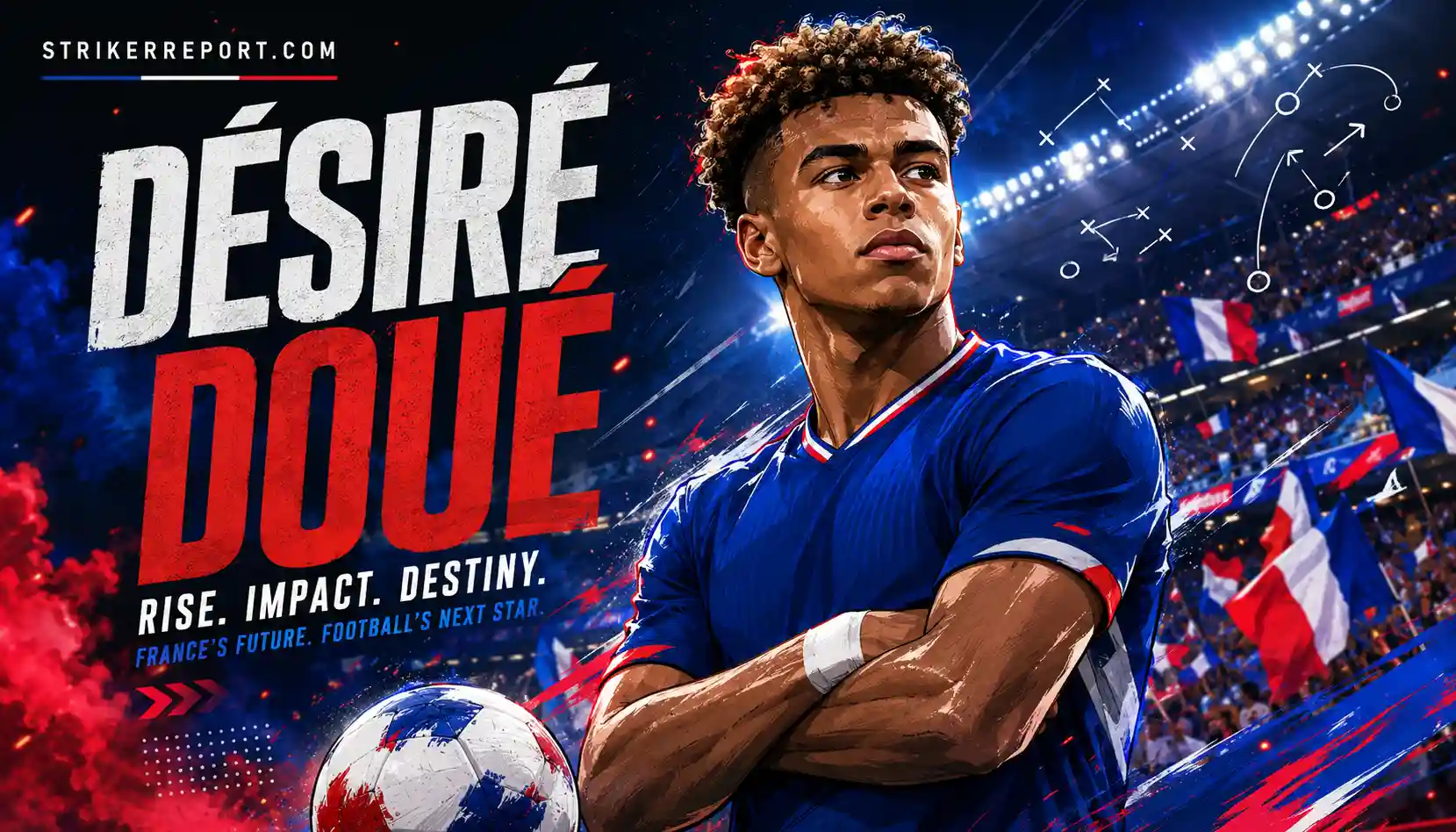
Désiré Doué — FIFA World Cup 2026 Fast Profile
🇫🇷 France | Winger / Attacking Midfielder | Age at WC 2026: 21
⚽ Current Club: Paris Saint-Germain | Jersey: #14
- 2024–25: Champions League winner & Final MVP — PSG 5–0 Inter Milan
- 2025 Golden Boy winner (Tuttosport) — successor to Lamine Yamal
- 2025–26: 6 goals + 3 assists in Ligue 1 (21 apps, injury-disrupted)
- Market Value: €90.6 million
- Age at World Cup 2026: 21 years old
Quick Facts: Désiré Doué at FIFA World Cup 2026
| Full Name | Désiré Nonka-Maho Doué |
| Date of Birth | June 3, 2005 |
| Age at World Cup 2026 | 21 years old |
| Nationality | French 🇫🇷 |
| Height | 1.81 m (5′ 11″) |
| Preferred Foot | Right |
| Current Club | Paris Saint-Germain (France) |
| Jersey Number | #14 (PSG) |
| Position | Winger / Attacking Midfielder / Second Striker |
| Transfer Fee (to PSG) | €50 million (Rennes, August 2024) |
| Market Value | €90.6 million |
| Contract Until | June 30, 2029 |
| @desiredoue | |
| Estimated Net Worth | ~€8–12 million (rapidly growing) |
The Story: Why Désiré Doué FIFA World Cup 2026 Is the Most Exciting Debut on the Planet
The date was June 2025. The Allianz Arena in Munich, repurposed as the stage for the UEFA Champions League final. Paris Saint-Germain versus Inter Milan. The scoreline — 5–0 to PSG, a demolition of one of Europe’s most defensively organised clubs — was extraordinary enough. But what made the football world genuinely stop and stare was the identity of the player voted man of the match. The Champions League Final MVP. The player who had scored and driven and created his way through one of the most complete European final performances in a generation.
He was 19 years old.
Désiré Doué — full name Désiré Nonka-Maho Doué — born in Angers on June 3, 2005, raised in the Rennes academy from age six, sold to PSG for €50 million the previous summer — had just won the Champions League and been named its best player. In the same calendar year, he won the Golden Boy. The UEFA Champions League Young Player of the Season. Ligue 1 Young Player of the Year. The European Super Cup. The French Cup. Ligue 1.
The Désiré Doué FIFA World Cup 2026 story is the story of modern football’s newest phenomenon — a 21-year-old who has already collected more silverware than most players manage in a full decade, who plays with a directness and technical fluency that is entirely his own, and who now steps onto the world’s biggest stage for the first time as part of a France squad that includes Kylian Mbappé, Ousmane Dembélé, and N’Golo Kanté.
In that company, it would be easy to overlook him. France’s squad is built around Mbappé’s genius and Dembélé’s brilliance. Doué, arriving as the squad’s youngest non-goalkeeper and the freshest debutant in the French setup, would understand the logic of patience.
But patience has never defined Désiré Doué. He does not wait for opportunities. He manufactures them. And at 21, with a Champions League winner’s medal already in his cabinet and a Golden Boy trophy on his shelf, the 2026 FIFA World Cup represents not a distant horizon for a promising youngster — but the next logical stop on a career that is moving at a speed football has rarely seen.
Biography: From the Streets of Angers to the Lights of the Parc des Princes
Désiré Nonka-Maho Doué was born on June 3, 2005, in Angers — a city in the Loire Valley in western France, known for its medieval château and its wine, and not historically celebrated as a factory for elite footballers. His family background carries West African heritage that gives his full name its particular beauty and cultural weight. He grew up in modest circumstances in a family where football was encouraged and ability was quickly recognised.
At just six years old, in 2011, he was taken into Stade Rennais’s youth academy — one of the most productive talent development systems in French football, responsible for producing players including Eduardo Camavinga and Ousmane Dembélé. For a child from Angers, the move to Rennes was a significant commitment — an early signal that the club believed in something they saw in the boy before most observers had a chance to form an opinion.
He stayed at Rennes for a decade. Ten years of development through every youth level, absorbing the tactical sophistication of the French academy system, refining his technical skills in an environment designed to produce players of European quality. His brother, Guela Doué, also joined Rennes’s academy — a footballing family, developing side by side through the same institution.
By the time Désiré was 17, Rennes’s first-team staff had seen enough. On August 7, 2022, he made his professional debut as a substitute in a Ligue 1 defeat to Lorient. He was 17 years and 65 days old. Within three weeks he had scored his first professional goal — in a 3–1 win over Brest — becoming the first player born in 2005 to score in any of the major five European leagues. The record was notable. The manner of the goal — direct, composed, technically precise — was more notable still.
Over two seasons at Rennes, he scored 7 goals and provided 5 assists in 57 appearances — modest numbers for a player of his profile, but Rennes’s system placed him in wide and rotational roles rather than as a central creative force. The talent scouts of Europe’s elite clubs had already identified that the numbers understated what they were watching. In August 2024, Paris Saint-Germain paid €50 million to find out how good he could truly be.
Club Career Highlights: How PSG Unlocked the Most Exciting Young Player in France
Désiré Doué’s arrival at PSG in August 2024 was, on paper, a significant gamble. €50 million for a 19-year-old from Rennes — a player with promise and good statistics at Ligue 1 level but without European experience, without a major trophy, and arriving at a club that had just lost Kylian Mbappé to Real Madrid and was in the process of transforming its identity from a collection of galactic individuals into a team with a collective spirit and a clear tactical identity.
Under Luis Enrique, PSG’s 2024–25 season started with Doué on the periphery. The manager’s system had established starters in wide positions — Ousmane Dembélé on the right, Bradley Barcola on the left — and Doué had to be patient, earning his moments from the bench, making an impact when the spaces were already opening, and waiting for the first-team trust that his performances in training clearly suggested he deserved.
The moment that changed everything came against RB Salzburg in the Champions League. Coming off the bench, he scored his first European goal in a 3–0 win. It was not just the goal — it was the manner: composed, direct, technically excellent under pressure, in a high-stakes European match he had not expected to play significant minutes in. Luis Enrique had seen what he needed to see.
From that point, Doué’s role expanded steadily through the campaign. By the Champions League knockout rounds, he was a regular in PSG’s starting plans. The semi-final against Arsenal — a match of enormous tension and tactical chess — produced one of his best performances of the season. Then came the final.
PSG 5–0 Inter Milan. A statement so emphatic it reshaped conversations about the Champions League’s current hierarchy. Doué scored, created, pressed with discipline, and delivered a performance of such complete quality that the UEFA judges had no doubt about their MVP choice. He was 19 years old. He had just been named the best player in the biggest club match on earth.
The trophies that followed that summer — the Club World Cup runner-up medal, the Golden Boy, the UEFA Champions League Young Player of the Season — confirmed what the Champions League final had announced: football had found its next generational talent, and his name was Désiré Doué.
The 2025–26 season has been more difficult — hamstring and back injuries disrupted his campaign significantly, limiting him to 21 Ligue 1 appearances with 6 goals and 3 assists by late May. But PSG retained their Ligue 1 title. And Doué, injury management behind him, arrives at the World Cup confirmed fit and selected in the French squad as the competition’s most intriguing debutant.
International Career: From Youth Prodigy to France’s World Cup Wild Card
Désiré Doué progressed through France’s youth international system with the same pace that characterised his club career — U17, U19, U21, and then a notable appearance with the France Olympic team at the 2024 Paris Games, where he won a silver medal as part of a squad that captivated the host nation before losing to Spain in the final.
His senior France debut came in 2025 — though injury disrupted what should have been a more extended introduction to the senior setup. A Grade 3 thigh injury in late 2025 ruled him out of September’s international fixtures and delayed his accumulation of senior caps at a crucial moment in France’s World Cup preparation cycle.
Despite the limited senior cap count — fewer than ten appearances for the full national team heading into the World Cup — manager Didier Deschamps named Doué in France’s 26-man squad for 2026. The decision was based not on accumulated international experience but on raw quality, Champions League credentials, and the understanding that at his best, Doué offers France an attacking threat from wide positions that is different in character from Mbappé’s central genius and Dembélé’s right-wing directness.
He is listed as one of France’s five World Cup debutants in the 2026 squad. Alongside Mbappé and Dembélé, he forms part of a front line depth that makes France’s attacking resources arguably the deepest at the tournament. He arrives at 21, with a Champions League winner’s medal, a Golden Boy trophy, and a senior career that has barely begun — and a World Cup debut that could define the next decade of French football.
Career Timeline: The Milestones That Built Désiré Doué
📅 2011 — Rennes Academy at Age Six
Joined Stade Rennais’s youth academy in 2011 at the age of six — one of the earliest possible entry points into professional football development. Spent a decade at the club, progressing through every age group in a system that had already produced Camavinga and Dembélé and understood exactly what elite young talent needed to become world-class.
📅 August 2022 — Professional Debut and First Goal: First Player Born in 2005 to Score in the Big Five
Made his professional debut for Rennes on August 7, 2022, at 17 years old. Scored his first professional goal three weeks later against Brest — becoming the first player born in 2005 to score in any of the major five European leagues. The record was the first of many that would define his early career.
📅 2024 Paris Olympics — Silver Medal with France U23
Part of the France Olympic team that captivated the host nation at the 2024 Paris Games. Reached the final before losing to Spain — the same Spain team built around Lamine Yamal and Nico Williams that was winning Euro 2024 simultaneously. The Olympic tournament gave Doué his first experience of major international competition and accelerated the timeline for his senior France recognition.
📅 August 2024 — €50 Million Move to PSG
Joined Paris Saint-Germain for €50 million — a significant fee for a 19-year-old from Rennes, but one that the club’s scouting data and Luis Enrique’s assessment justified without hesitation. The move represented PSG’s investment in the post-Mbappé era: building a squad of young, high-quality French talent capable of sustaining Champions League competition.
📅 June 2025 — Champions League Winner & Final MVP at 19
Named man of the match — Champions League Final MVP — as PSG defeated Inter Milan 5–0 in Munich. Scored and created in a performance of such complete quality that European football ran out of adjectives. At 19 years old, he had won the most prestigious club trophy in the world and been named its best player. The announcement that something truly exceptional had arrived in world football.
📅 November 2025 — Golden Boy Winner: Lamine Yamal’s Successor
Named the 2025 Golden Boy by Tuttosport — the award given to the best player under 21 in European football, succeeding Lamine Yamal as winner. Finished ahead of Arda Güler, Pau Cubarsí, and teammate Warren Zaïre-Emery. The award confirmed Doué as the consensus choice for the best young player in world football across 2025.
📅 May 2026 — Named in France’s 26-Man World Cup Squad
Confirmed in Didier Deschamps’s 26-man squad for the 2026 FIFA World Cup — one of five French debutants at the tournament. Listed as the squad’s youngest non-goalkeeper at 21. France are ranked first in the world. Doué arrives as the wild card in a squad of established stars — the player whose unpredictability could be France’s decisive weapon in knockout football.
2025–26 Season Stats
* Season disrupted by hamstring (Oct–Dec 2025) and back injury (Mar 2026). Stats reflect available appearances only.
Club Stats — Paris Saint-Germain (2025–26)
| Competition | Apps | Goals | Assists | G+A |
|---|---|---|---|---|
| Ligue 1 | 21 | 6 | 3 | 9 |
| Champions League | ~8 | 4 | 2 | 6 |
| Coupe de France | ~3 | ~2 | — | ~2 |
| All Competitions 2025–26 | ~35 | ~13 | ~6 | ~19 |
| Previous Season 2024–25 (debut PSG year) | ~40 | 9 | 11 | 20 |
International Stats — France (Senior Career)
| Competition | Caps | Goals | Assists |
|---|---|---|---|
| Senior France (all) | ~8 | ~2 | ~1 |
| Paris 2024 Olympics (U23) | ~5 | ~2 | ~2 |
| FIFA World Cup 2026 | First appearance | — | — |
Playing Style Breakdown: What Makes Désiré Doué So Dangerous at FIFA World Cup 2026
1. Attacking Qualities
Doué is primarily a left-sided attacking player who inverts onto his stronger right foot — a profile that creates the same defensive dilemmas as Lamine Yamal on the opposite flank. He can play as a wide forward, an attacking midfielder behind the striker, or in a fluid position that rotates based on where the space appears. His most dangerous quality is the directness with which he carries the ball at defenders — he does not hesitate, does not over-elaborate, and does not lose the ball under pressure at a rate that his age profile would suggest. His Champions League Final performance against Inter Milan’s elite defensive organisation was the definitive proof that this is not a talent that requires protecting from the highest level of football. He thrives in it.
2. Technical Skills
His technical foundation — built across ten years in Rennes’s academy and refined under Luis Enrique’s technically demanding PSG setup — is exceptional for a player of his age. His first touch in tight situations is excellent. His dribbling technique relies more on timing and body feints than pure pace — he changes direction and speed to deceive defenders rather than simply outrunning them. His right foot is notably stronger, which means he naturally looks to cut inside from the left, but his delivery and crossing from wide positions with either foot have improved significantly since his Rennes days. His through-ball play — the ability to find runners in behind — is more developed than most observers outside the Ligue 1 sphere have yet appreciated.
3. Physical Attributes
At 1.81m, Doué is taller than most technical wingers of his type, which gives him a physical dimension in duels and aerial situations that pure technical wide players lack. He is not the quickest player in the France squad — Mbappé and Barcola have more pure pace — but his acceleration over the first five to eight metres is sharp, and his combination of height, balance, and strength makes him difficult to physically dispossess once he has established his body position. The hamstring injury that disrupted his 2025–26 season is the one physical concern entering the tournament.
4. Tactical Intelligence
For a 21-year-old, Doué’s tactical understanding is unusually mature. Under Luis Enrique at PSG — one of the most tactically demanding managers in world football — he learned to press with structure, to position himself in the half-spaces between opposition midfield and defence, and to time his forward runs to arrive in the penalty area at the same moment the ball does. These are qualities that take most forwards three or four full seasons to develop. Doué absorbed them in one. His adaptability — the ability to play multiple positions across the attacking line depending on tactical demands — makes him a uniquely useful squad option for Deschamps at a World Cup where versatility in the knockout rounds can decide everything.
5. Weaknesses / Areas to Watch
His senior international experience is the most obvious limitation. Fewer than ten caps heading into a World Cup means the specific pressures — the crowd intensity, the tactical analysis that opponents produce specifically for the tournament — are genuinely new to him. The hamstring history from 2025–26 requires monitoring across a tournament schedule of potential seven matches. And as a player who tends to drift inside rather than stay wide, he can occasionally leave France’s left flank exposed behind him when possession is lost — a detail that organised defensive systems will have studied carefully.
Skill Ratings: Désiré Doué at World Cup 2026
| Attribute | Rating / 100 | Assessment |
|---|---|---|
| 🎯 Dribbling | 91 | Elegant and direct; timing-based deception over raw pace |
| ⚽ Finishing | 87 | Composed in big moments — see Champions League Final |
| ⚡ Pace | 87 | Sharp acceleration; not the fastest but deceives through movement |
| 👁 Vision | 88 | Sees through-ball options quickly; UCL assist stats confirm range |
| 🎯 Passing | 86 | Through balls and key passes developing into elite range |
| 🏃 Movement | 89 | Between-the-lines runs; arrives in the box at the right moment |
| 💪 Physicality | 82 | Tall for a winger; good balance; hamstring history a concern |
| 🛡 Defensive Work | 75 | Learned pressing under Luis Enrique; still developing defensively |
| 👑 Leadership | 76 | Young but performs without fear; big-game mentality already proven |
Records & Milestones
🏆 Champions League Final MVP at 19 — PSG 5–0 Inter Milan
📊 Named man of the match in the 2024–25 UEFA Champions League final as PSG defeated Inter Milan 5–0. Scored and contributed in a performance of such authority that the UEFA judging panel was unanimous. Became one of the youngest Champions League Final MVPs in the competition’s history.
📅 June 2025
🏆 Golden Boy 2025 — Successor to Lamine Yamal
📊 Won the Tuttosport Golden Boy award in 2025 — the prize awarded to the best player under 21 in European football — succeeding Lamine Yamal as winner. Finished ahead of Arda Güler, Pau Cubarsí, and Warren Zaïre-Emery. The award is given once per player; Doué takes the 2025 title with authority and finality.
📅 November 2025
🏆 First Player Born in 2005 to Score in the Big Five European Leagues
📊 Scored for Rennes against Brest in August 2022 — at 17 years old — becoming the first player born in 2005 to score in the English, Spanish, German, Italian, or French top divisions. The record announced a generation and placed Doué ahead of every peer in the most meaningful possible statistical category: actually doing it in professional football.
📅 August 2022
🏆 UEFA Champions League Young Player of the Season 2024–25
📊 Named UEFA’s best young player in the Champions League for the 2024–25 campaign — scoring 5 goals and providing 5 assists across 16 Champions League appearances in PSG’s continental treble-winning season.
📅 2024–25
🏆 Olympic Silver Medal — Paris 2024
📊 Part of the France U23 Olympic team that reached the final of the 2024 Paris Games — losing to Spain — in front of the home crowd at the Parc des Princes. The tournament gave Doué his first experience of major international competition at senior level and accelerated his promotion to the full France squad.
📅 August 2024
🏆 PSG Continental Treble 2024–25 — Champions League, Ligue 1, French Cup
📊 Part of the PSG squad that won Ligue 1, the Coupe de France, and the UEFA Champions League in the same season — the first time PSG had won Europe’s premier club competition in the club’s history. Doué’s contribution across all three competitions was integral to the achievement.
📅 2024–25
Désiré Doué FIFA World Cup 2026 Preview: France’s Wild Card in a Squad of Stars
France arrive at the 2026 FIFA World Cup ranked first in the world by FIFA’s official rankings — a designation that places the weight of expectation squarely on a squad that already knows how to carry it. They were runners-up in 2022, losing in a final of almost supernatural drama against Argentina. They have the world’s most prolific active international goalscorer in Mbappé. They have the Ballon d’Or winner in Dembélé. They have N’Golo Kanté providing midfield steel at 35. And in Désiré Doué, they have the wildcard — the 21-year-old who cannot be planned for because his trajectory defies conventional expectation.
Didier Deschamps’s France will operate primarily in a 4-3-3 or 4-2-3-1 shape built around Mbappé’s central position, with Dembélé on the right providing the established wide threat. Doué’s role is more fluid — he can play left wing, behind the striker, or in a wide-left position that exploits his natural inverted movement. His most likely scenario is as an impact player in the early stages of the tournament, coming off the bench when France need to unlock compact defensive structures in the knockout rounds.
But this is Désiré Doué — the player who scored the Champions League Final MVP goal at 19, who produces his best football when the stage is biggest. Deschamps is not a manager who starts inexperienced players in World Cup openers without strong justification. But if Doué’s performances in training replicate what PSG’s coaching staff saw throughout 2024–25, that justification may arrive earlier in the tournament than the conventional wisdom about debutants would suggest.
France’s group stage — against Australia, Morocco, and Denmark — is manageable. The knockout rounds, where France’s squad depth and individual brilliance have historically proved decisive, are where Doué’s role could expand dramatically. A Mbappé injury, a tactical adjustment, a knockout tie where France need unpredictability rather than experience — any of these scenarios places Doué in the starting XI. And when he starts, as PSG’s 2024–25 season demonstrated conclusively, things happen.
StrikerReport Prediction: France reach the final. Whether they win it is the question that will occupy football between now and the final whistle in MetLife Stadium on July 19. Doué will not be France’s leading scorer. He will not be their captain or their most capped player. But in a knockout tournament decided by moments of individual brilliance, he is the player most likely to produce a moment that nobody saw coming — because that is what he has done at every stage of a career that nobody saw coming.
Head-to-Head: Désiré Doué vs Bradley Barcola — France’s Next Generation Debate
Within France’s own squad, the most interesting comparison involves two players of the same generation, the same club, and the same position. Désiré Doué and Bradley Barcola — both PSG, both French, both 21 — are competing for the same wide attacking role in Deschamps’s system. One starts. One impacts from the bench. Which one should it be?
| Category | Désiré Doué 🇫🇷 | Bradley Barcola 🇫🇷 |
|---|---|---|
| Age at WC 2026 | 21 | 22 |
| 2024–25 Club Goals (all comps) | 9 | ~18 |
| UCL Final MVP | ✅ | ❌ |
| Golden Boy Award | ✅ 2025 | ❌ |
| Market Value | €90.6m | ~€80m |
| Pace Rating | 87 | 94 |
| Finishing Rating | 87 | 86 |
| Tournament Threat Rating | ★★★★ | ★★★★ |
The case for Doué: Champions League Final MVP. Golden Boy. UCL Young Player of the Season. The individual award collection makes the argument almost automatically. When it matters most — in the biggest matches, against the best opponents — Doué has consistently produced. His technical creativity and movement between lines offers France a dimension that pure wide forwards like Barcola, however gifted, do not replicate.
The case for Barcola: Barcola was PSG’s most consistently productive wide player in 2024–25 on a game-by-game basis — more goals, more regular appearances, fewer injury disruptions. His pace is genuinely elite — among the fastest wide players in European football — and in a France system that frequently needs quick attacking transitions, that raw speed is a tactically decisive asset. He has more senior France caps and more consistent form across a full season.
Final Verdict: Barcola edges the consistency argument. Doué wins the big-game argument. Deschamps will likely start Barcola in the group stage and use Doué as the weapon he keeps in reserve for knockout football. It is, for France’s opponents, a deeply uncomfortable set of options to plan against.
Fun Facts & Personal Life: The Quiet Genius of Angers
- The family football club: Désiré’s brother Guela Doué also came through Rennes’s academy — a footballing family developing through the same institution simultaneously. Guela has also progressed into professional football, making the Doué family one of France’s most notable sibling football stories since the Dembélé generation came through the system.
- No words after the final: When Désiré Doué was handed the Champions League Final MVP award after PSG’s 5–0 demolition of Inter Milan, he told reporters: “I have no words, incredible for me. I have no words.” The repetition — the genuinely stunned 19-year-old unable to process what had just happened — was one of the most endearing post-match moments of the 2024–25 European season. He had just won the Champions League. He had just been named its best player. He was still a teenager.
- The name itself: His full name — Désiré Nonka-Maho Doué — carries the weight of his West African heritage in its middle names, a cultural identity that he maintains with pride. In French, “Désiré” means “desired” or “wished for.” It is, as football’s poets have noted, a name that football itself might have chosen.
- Social media mystery: Unlike most young footballers of his generation, Doué maintains minimal public social media presence relative to his profile. He has not commented publicly on personal relationships and keeps his private life firmly separate from his public footballing identity. In an era of constant digital exposure, the restraint is unusual — and has, if anything, increased the mystique surrounding a player whose football already makes enough noise without additional amplification.
- The Laureus nomination: In January 2026, Doué was nominated for the Laureus World Sports Award for Breakthrough of the Year — an award that spans all sports globally, not just football. Being considered alongside athletes from tennis, athletics, swimming, and cycling for the world’s most notable sporting breakthrough confirmed that the scale of his 2024–25 season had registered far beyond football’s normal audience.
StrikerReport Verdict: Désiré Doué at FIFA World Cup 2026
8.8 / 10
StrikerReport World Cup 2026 Rating
Désiré Doué arrives at the 2026 FIFA World Cup as the tournament’s most fascinating debutant. Not because he is unproven — he has a Champions League winner’s medal and a Final MVP trophy that proves otherwise. But because the specific pressures of a World Cup — the squad competition for France’s wide positions, the limited senior cap experience, the injury history from a disrupted 2025–26 season — mean this tournament carries genuine uncertainty alongside extraordinary promise.
When Doué is fit, available, and trusted with minutes in big matches, the evidence is overwhelming: he produces. He produced in the Champions League knockout rounds. He produced in the final. He produced from the bench against opponents who had prepared for the team they were facing. He is 21 years old, named the best young player in European football, and playing his first World Cup in a France squad ranked first in the world.
The boy from Angers desired to be desired. The football world already desires him completely. Now the World Cup stage waits — and Désiré Doué has never been intimidated by any stage that has been placed in front of him.
Also read : Lamine Yamal FIFA World Cup 2026: Profile, Stats & Career | StrikerReport
Neymar FIFA World Cup 2026: Profile, Stats & Career | StrikerReport
About the Author