India FIFA World Cup: Why Does the World’s Most Populous Nation — 1.4 Billion People — Never Play in Football’s Greatest Tournament?
By StrikerReport Editorial Team | June 7, 2026
India FIFA World Cup: The Most Baffling Absence in Global Sport
When the FIFA World Cup 2026 kicks off on June 11 in Mexico City, 48 nations from across the globe will take the field. The USA is there. Canada is there. Panama is there — a nation of just 4.3 million people qualifying ahead of the tournament. Morocco is there. Cape Verde — population 560,000 — is there. But India, with a population of approximately 1.4 billion people — nearly one in five human beings on the planet — is watching from home. Again.
The absence of India at the FIFA World Cup is one of the great statistical paradoxes of global sport. By sheer population, India should theoretically produce the world’s most fertile football talent pool. By cricket standards, it has already demonstrated the ability to dominate a global sport commercially and competitively. By the logic of simple probability — more people, more chance of developing elite footballers — the Blue Tigers should have appeared at multiple World Cups by now.
ISL Players at World Cup 2026: Indian Football’s Growing Global Footprint
Premier League vs MLS vs Saudi Pro League vs ISL 2026: Full Comparison of Fans, Tickets & Streaming
And yet they have not appeared at a single one. Not in 1954. Not in 1974. Not in 1994, when the USA hosted the tournament and the global audience peaked. Not in 2022. And not in 2026, despite this being the first World Cup with 48 teams — a format specifically designed to give more nations, including Asian nations, a genuine pathway to qualification.
To understand why, you have to go back to 1950. And to a myth about bare feet.
The 1950 World Cup: India’s Only World Cup Moment — and They Never Showed Up
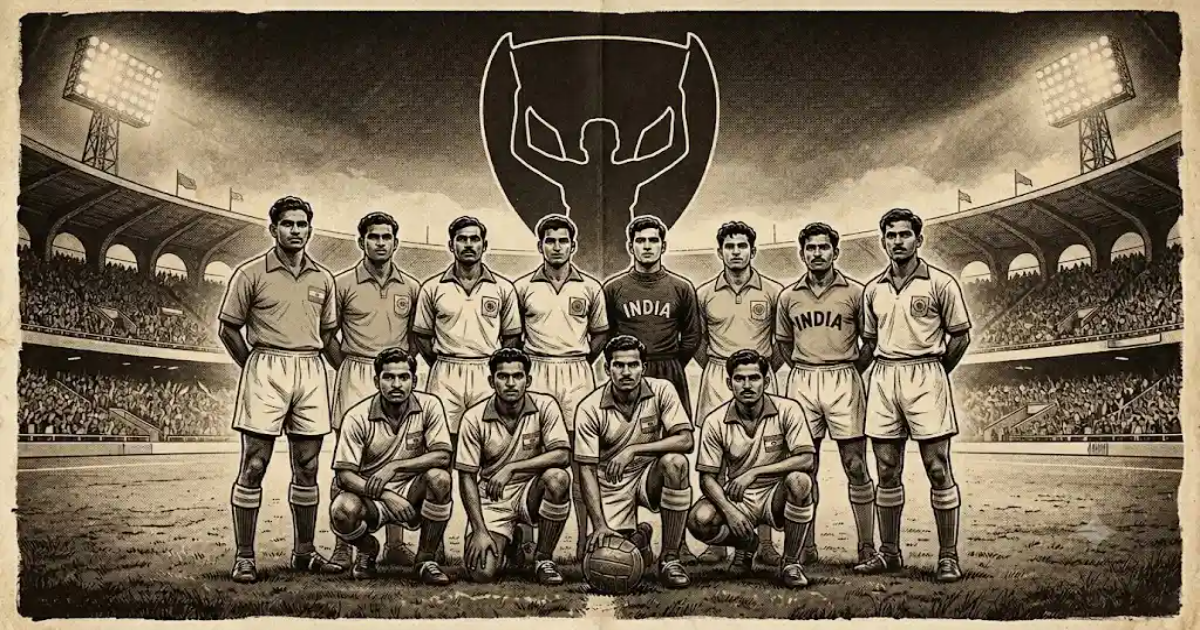
History’s great irony about India and the FIFA World Cup is that technically, India has already qualified for one. In 1950, ahead of the tournament in Brazil, India were drawn into the qualification process alongside several Asian teams. One by one, those teams withdrew. South Korea withdrew. Burma withdrew. The Philippines withdrew. India, left standing alone in their qualification group, advanced by default — without playing a single match — and were drawn into Group 3 of the 1950 FIFA World Cup alongside Sweden, Paraguay, and defending champions Italy. Their name appeared in the FIFA World Cup draw held at Rio de Janeiro on May 22, 1950.
They never arrived. The All India Football Federation withdrew the team before the tournament began. The official reasons cited by AIFF were a combination of financial constraints — the cost of travelling to Brazil in 1950 was significant — lack of preparation time, and a preference for focusing on the Olympics, where India’s football team had established more competitive credentials, including an appearance at the 1948 London Games.
Over the decades, a more romantic myth has circulated widely: that India withdrew because FIFA refused to allow their players to play barefoot. The story has been repeated so frequently that many football historians have had to specifically address it. History will always remember that India qualified for the FIFA World Cup in 1950 and chose to walk away, but the barefoot reason was not the primary factor. Official records and the research of football historians confirm that financial and logistical challenges — including travel costs and mandatory use of football boots — were the documented reasons cited by AIFF. The barefoot explanation, however poetic, is largely myth.
What is not myth is the consequence: India missed the one genuine opportunity that fell to them, and they have never been close to qualifying through on-field merit since.
Seven Decades of Qualification Attempts — and Why They Always Fail
Between 1951 and 1985, India did not even enter FIFA World Cup qualifying campaigns, focusing instead on Olympic football and the Asian Games — competitions where they achieved genuine success, including gold medals at the 1951 and 1962 Asian Games. From 1951 to 1985, India did not enter any FIFA World Cup qualification campaigns, as the AIFF focused its efforts on Olympic football and the Asian Games. It was a strategic decision that sacrificed a generation of World Cup qualifying experience at the altar of regional competition success.
From 1986 onward, India began entering AFC World Cup qualifying campaigns consistently. India has attempted qualification 11 times overall, entering the Asian Football Confederation (AFC) process from 1986 onward, but has never advanced to the World Cup finals. The pattern has been depressingly consistent: early elimination in the first or second round of AFC qualifying, followed by a combination of managerial change, administrative upheaval, and renewed promises of structural reform that rarely materialise in time for the next cycle.
The 2026 qualifying campaign was supposed to be different. Since the FIFA World Cup 2026 was going to comprise 48 teams compared to the previous edition, which had 32 teams, there were many expectations that the team from India would get through to the FIFA World Cup. Asia’s allocated slots increased from 4.5 to 8.5 — a dramatic expansion that, on paper, should have opened doors for a nation of India’s size and footballing potential.
Instead, India finished third in their group, officially out of the FIFA World Cup 2026 race. Only the top two teams from the group advanced to the next stage of the AFC qualifiers. India was drawn into Group A alongside Qatar, Kuwait, and Afghanistan. With Qatar as overwhelming favourites, the realistic battle was for second place — and India lost it. India had a hard time during the second round of the AFC qualifiers and failed to win sufficient games to progress further. The Indian team had to compete with more experienced teams of higher-ranking Asian countries, which have better football systems.
The Five Real Reasons India Has Never Played in a FIFA World Cup
1. Cricket’s Cultural Dominance
India is, by global commercial metrics, the most cricket-obsessed nation on earth. The Board of Control for Cricket in India generates revenues that dwarf the AIFF’s entire budget. Sponsorship, media rights, grassroots investment, coaching infrastructure — virtually every sporting rupee in India flows toward cricket. Football has grown significantly in popularity over the last decade, particularly in Goa, Kerala, West Bengal, and the northeastern states. But the structural and financial resources that elite football development requires have consistently been diverted toward a sport that India already dominates globally.
2. Administrative Failure at the AIFF
The All India Football Federation has been plagued by administrative issues that FIFA itself was forced to address directly. In August 2022, FIFA suspended India’s membership — the AIFF became only the third football governing body in the world to be suspended in the organisation’s history — due to third-party interference in its administration. The suspension was lifted in November 2022 after a new AIFF committee was elected, but the reputational damage and the disruption to club and national team planning during that period was significant. A governing body that spends its energy on internal political battles cannot simultaneously build a coherent national team development programme.
3. Insufficient Club Infrastructure
The Indian Super League, launched in 2014, has grown into a genuinely popular domestic competition with significant commercial backing. But ISL clubs do not yet consistently produce players capable of performing at AFC Champions League level — the competitive benchmark that separates nations capable of World Cup qualification from those that fall short in the qualifying rounds. The development pathway from grassroots football to ISL to national team selection remains fragmented, and the gap between the best ISL players and the best players from Japan, South Korea, and Australia — India’s direct AFC competitors — remains considerable.
4. FIFA Ranking Trapped in a Vicious Cycle
India’s FIFA ranking — approximately 127th at time of writing — creates a self-reinforcing problem. A low ranking means India is drawn against stronger opponents in qualifying and faces tougher schedules in the AFC’s round-robin format. Poor results against stronger opponents keep the ranking low. A low ranking perpetuates tough draws. Breaking this cycle requires sustained results against quality opposition — which is precisely what the qualifying format does not provide for a nation at India’s current level.
5. Youth Development Infrastructure Still Building
India hosted the 2017 FIFA U17 World Cup — a tournament that generated genuine excitement and produced the country’s first FIFA goal-scorer (Jeakson Singh Thaunaojam) — and several of those youth tournament players are now progressing through the senior system. But the pipeline from youth identification to elite senior performance takes a decade to bear fruit at scale. The investments of 2017 are only now beginning to materialise in the form of a slightly deeper senior squad — not yet deep enough to qualify for a World Cup, but deeper than the generation that preceded it.
Sunil Chhetri: The Man Who Carried Indian Football Alone
Any honest article about India and the FIFA World Cup must acknowledge the extraordinary career of Sunil Chhetri — a player who, by international goalscoring standards, belongs in the same conversation as some of the world’s finest. With over 94 international goals and 151 caps for India before his retirement, Chhetri was the second-highest active international goalscorer in the world at the time he retired, trailing only Cristiano Ronaldo. He scored goals that defeated Pakistan. He scored goals that won the SAFF Championship multiple times. He became the human embodiment of Indian football’s potential.
But no individual player, however gifted, can qualify a nation for the World Cup alone. Chhetri’s legacy is the inspiration he provides to a generation of younger Indian players — the proof that an Indian footballer can compete at a level that commands genuine international respect. Sunil Chhetri, India’s legendary captain, now retired, is one of the most famous figures in Indian football history, and is also an inspiration for younger generations. Whether the generation he inspired can eventually deliver what he himself could not — a World Cup appearance — is the question Indian football will spend the next decade answering.
Is India Ever Going to Play in a FIFA World Cup?
The most optimistic version of the answer is: yes, eventually. The ISL is producing better players than it was a decade ago. The 2017 U17 World Cup cohort is maturing. FIFA’s structural expansion — 48 teams in 2026 and potentially beyond — gives India more pathways than have ever existed. Asian football’s global prestige has increased significantly, which means more investment in the AFC qualification structure and more competitive matches that develop teams at India’s level.
The most realistic version of the answer is: not soon. Japan qualified for their eighth consecutive World Cup in 2026. South Korea qualified for their eleventh. Australia qualified. Saudi Arabia qualified. Qatar qualified. The gap between India and Asia’s established football nations is not simply about individual talent — it is about decades of accumulated systemic investment in coaching, youth development, club infrastructure, and competitive scheduling that India is still building from the ground up.
India’s lack of participation in the FIFA World Cup is attributable to a combination of historical choices, structural constraints, and cultural influences. The gap between what people want and what they can achieve is still very big. But it is getting smaller. Slowly, imperfectly, but measurably smaller. The 1.5 billion people watching the 2026 World Cup from home are not watching out of indifference. They are watching with the particular hunger of a nation that knows it deserves to be there — and is not there yet.
That yet is carrying an enormous amount of weight. One day, it will not be needed.
StrikerReport Verdict: India and the World Cup
India’s absence from the FIFA World Cup is not a mystery — it is the cumulative result of historical decisions, administrative failures, cultural priorities, and structural gaps that decades of half-hearted reform have not yet resolved. The 1.5 billion people deserve better from their football federation. And they will — eventually — get it. The next generation of Indian footballers, raised on ISL football and inspired by Sunil Chhetri, are building toward something. The World Cup is not a question of if for India. It is a question of when.
Premier League vs MLS vs Saudi Pro League vs ISL 2026: Full Comparison of Fans, Tickets & Streaming
East Bengal ISL 2026 Champions: Red and Gold End 22 Years of Hurt
🔹🔹🔸Follow us on Facebook🔸🔹🔹
About the Author