What Does a Football Manager Actually Do? A Day in the Life of the Job
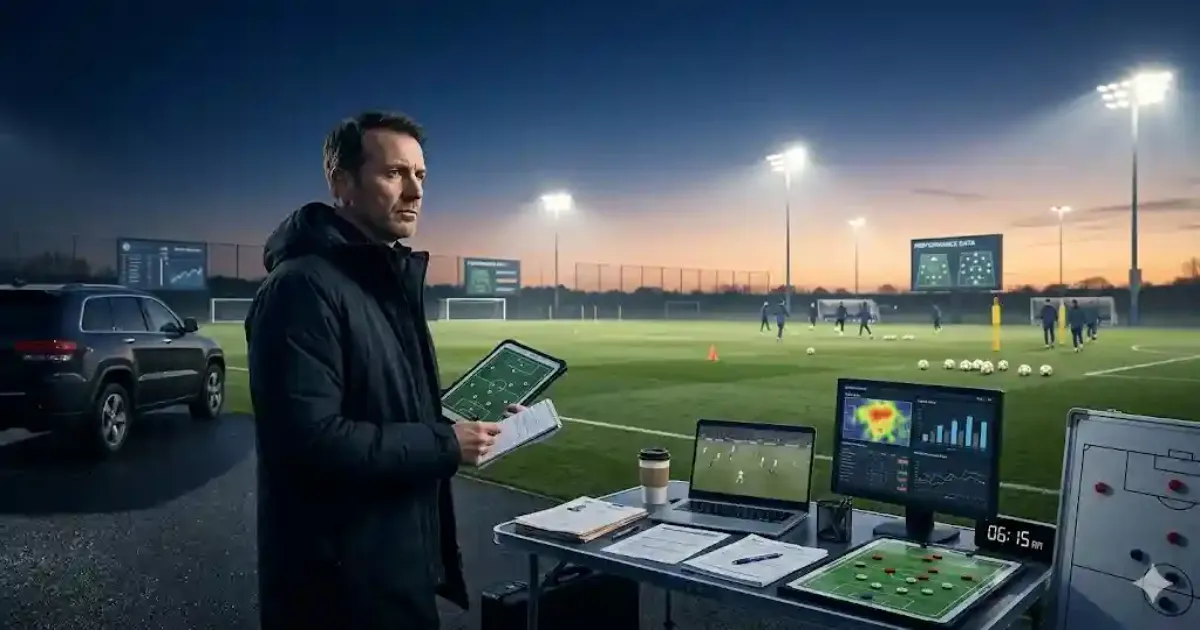
It is 6:15 on a Tuesday morning in February. The training ground lights flick on. The first car pulls into the car park — it belongs to the manager. The players will not arrive for another 90 minutes. The manager has been here before them every single day since the season began.
In the next eight hours, before a ball is kicked in training, the manager will review last night’s scouting footage, meet with the head of sports science about a midfielder’s hamstring data, respond to an enquiry from an agent representing a forward who may become available next month, agree the week’s training plan with the assistant, and mentally rehearse the pre-training team talk he will give in 80 minutes.
This is what a football manager does. It starts earlier than you think, lasts longer than the match, and extends far beyond the 90 minutes that supporters see.Inside Football Academies: How Elite Clubs Build Tomorrow’s Superstars
Thiago Messi: Club Career, Playing Style, Lifestyle and Future Prospects
Cristiano Ronaldo Jr.: Club, Lifestyle, Career and Future Prospects
The Common Misconception
When most people picture a football manager, they picture a figure in a technical area — shouting instructions, making substitutions, pointing at the pitch, and occasionally looking furious at a referee’s decision. The match is visible. The rest of the job is not.
A football manager is responsible for overseeing the sporting and operational aspects of a football team. The role includes designing the squad and managing player recruitment, supervising coaching staff and medical teams, planning budgets, coordinating with youth academies and scouting departments, and representing the club at official events, press conferences, and meetings.
That description covers roughly the same amount of ground as calling a surgeon “someone who cuts people open.” It is accurate and completely insufficient.
What a football manager actually does — day by day, hour by hour, across a 38-game season and potentially a European campaign — is one of the most complex professional jobs in the world of sport. It combines tactical intelligence, people management, public relations, financial oversight, psychological expertise, and media performance, all in an environment where failure is public, immediate, and in many cases career-ending.
Monday: The Morning After
Every manager who has worked in elite football will tell you that Monday mornings after a match are unlike any other working morning. Win on Saturday, and Monday is charged with energy but shadowed by the next opponent. Lose on Saturday, and Monday is the first day of damage limitation — meeting players who need to be simultaneously held accountable and rebuilt.
The first task on Monday is watching the full match back — not the highlights, not the tactical software’s automated heat maps, but the full 90 minutes. Managers watch opponents’ matches in full because scouting software can show you what happened but not why it happened. The context of a decision — the defensive shape in the 67th minute that led to the 71st-minute goal — is visible to a trained eye watching the full footage in a way it is not visible in a data dashboard.
By midday, the manager is in a meeting with the fitness and sports science team. Modern elite football generates an extraordinary volume of player performance data. GPS vests worn in training and matches track distance covered, sprint speed, acceleration and deceleration loads, and heart rate zones for every player in the squad. The manager reviews this data alongside a sports scientist who translates the numbers into training recommendations. A player whose high-intensity running output dropped significantly in the second half may need a reduced training load on Monday. A player showing unusually low sprint speeds across three consecutive matches may be managing an unacknowledged physical complaint.Who Is Gianluigi Buffon? The Journey of Italy’s Legendary Goalkeeper
The manager decides — using this data alongside their own observations and the medical staff’s assessment — who trains fully, who trains modified, and who rests.
Tuesday: The Tactical Week Begins
By Tuesday morning, the tactical preparation for the next match begins in earnest. The opposition have been scouted. Reports from the analysis team are ready. The manager sits with their assistants and the video analyst for a session that at some clubs lasts four to five hours.
What are they looking for? Everything. How the opponent builds from the back. Whether their centre-backs are comfortable with the ball at their feet or prefer to go long. How high their defensive line sits. Whether their press has a specific trigger — a back-pass to the goalkeeper, for example, or the ball to a specific centre-back who is uncomfortable with pressure. Where their wide players defend in transition. Whether their striker drops deep or stays high. How they defend set pieces.
All of this is coded into a session presentation that the manager will deliver to the players. The best tactical presentations in modern football — the ones given before the most important matches — are masterpieces of visual simplification: a 90-minute briefing that communicates a coherent counter-strategy without overwhelming players with too much information.
For a full training session on Tuesday, the manager oversees a combination of physical work — recovery runs, technical drills, small-sided games — alongside the first of the week’s tactical exercises. A 6v6 game is not simply a game: the manager has set up specific triggers, rules, and objectives designed to train the exact movements they want the team to execute on Saturday. The “rondos” that Guardiola’s teams have made famous — circular possession games with a defender in the middle — are not warm-ups. They are training tools that develop the quick decision-making and body orientation that tiki-taka possession football requires.
The manager watches all of this. They intervene occasionally — stopping the game to demonstrate a movement, repositioning a player, calling out a specific player’s name to reinforce a correct action. But they do not intervene constantly. The best managers know that over-coaching — stopping a session every 45 seconds to give instructions — prevents players from developing the game intelligence that coaching is supposed to produce.
Wednesday: People Management
Every manager who has run a squad of 25 professionals will tell you that the most difficult part of the job is not the opponent. It is the players who are not playing.
In elite football, squads contain 22 to 26 players. Starting lineups contain 11. In any given week, between 11 and 15 professionals are aware that they will not start the next match unless something changes. These players — some of them international stars, some of them earning £100,000 a week, many of them at the peak of their physical powers and professionally frustrated — need to be managed daily.
The manager deals with this through a combination of individual conversations, transparent selection communication, and the implicit promise that form, not politics, determines selection. The most experienced managers describe this as the most emotionally draining part of the job. The tactics board is easier than the conversation with a senior player who has not started in six weeks and has a clause in his contract that triggers a release if he fails to play a certain number of matches.
Wednesday is also when agents call. The transfer window may be closed, but the groundwork for the next window — January or summer — is laid in conversations that happen throughout the year. A manager who wants a specific type of midfielder knows which agents to cultivate. An agent with a client who would benefit from moving clubs knows which managers to keep warm.
The manager does not do this alone. A director of football or sporting director handles formal negotiations. But the manager provides the sporting requirement — “I need a left-footed centre-back who can play from the back and cover at left-back” — and maintains awareness of who is available and at what price.
Thursday: The Press Conference
Thursday is typically the manager’s main pre-match media day. A Premier League manager will face the assembled press pack — club correspondents, national journalists, television cameras, radio microphones — in a formal press conference that lasts 20 to 45 minutes.
The press conference is a performance. Not a dishonest one, but a carefully calibrated one. Managers are responsible for handling media relations, giving interviews, and holding press conferences, representing the club’s vision and addressing any controversies while maintaining the club’s public image.ASEAN Championship 2026 Preview: A 30th Anniversary Like No Other
A manager reveals the minimum necessary about their starting lineup while satisfying enough journalistic curiosity to prevent speculation that might unsettle players. They acknowledge the opponent’s quality without giving them a psychological advantage. They respond to questions about injured players, disputes, or transfer rumours with answers that are technically truthful but tactically uninformative.
The best press-conference managers — Guardiola, Klopp, Mourinho, Ferguson — have turned this weekly obligation into a form of competitive advantage. Their public communication shapes how their team is perceived, manages expectations up or down before matches, and sometimes directly influences opponents who hear their post-conference assessments replayed in rival dressing rooms.
After the press conference, the manager meets individually with the players who need particular information before the match. The striker who will face their former club and needs emotional anchoring. The young full-back making their first start against a top-five team who needs either genuine confidence-boosting or a measured reality check. The captain who will be asked about a rumour in their post-match interviews.
Friday: Final Preparation
The day before a match — for most managers — is about sharpening and settling rather than introducing. The tactical plan has been set. The starting lineup has been decided, though perhaps not yet announced to the players. Friday training is typically short, sharp, and emotionally elevated: a walk-through of set pieces, a controlled 9v9 game at high intensity, and a team meeting.
In English football, the manager has overall responsibility for running of a football team, including selecting the team, choosing the tactics, recruiting and transferring players, negotiating player contracts, and speaking to the media. In other football cultures — Spain particularly — the manager is more purely a head coach whose responsibilities end at the training ground boundary. A Spanish entrenador does not negotiate contracts. A director of football handles recruitment. The manager’s authority is genuinely limited to team selection, tactics, and training.
The implications of this distinction are significant. A manager in the English model is closer to a CEO: responsible for everything from the first team budget to the youth development philosophy to the club’s playing identity. A coach in the Spanish model is a specialist whose expertise is the team’s performance on the pitch. Both systems produce champions. Both produce problems when the system breaks down.
Saturday: Matchday
The manager wakes before the team. The pre-match schedule is agreed with the sports science team: meal times, team meeting time, warm-up protocols. The manager delivers the pre-match team talk — a speech that, in the best cases, has been thought through across the entire week and is delivered with conviction because it is built on genuine belief.
During the match: the manager makes between three and five substitutions. They communicate with assistants — one watches the space in front of the defensive line; another tracks the opponent’s wide players; the analyst sends live notes through a headset. The substitutions are not made randomly. They are sequenced responses to patterns in the match’s data and the manager’s observation.
Post-match: a brief address to the players, then the media mixed zone (immediate interview commitments), then the formal press conference. The manager must answer questions about every significant decision they made — substitutions, formations, selections — in front of journalists who have just watched the same 90 minutes with different interpretations.
By the time the manager leaves the stadium, the analysis team is already preparing the clips for Monday morning.
The cycle restarts at 6:15 AM.VAR in Football Explained: How It Works, Why It Divides Fans and What’s New at World Cup 2026
What Makes a Great Football Manager?
The greatest managers share a quality that statistics cannot capture. They know which decision to make at the moment that the decision matters — and they have the courage to make it, publicly, in a context where being wrong is career-defining.
Football managers are responsible for overseeing the team’s training, tactics, and player selection — but they play a crucial role in building team spirit, developing strategies, and making critical decisions during matches. Their role extends beyond match day.
The tactics board is the part of the job that supporters see. The rest — the data meetings at dawn, the agent calls on a Wednesday afternoon, the conversation with an unhappy star player on a Thursday evening, the team talk that a dressing room needs to hear before a must-win match — is invisible. But it is where most of the job actually lives.
Understanding what a manager actually does changes how you watch football. Every substitution, every tactical shift, every moment of apparent genius or apparent failure on the touchline is the output of a week of work that began the morning after the last match ended.
The tactics board is the visible surface. The job is the water beneath it.
About the Author


1 thought on “What Does a Football Manager Actually Do? The Job Behind the Tactics Board — A Full Week in the Life”