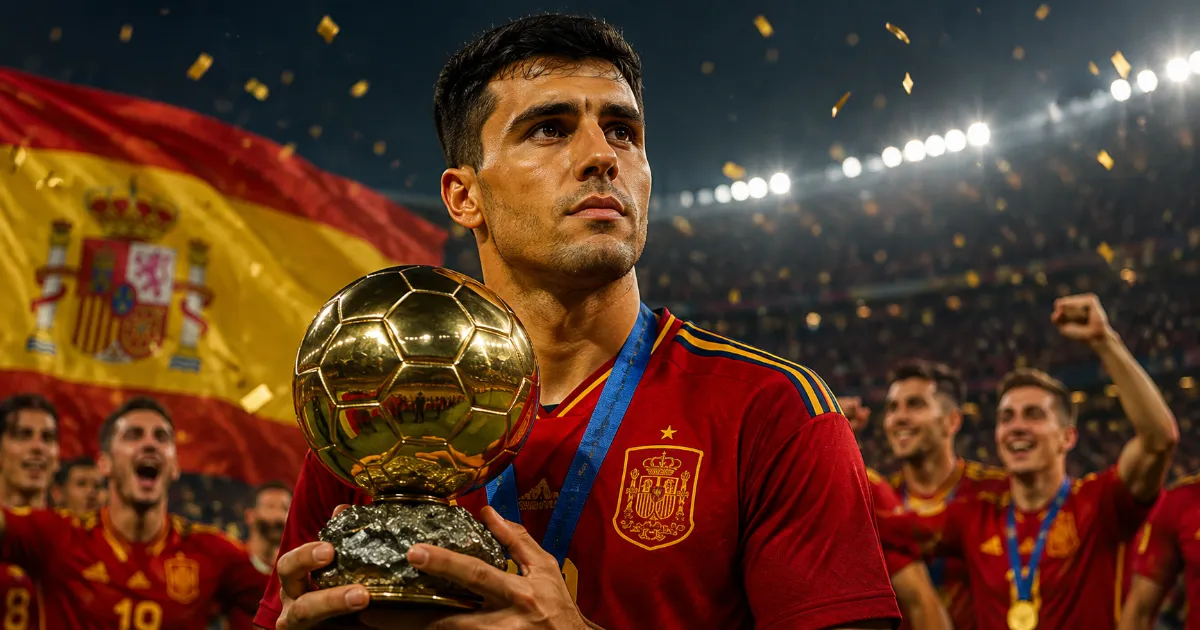
 The Complete Midfield Performance of Golden Ball Winner Rodri
Most Golden Ball winners announce themselves through moments the highlight reels can’t resist: a hat-trick, a wonder strike, a decisive assist in the final itself. Rodri won it differently. Spain’s defensive midfielder collected the Golden Ball winner honor for the 2026 World Cup without scoring a single goal in the final and without ever being the player a broadcast camera instinctively cut to first. That’s precisely why the award matters so much this time. FIFA’s voting panel looked past the obvious highlight-reel candidates and recognized something harder to capture on a stat sheet: the player who made an entire World Cup-winning defense function.
15 Champions League Players to Watch in 2026/27: Superstars & Young Guns
LaLiga 2026/27 Schedule: Fixtures, Dates & Times
Premier League 2026/27 Schedule: This Week and Next Week
We Called It: How Our Spain World Cup Prediction Came True
Luis de la Fuente Masterclass: How He Built World Champions
The Numbers Behind the Award
Rodri’s individual statistics won’t jump off the page the way Kylian Mbappé’s ten Golden Boot goals or Lionel Messi’s eight will. What Rodri’s tournament actually produced was control: Spain conceded a single goal across eight matches, the fewest ever allowed by a World Cup-winning team in the tournament’s history, and Rodri sat at the exact center of that record every time. His positioning at the base of Spain’s midfield dictated where opponents could and couldn’t operate, repeatedly cutting off passing lanes before they became genuine chances long before any of Spain’s back four had to make a covering tackle.
That’s the fundamental challenge in explaining why Rodri deserved this award to anyone who hasn’t watched Spain closely all tournament: his value is almost entirely preventative. He didn’t produce the moments that get replayed. He prevented the moments that would have needed replaying in the first place, and did so with such consistency that by the World Cup final, opposing coaches were building entire game plans around how to get their attackers past him rather than around him.
Complete FIFA World Cup 2026 Awards List: Every Winner
Beating Messi and Mbappé to the Prize
Rodri’s Golden Ball victory came ahead of Lionel Messi, who took the Silver Ball, and Kylian Mbappé, who claimed the Bronze. Both of those players produced statistically flashier tournaments; Messi finished with eight goals and four assists, extending a scoring streak across consecutive World Cup matches that broke records dating back to 1966, while Mbappé’s ten goals made him the tournament’s outright top scorer and pushed his career World Cup tally past Messi’s own for the all-time record. On pure output, either would have been a defensible pick.
What separated Rodri wasn’t output. It was outcome. Messi’s Argentina lost the final. Mbappé’s France didn’t even reach it, eliminated in the semifinal before beating England in an entertaining but ultimately meaningless third-place playoff. Rodri’s Spain won the World Cup, and won it playing through the toughest stretch of the bracket, Portugal, Belgium, France, and Argentina in the knockout rounds, without their defensive foundation ever cracking. FIFA’s voting panel, weighing individual brilliance against the player who most directly explains why his team lifted the trophy, ultimately sided with substance over spectacle.
Spain Won the FIFA World Cup 2026: How La Roja Conquered the World Again
Argentina’s Rebuild After Messi Begins Now
The Argument Against Rodri, and Why It Falls Short
It’s worth engaging honestly with the counter-argument, because there is one. Golden Ball voting has historically leaned toward attacking players, and there’s a reasonable case that an award meant to recognize the tournament’s single best individual performer should default to whoever most directly created goals rather than whoever most directly prevented them. Messi’s redemption arc, chasing a second consecutive title at 39 in what’s assumed to be his final World Cup, carried a genuinely compelling emotional narrative that Rodri’s understated excellence simply couldn’t match in terms of pure storytelling.
But football, at its core, is a sport decided by which team concedes fewer opportunities and converts more of its own, and Rodri’s fingerprints were on both halves of that equation more consistently than any other player left standing by the final. Spain didn’t win by accident or by riding one transcendent attacking talent through moments of chaos the way Argentina so often did across their own knockout run. They won by controlling matches from the first minute to the last, and the player most responsible for that control, more than Unai Simón’s goalkeeping, more than Lamine Yamal’s dribbling, more than Ferran Torres’s eventual final-winning strike, was Rodri.
A Career Built for This Exact Recognition
Rodri’s path to this individual honor tracks closely with his broader career arc. Long regarded within elite coaching circles as one of the most tactically intelligent midfielders of his generation, he’s spent years accumulating exactly the kind of respect from opposing managers and teammates that rarely translates into mainstream recognition, since his game has never been built around the kind of moments that generate viral highlight clips. His club career at Manchester City, where he’s been a foundational piece of one of the most successful teams in modern football history, has followed an identical pattern: enormous value, relatively modest public acclaim, at least compared to teammates who score the goals he sets up the conditions for.
This Golden Ball award represents something close to overdue recognition for that entire body of work, not just an isolated great tournament. Rodri has been performing at this level for years. The World Cup simply gave the entire footballing world its biggest possible stage to finally notice.
What This Means for How We Value Midfield Play
Beyond the individual honor itself, Rodri’s Golden Ball win carries a broader significance for how football discourse tends to evaluate midfield contribution. Defensive and controlling midfielders have historically struggled to win major individual awards precisely because their value resists easy statistical measurement; you can count goals and assists far more easily than you can count the dangerous passes that never got played because a midfielder was standing in the right spot to discourage them. Rodri’s recognition here, arriving on the heels of his 2024 Ballon d’Or win, suggests football’s broader awards culture may finally be catching up to what elite coaches have understood about players like him for years: that controlling a match’s tempo and denying an opponent’s best options is every bit as decisive as scoring the goals that ultimately go in.
The Verdict
Rodri didn’t need a hat-trick or a match-winning strike in the final to justify this award. He needed exactly what he provided across eight matches: positional discipline that turned Spain into the stingiest World Cup-winning defense in the tournament’s history, and a calm, controlling presence that let Yamal, Torres, Oyarzabal, and the rest of Spain’s attacking talent operate with a security net most opposing midfields simply couldn’t punch through. The Golden Ball has gone to flashier players in previous tournaments. This time, it went to the player who explains, more completely than any statistic can capture, why Spain are champions of the world again.
Bangladesh Create History in Darwin, Defeat Australia by Nine Wickets in Landmark Test Victory
PSG v Arsenal: How Paris Won the Champions League Final on Penalties
NBA Schedule 2026-27: Christmas Day Rivalries, Ring Night and the Games to Watch
About the Author

1 thought on “Golden Ball Winner Rodri: The Case for Football’s Quietest Superstar”