What Comes Next for a Golden Generation Without Its Defining Player
 What Comes Next for a Golden Generation Without Its Defining Player
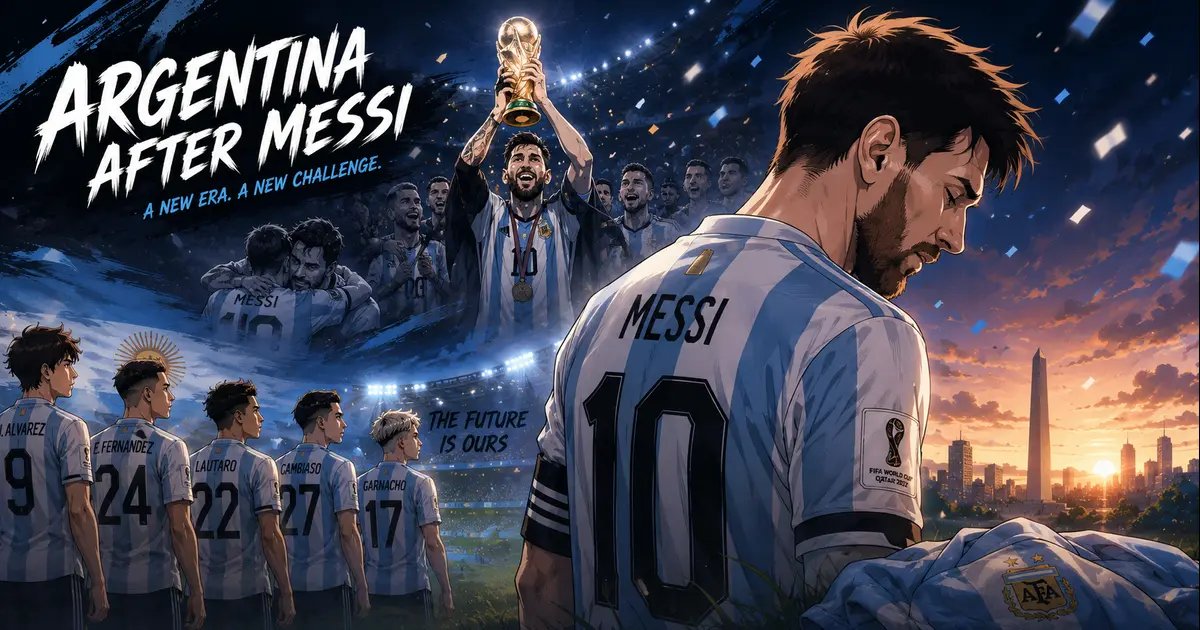
There’s a specific kind of silence that follows the end of a genuinely irreplaceable career, and Argentine football is about to spend the next four years inside it. Lionel Messi’s international future beyond this summer’s World Cup final defeat to Spain is now widely expected to be over, and with it closes not just a playing career but an entire era of Argentine football built, in large part, around a single generational talent. Argentina’s rebuild after Messi starts now, and the scale of the challenge is genuinely significant.Messi’s Last World Cup? The Signs Are Hard to Ignore
The Brutal Honesty of “Irreplaceable”
It’s worth sitting with just how directly this summer’s final reinforced Messi’s importance, rather than rushing past it. Argentina reached the final having needed extra time or late goals in four consecutive knockout matches — a run of drama built substantially on Messi’s continued ability to conjure decisive moments even at 39. In the final itself, held to just one shot and zero touches inside the box by Spain’s suffocating defensive plan, Argentina’s attack simply had no answer once their most reliable source of individual magic was neutralized. That is, in the most literal sense possible, what “irreplaceable” looks like on a football pitch: not a player Argentina can’t function without entirely, but a player whose absence from full effectiveness directly correlated with the team’s inability to create anything in the biggest match of the tournament.
The Age Problem Nobody Can Solve With a Transfer
Strip away the sentiment, and Argentina’s rebuild challenge is fundamentally an age-curve problem, and a fairly stark one. By the time 2030 arrives, Julián Álvarez will be 30. Lautaro Martínez will be 32. Enzo Fernández — who will have plenty of explaining to do about his red card in this year’s final by the time the next cycle begins — will be 33. Nahuel Molina, Cristian Romero and Lisandro Martínez will all be 32. Emiliano Martínez, Argentina’s World Cup-winning goalkeeper from 2022, will be 37. This isn’t a squad with one aging star to replace. It’s a squad where the overwhelming majority of established, proven contributors will be entering the back half of their careers, or past it entirely, by the next tournament.
That’s a fundamentally different rebuild challenge than most nations face after losing a single generational talent. Spain’s title-winning core skews remarkably young heading into 2030. Argentina’s does the opposite — even setting Messi’s specific absence aside, this is a golden generation that, as a collective, is aging out together, all at roughly the same time.
Álvarez and Martínez: The Bridge, Not the Solution
Julián Álvarez has grown increasingly comfortable as a genuine leading man for Argentina rather than a supporting attacker, and Lautaro Martínez remains one of the more clinically effective strikers in world football. Both will likely anchor Argentina’s attack through the early stages of this rebuild, and both are talented enough to keep Argentina competitive on pure individual quality alone. But neither player offers the specific kind of chance-creation-from-nothing that defined Messi’s role in this system for two decades — the ability to drop deep, receive under pressure, and manufacture a genuine scoring opportunity out of situations where no obvious opening existed. Replacing goals is one challenge. Replacing that specific kind of individual creative control is a different, and considerably harder, one.
What Manager Lionel Scaloni Actually Needs to Solve
Scaloni’s task over the next four years isn’t simply finding “the next Messi” — a search that would be a category error even to attempt, given how singular Messi’s combination of vision, composure and longevity has been. It’s a more practical, structural question: how does Argentina generate creative output in the final third without a player capable of unlocking defenses through individual quality alone? That likely means a genuine tactical evolution rather than a like-for-like swap — more emphasis on combination play and rotational movement between Álvarez, Martínez and whichever younger attacking talents emerge over the next cycle, rather than funneling creative responsibility through one central figure the way Argentina has, in various forms, for the better part of twenty years.
The Uncomfortable Question About Squad Depth
Argentina’s odds for the 2030 tournament have already drifted out to around 12/1 in early markets — a notable slide for a team that entered this summer as reigning champions and finished as runners-up. That pricing reflects more than just Messi’s absence; it reflects genuine uncertainty about the depth of Argentina’s next generation. Spain’s pipeline produced Yamal, Cubarsí, Pedri and Gavi in close succession. France’s produces elite talent seemingly every cycle without pause. Argentina’s next wave — the players who’ll need to emerge as genuine difference-makers by 2030 — remain considerably less proven at the senior international level than their counterparts in the nations now favored ahead of them.
The Case for Optimism, Such As It Exists
None of this means Argentina’s rebuild is doomed, and it’s worth resisting the temptation to write off a footballing nation with this much talent and infrastructure simply because one transcendent individual is moving on. Scaloni has already proven, across a World Cup title in 2022 and a runner-up finish in 2026, that he’s one of the more tactically flexible and man-management-savvy coaches in international football. Argentina’s youth setup continues to produce technically excellent players, even if none has yet emerged with anything close to Messi’s ceiling. And history offers at least one useful precedent: nations have successfully navigated the transition away from a defining generational talent before, even if the adjustment period is rarely smooth or immediate.
The Honest Outlook
Argentina’s rebuild after Messi is not a crisis in the way a genuine footballing decline would be — this remains a nation with real infrastructure, a proven coach, and enough individual talent to stay competitive on the world stage. But it is a genuine reset, not a minor adjustment. An aging core departing in clusters rather than waves, no obvious individual heir to Messi’s specific creative role, and a next generation that hasn’t yet proven itself at this level all point toward a transition period that could extend well beyond a single tournament cycle. The 2022 and 2026 finals may end up being remembered as the closing chapters of Argentine football’s most successful era in decades. What comes next is, for the first time in a generation, a genuinely open question.
It’s worth remembering, too, that Argentina has navigated generational transitions before, even if none carried quite the same weight as this one. The years following Diego Maradona’s playing career were genuinely difficult for the national team, and it took the better part of a decade before Argentina rediscovered a clear identity heading into the tournaments that eventually built toward this current golden generation. History doesn’t guarantee a repeat of that pattern, but it does suggest that even the most painful transitions in Argentine football have historically proven temporary, rather than permanent, setbacks.
About the Author