 Messi Is Being Criticized Despite a Legendary Career
Lionel Messi walked off the pitch in New Jersey in tears, having just played what’s widely assumed to be his final World Cup match. By most measures, that should have been the dominant image of the tournament’s closing chapter — a legend’s emotional farewell, regardless of the scoreline. Instead, a single moment in the closing stages of extra time has generated a genuine wave of criticism, complicating the ending in ways few would have predicted before kickoff. Here’s exactly why Messi is being criticized right now, and what it does and doesn’t say about his legacy.
Champions League 2026/27 Schedule: Fixtures, Dates & Times
Premier League 2026/27 Schedule: This Week and Next Week
Messi to Saka: Every Hat-Trick Scored at FIFA World Cup 2026
The Moment That Triggered the Backlash
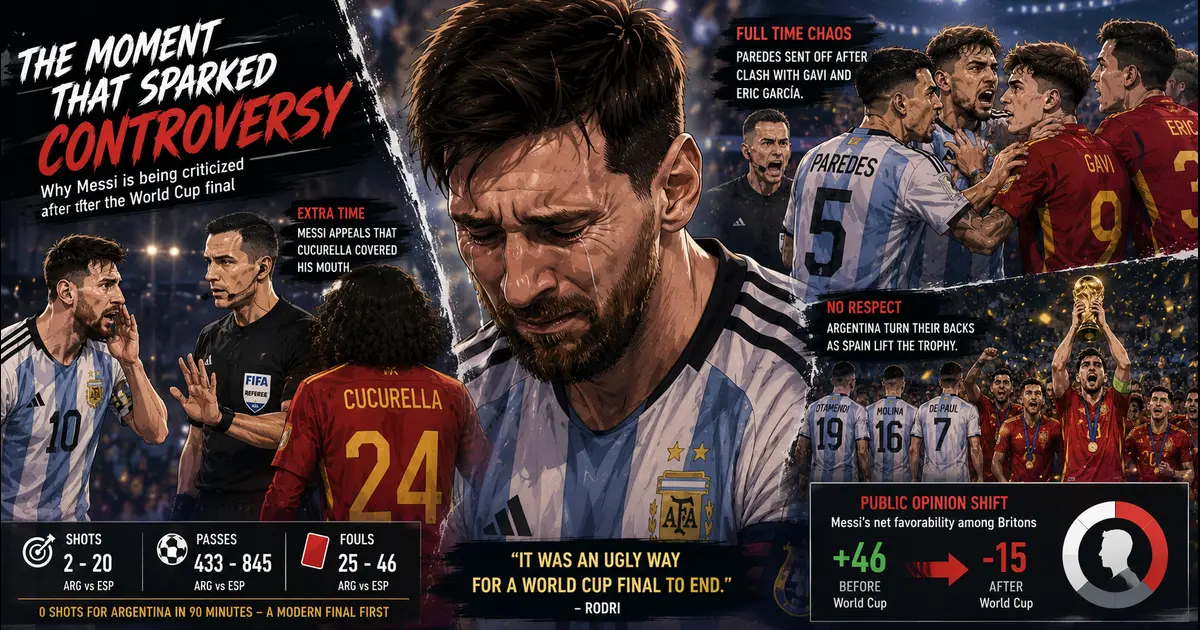
With Argentina already down to ten men following Enzo Fernández’s second-yellow dismissal, and the match still goalless deep into extra time, Messi appealed to referee Slavko Vinčić that Spain’s Marc Cucurella had covered his mouth while speaking to an opponent — a specific offense that, under a newly introduced FIFA rule at this tournament, has resulted in red cards for other players this summer, including Paraguay’s Miguel Almirón. Officials reviewed the appeal and declined to act on it, ruling Cucurella’s gesture non-confrontational. But the appeal itself, captured clearly on broadcast cameras, was enough to ignite immediate criticism.
Social media reaction was swift and largely unflattering. “Lost so much respect for Messi trying his hardest to get Cucurella sent off,” read one widely shared reaction. Another was blunter still, calling the moment “such a rat” act. Former England defender Lee Dixon, working the match for ITV, offered a similarly pointed assessment on air: “The game has gone if you’re getting bookings and red cards for that, to get somebody sent off.” For a player whose reputation has been built almost entirely on sublime skill rather than gamesmanship, the moment landed as a jarring departure from type.
The Numbers Behind the Backlash Are Real
This isn’t just a case of a few loud voices on social media exaggerating a minor moment. According to a YouGov poll cited by the Daily Mail, Messi’s net favorability rating among Britons dropped from +46 before the World Cup to -15 after the tournament concluded — a genuinely dramatic swing for a player whose global popularity has rarely fluctuated significantly across two decades in the public eye. That kind of movement suggests the Cucurella moment wasn’t processed by casual viewers as an isolated one-off, but as data that meaningfully shifted how at least one large national audience perceived him, even if only temporarily.
It Didn’t Happen in Isolation
Messi’s individual moment arrived inside a match that had already turned bad-tempered well before the final whistle. Argentina committed 25 of the contest’s 46 total fouls, and the closing stages produced a genuinely ugly full-time confrontation, with Leandro Paredes sent off after the match for a physical clash with Spain’s Gavi and Eric García. Argentina’s players then declined to properly participate in Spain’s trophy celebration, turning their backs as the newly crowned champions lifted the trophy. None of that conduct belongs to Messi individually, but it created a broader context in which his own moment of gamesmanship was read as part of a pattern rather than a standalone lapse — fair or not, perception in football rarely separates an individual moment cleanly from the collective mood surrounding it.
The Case for Context and Proportion
It’s worth stepping back and asking what, precisely, Messi actually did. He pointed out a genuine on-field incident to a match official and asked for a decision — something players at every level of football do constantly, week in and week out, without generating international headlines. The rule itself, however unusually specific, was a legitimate part of this tournament’s regulations, and Messi wasn’t fabricating an incident; Cucurella’s gesture happened, and Messi simply asked for the same standard applied elsewhere this summer to be applied here too. Officials reviewed it and disagreed. That’s a fairly ordinary sequence of events for professional football, magnified considerably by the stage it happened on and the surrounding tension of a match Argentina were losing, a man down, in the biggest game either team could play.
There’s also a broader question of proportion worth asking honestly: does one moment of gamesmanship in extra time of a World Cup final meaningfully define the career of a player who has spent two decades being lauded, correctly, as one of the most gifted and graceful footballers the sport has ever produced? Argentina manager Lionel Scaloni’s own comments after the match focused not on any controversy but on genuine, almost disbelieving admiration: “The figure of Messi is just… he’s 39 years old! I was absolutely certain he would keep playing for as long as he wanted.” That’s the reaction of someone who spent years working alongside him, watching him produce moments of genuine magic long after conventional wisdom said his powers should have faded.
Why the Criticism Still Matters, Even If It’s Overstated
None of this context erases the fact that the criticism is happening, or that it reflects something real about how the moment landed. Legendary careers are not exempt from scrutiny in their final act, and arguably the opposite is true — the more storied the career, the higher the standard the final chapter gets held to. Messi’s status as arguably the greatest player of his generation doesn’t grant him immunity from criticism when a specific moment genuinely looks bad on camera; if anything, it raises the bar for what fans and pundits expect from him precisely because he has spent so long clearing it.
It’s also worth noting that this isn’t the first time Messi’s emotional intensity has drawn scrutiny in a losing effort — a furious reaction during a 2018 World Cup group-stage collapse against Croatia drew similar, if smaller-scale, criticism at the time. Elite competitors, across every sport, occasionally have moments where the desperation to win a specific contest overrides the composure that usually defines them. That doesn’t excuse the Cucurella moment, but it does place it inside a recognizable pattern of how even the most controlled competitors sometimes behave when a career-defining match is slipping away.
The Honest Verdict
Messi is being criticized right now for a real, specific, camera-captured moment of gamesmanship in the biggest match of his career — and that criticism is a legitimate reaction to something that actually happened, not a media invention. But it’s also worth holding two things true at once: the moment was a genuine lapse in an otherwise remarkable farewell tournament, and it does not retroactively define two decades of a career built on extraordinary skill, sportsmanship in victory, and moments of joy that have connected with audiences far beyond football itself. Legends are still human. This was Messi being human, in the worst possible moment for it to happen on camera — and the criticism, however sharp in this specific week, is unlikely to be the lasting image history ultimately settles on for a career this complete.
About the Author