 The trophy has barely been handed out in New Jersey, and already football’s attention is turning toward the next edition. The road to FIFA World Cup 2030 is unlike anything the tournament has attempted before — six host countries across three continents, a centenary celebration a century in the making, and a format that could grow even larger than the record-breaking 48-team edition just completed. Here’s everything worth knowing as qualifying begins.
Six Hosts, Three Continents, One Tournament
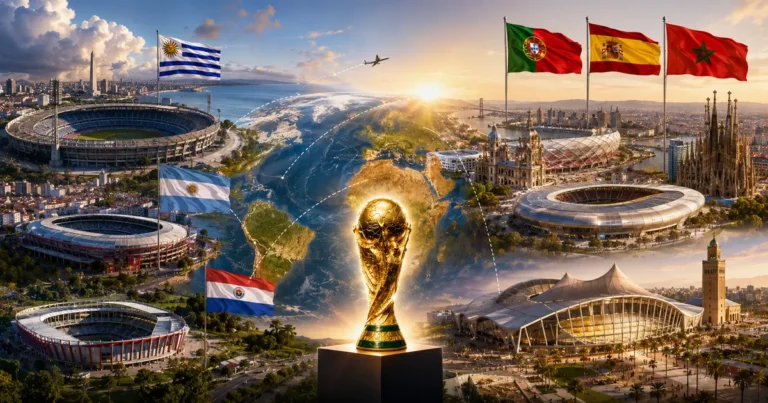
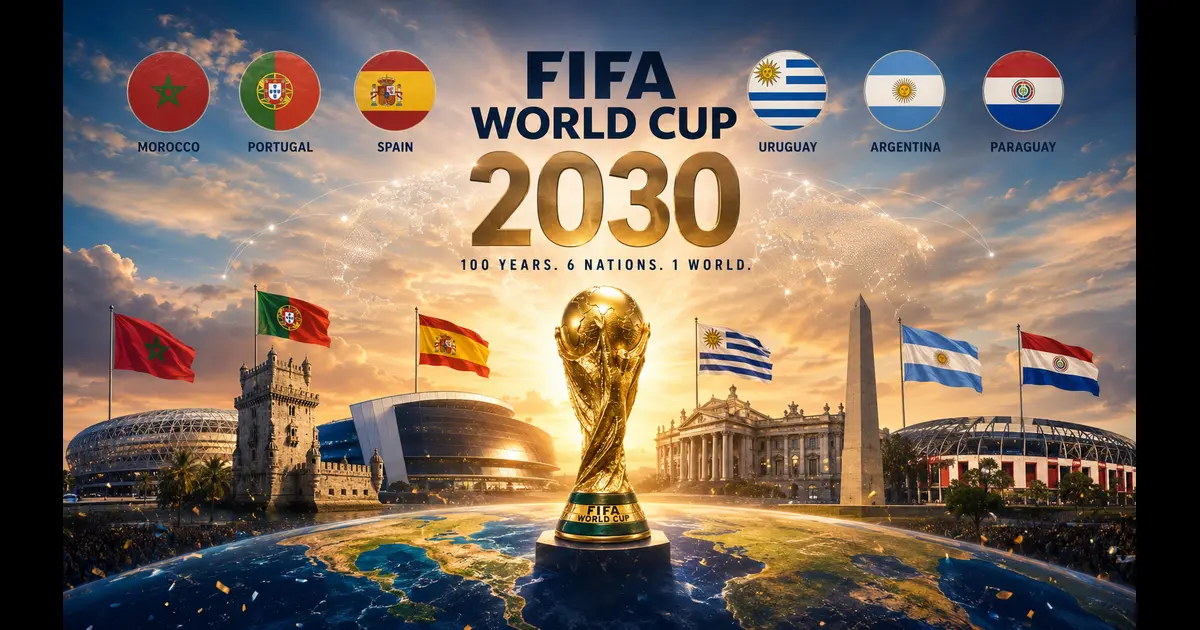
The 2030 World Cup will be the 24th edition of the men’s global tournament, and its format is genuinely unprecedented. Morocco, Portugal and Spain will serve as the primary hosts, staging the overwhelming majority of matches across June and July 2030. But to mark the tournament’s 100th anniversary, three additional countries — Uruguay, Argentina and Paraguay — will each host a single centenary celebration match, played as the opening fixtures for those nations’ own campaigns.
The symbolism here is deliberate and specific. Uruguay hosted the very first World Cup back in 1930, staging the final at Montevideo’s Estadio Centenario, where the host nation beat Argentina to lift the inaugural trophy. A century later, that same stadium will host one of 2030’s opening centenary matches, with Argentina and Paraguay each hosting one additional fixture of their own in Buenos Aires and Asunción respectively. It’s a rare instance of FIFA building genuine historical reverence directly into a tournament’s structure, rather than simply commemorating an anniversary through ceremony alone.
The Schedule, As It Stands
According to FIFA’s proposed calendar, the centenary matches in Uruguay, Argentina and Paraguay will kick off the tournament on June 8 and 9, 2030, accompanied by a dedicated centenary ceremony. The official opening ceremony then shifts to the main hosts, with the tournament’s formal opening matches played across Morocco, Portugal and Spain on June 13 and 14. Any remaining teams drawn into groups alongside Uruguay, Argentina or Paraguay will play their own opening fixtures that same weekend, on June 15 and 16. The final is provisionally scheduled for Sunday, July 21, 2030 — though FIFA has cautioned that the full match schedule and venue list are still being finalized.
Who’s Already Qualified
Six nations have already secured automatic qualification, and the list reads like a genuine murderers’ row of footballing history. Spain, Portugal and Morocco qualify automatically as the tournament’s three primary co-hosts. Uruguay, Argentina and Paraguay qualify automatically through their centenary hosting roles. That leaves 42 remaining places to be decided through FIFA’s various continental qualifying tournaments over the next several years — assuming, that is, the format doesn’t change again before qualifying concludes.
Of particular note: Spain arrives at 2030 as the reigning World Cup champion, having beaten Argentina 1-0 after extra time in this summer’s final in New Jersey. That sets up a genuinely remarkable subplot for 2030 — Spain will have the chance to defend their title as co-hosts on home soil, attempting to become the first nation to defend the World Cup successfully since Brazil managed it in 1962.
The Expansion Question Nobody’s Fully Answered Yet
Just as the football world adjusts to the first-ever 48-team World Cup, FIFA president Gianni Infantino has already floated the possibility of expanding the tournament even further for 2030 — potentially to 64 teams. The argument, as Infantino has presented it, is that a centenary tournament spanning six host nations across three continents is precisely the kind of milestone occasion that would justify a historic further expansion. Nothing has been confirmed, and the logistics of staging a 64-team tournament would represent an enormous additional undertaking even by the standards of a six-country hosting arrangement — but the fact that the conversation is being had publicly, this early, suggests FIFA is at minimum seriously exploring it.
The Venues Taking Shape
While the full stadium list for 2030 has yet to be finalized, the hosting nations have already submitted an ambitious slate of proposed venues to FIFA as part of their original bid. Among the standout submissions are several of Europe’s most iconic grounds, spanning historic capacity stadiums across Spain, Portugal and Morocco alongside newer purpose-built arenas. A total of 23 stadiums were included in the official hosting plans approved at the Extraordinary FIFA Congress in December 2024, when Morocco, Portugal and Spain’s joint bid was confirmed as the sole candidacy for the tournament. Notably, some of the continent’s most famous venues remain works in progress — Barcelona’s Camp Nou, for instance, is still undergoing renovation, adding an extra layer of logistical planning FIFA and the host federations will need to finalize well before qualifying concludes and the tournament draws closer.
What This Means for the Sport’s Next Four Years
For fans, players and federations alike, the practical reality of 2030’s qualifying process starts almost immediately. With 42 spots still to be decided and continental qualifying tournaments beginning their own cycles over the coming years, national teams across every confederation are already shifting focus from this summer’s tournament toward securing their place at the next one. For nations that missed out on 2026 entirely, the automatic qualification of six historically significant footballing nations for 2030 makes an already competitive qualifying landscape even tighter for the remaining slots.
There’s also a broader symbolic weight to this specific edition that goes beyond the usual four-year cycle. A World Cup that begins in South America, honoring the tournament’s literal birthplace, before shifting to Europe and Africa for its main proceedings, is as close as FIFA has ever come to staging something that feels less like a single tournament and more like a genuine global celebration of the sport’s history. Whether the football itself lives up to that framing is, as always, a question only the pitch can answer — but as of this week, the road to finding out has officially begun.
For now, national federations across every confederation are already recalibrating their own plans around this new landscape. Coaches whose contracts run through this qualifying cycle will be judged against a backdrop that includes six automatic qualifiers most nations will never have to face in the group stage, and federations without an automatic route in will be plotting their qualifying campaigns with an unusually clear picture of exactly how tight the remaining 42 places are likely to become. Four years is a long time in football, but for the sport’s governing bodies, players and supporters alike, the countdown to 2030 has, in every meaningful sense, already started.
About the Author