 From Maradona’s Napoli miracle to Totti’s one-club loyalty, these are the greatest Serie A players of all time who defined Italian football.
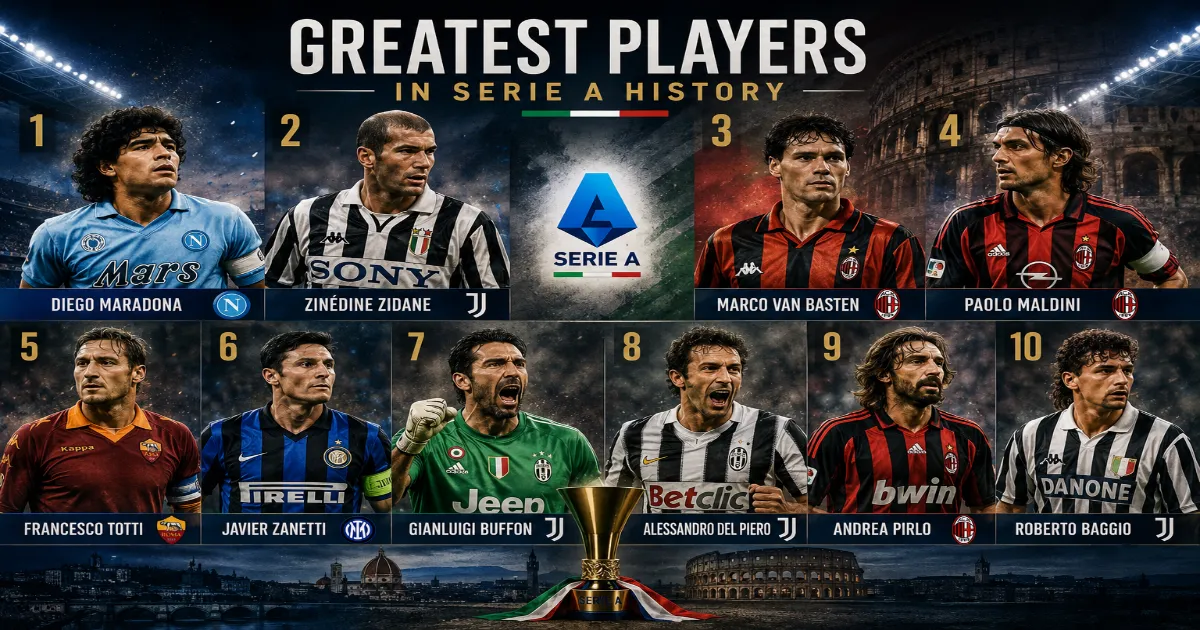
Serie A’s reputation as one of the most tactically demanding leagues in football history has made it a proving ground for some of the sport’s most complete and celebrated players, from a Argentine genius who single-handedly transformed a previously unsuccessful club to homegrown Italian icons who spent entire careers loyal to a single institution. Here’s a ranking of the ten greatest players in Serie A history.
The Top 10 Most Expensive Football Transfers in History
The Top 10 Most Expensive Football Transfers in History
10. Roberto Baggio
Baggio’s technical elegance and clutch goalscoring across spells with Fiorentina, Juventus, AC Milan, and Bologna made him one of the most beloved players in Italian football history, a status cemented by his 1993 Ballon d’Or triumph. Despite the heartbreak of his missed penalty in the 1994 World Cup final, Baggio’s Serie A career produced sustained individual brilliance across multiple clubs, a rare feat in a league where fan loyalty often runs deeply hostile toward players who move between historic rivals.
9. Andrea Pirlo
Pirlo’s deep-lying playmaking redefined what a defensive midfielder could contribute creatively, first at AC Milan and later at Juventus, where his passing range and set-piece delivery became central to both clubs’ domestic and European success during his respective spells. His tactical influence on the sport extended well beyond his own statistics, inspiring a generation of coaches and midfielders to reconsider how deep positional play could double as a genuine creative outlet rather than a purely defensive role.
8. Alessandro Del Piero
Del Piero’s two-decade association with Juventus produced the club’s all-time leading goalscorer record and cemented his status as one of the most beloved one-club players in Serie A history. His technical quality, particularly his signature curling finishes from the left side of the penalty area, made him one of the most reliable and aesthetically pleasing goalscorers of his generation, sustained across a Juventus career that included both genuine European glory and the club’s painful Calciopoli-driven relegation, a period of adversity Del Piero chose to endure alongside the club rather than depart for an easier path elsewhere.
Messi Retires: Inside the Rise, Falls, and Redemption of a Legend
Thiago Messi: Club Career, Playing Style, Lifestyle and Future Prospects
Cristiano Ronaldo Jr.: Club, Lifestyle, Career and Future Prospects
7. Gianluigi Buffon
Few goalkeepers in football history have combined longevity and consistent excellence quite like Buffon, whose Serie A career spanned an extraordinary quarter-century largely with Juventus, punctuated by a return to Parma, the club where his career began, for one final season. His shot-stopping brilliance, commanding presence, and role anchoring Italy’s 2006 World Cup-winning defense place him among the finest goalkeepers the sport has ever produced, and his sustained excellence well into his forties remains one of the most remarkable individual longevity stories in Serie A history.
6. Javier Zanetti
Zanetti’s two-decade association with Inter Milan, serving as club captain for the majority of that span, makes him one of the most singularly loyal and respected figures in Serie A history. His tactical versatility, capable of playing at right-back, left-back, or in midfield with equal effectiveness, combined with his role anchoring Inter’s historic 2010 treble-winning squad, cements his status as one of the finest and most dependable players the league has ever produced.
5. Francesco Totti
Totti’s entire senior career, spanning 25 years exclusively with Roma, makes him one of the purest examples of one-club loyalty in modern football history. His combination of clinical finishing, elegant playmaking, and deep emotional connection to his hometown club made him a genuine cultural icon in Rome well beyond his considerable footballing achievements, including Roma’s 2001 Scudetto and his central role in Italy’s 2006 World Cup triumph. Few players anywhere in world football have maintained such sustained individual quality across a career spent entirely at a single institution.
4. Paolo Maldini
Maldini’s 25-year AC Milan career, during which he won the Scudetto seven times and the European Cup or Champions League five times, established him as arguably the finest defender in the sport’s history and a defining symbol of the club’s golden era under Arrigo Sacchi and Fabio Capello. His positional intelligence and sustained physical excellence, remaining a first-team regular into his late thirties, make him one of the clearest individual embodiments of Serie A’s historic reputation for producing tactically sophisticated, defensively masterful players.
3. Marco van Basten
Van Basten’s brief but utterly dominant AC Milan career, cut tragically short by chronic ankle injuries in his late twenties, produced some of the most spectacular individual moments Serie A has ever witnessed, including his legendary volleyed goal in the 1988 European Championship final. His three Ballon d’Or awards and central role in Milan’s dominant late-1980s squad under Sacchi cement his status as one of the finest pure forwards to ever play in Italy, even with a career that ended agonizingly early relative to his sustained brilliance.
2. Zinedine Zidane
Zidane’s five seasons at Juventus, before his eventual move to Real Madrid, produced two Serie A titles and established him as one of the most complete midfield playmakers Italian football has ever hosted. His technical elegance and vision helped define Juventus’s tactical identity during the late 1990s, and his Serie A years remain widely regarded as a crucial developmental stage in the career of a player later recognized as one of the finest footballers in the sport’s entire history.Zinedine Zidane’s Greatest Moments: The Career That Defined a Generation
1. Diego Maradona
No player has left a more complete, transformative mark on a single Serie A club than Diego Maradona did at Napoli. His arrival in 1984 brought genuine footballing hope to a club that had never previously won a Scudetto, and his individual brilliance across seven seasons delivered two Italian championships and a UEFA Cup title, a level of institutional transformation single-handedly attributable to one player that remains essentially unmatched anywhere else in football history. Maradona’s combination of close control, vision, and clutch match-winning ability made him not just Serie A’s greatest-ever individual talent, but arguably the most complete embodiment of what a single transformative signing can mean to an entire footballing city.
Diego Maradona: The Rise, the Ruin and the Religion He Became
Honorable Mentions
Several other names deserve recognition just outside this specific top ten. Gianfranco Zola’s technical brilliance for Napoli and later Parma produced some of the most aesthetically pleasing football of the 1990s, even without matching the trophy count of several names on this list. Ronaldo Nazário’s brief but electric spell at Inter Milan produced moments of individual brilliance that remain vividly remembered by Serie A fans despite injury considerably shortening his time in Italy. And Fabio Cannavaro’s defensive excellence for Parma, Inter, and Juventus, culminating in his 2006 Ballon d’Or triumph, remains one of the finest defensive careers Serie A has produced, even without quite matching Maldini’s sheer longevity and sustained institutional impact at a single club.
Why Italy Produces This Kind of Player
What ties this list together is Serie A’s longstanding tactical culture, one that has historically prized positional discipline, defensive intelligence, and technical elegance over pure physical directness, a footballing philosophy that has consistently produced players capable of combining individual brilliance with genuine tactical sophistication. That cultural emphasis, passed down through generations of Italian coaching and reinforced by the league’s historically intense tactical rivalries, remains a significant part of why Serie A continues to be regarded as one of the most demanding proving grounds anywhere in world football, regardless of how the league’s broader financial standing relative to England and Spain has shifted across recent decades.
The Foreign Imports Who Shaped Serie A’s Identity
Beyond the individual entries on this list, it’s worth acknowledging the broader pattern of foreign stars who chose Serie A specifically because of its reputation for tactical sophistication and genuine competitive prestige during the league’s peak decades. Maradona, Van Basten, and Zidane all arrived in Italy already recognized as exceptional talents, yet each found something in Serie A’s specific tactical culture and competitive intensity that elevated their careers to another level entirely. This pattern, foreign superstars using Italian football specifically as the stage for their most iconic career achievements, reflects just how significant Serie A’s reputation once was as the destination league for the sport’s finest individual talents, a status the league has worked hard to help reclaim in recent seasons following a period of relative financial decline compared to England’s Premier League specifically.
How This List Might Look in a Decade
Looking ahead, several current Serie A performers could reasonably stake a claim to future inclusion on an updated version of this ranking, though the sheer weight of history and trophy count required to break into a list this exclusive means genuine staying power, rather than a single standout season, will ultimately determine who eventually joins these ten names. What remains clear is that Serie A’s specific tactical culture, defensive discipline paired with genuine technical elegance, continues to produce and attract the kind of complete footballing talent that has defined this list across nearly a century of Italian top-flight football, a tradition that shows every sign of continuing regardless of how the league’s broader financial standing relative to its European rivals continues to evolve in the years ahead.
About the Author