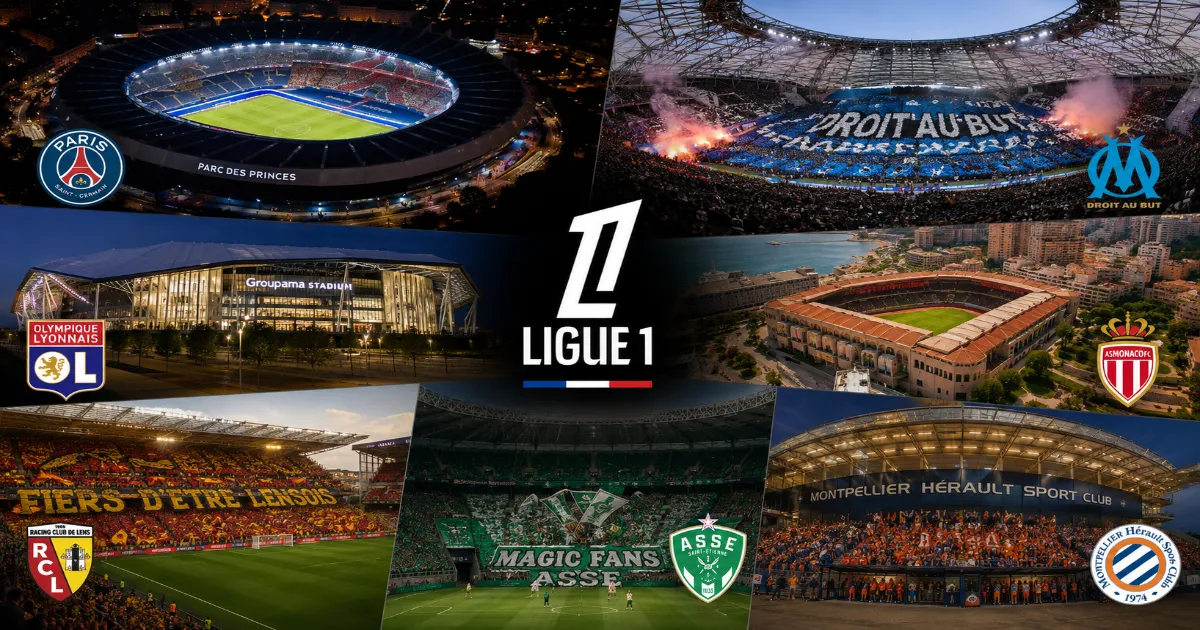
 From the roaring Stade Vélodrome to the industrial passion of Lens, these are the grounds that give Ligue 1 Stadium its distinct character.
Ligue 1’s stadiums rarely draw the same global attention as England’s or Germany’s most famous grounds, but French football’s top flight is home to some of the continent’s most passionate, historically rich, and architecturally distinctive venues. Here’s a full guide to the grounds that give Ligue 1 its own genuine matchday character.
The Top 10 Most Expensive Football Transfers in History
The Indian Super League Story: A Football Revolution in South Asia
Parc des Princes (Paris Saint-Germain)
PSG’s home ground has become one of the most recognizable stadiums in world football over the past decade, its steep, enclosed bowl design creating a genuinely intimidating atmosphere for visiting teams, particularly in the famous Auteuil end where the club’s most passionate supporter groups gather. Originally opened in 1972, the stadium’s compact, close-to-the-pitch design stands in notable contrast to the considerably larger, more modern stadiums built by several of PSG’s fellow European super-clubs, giving matches at the Parc des Princes an unusually concentrated, high-decibel atmosphere despite its comparatively modest capacity of under 50,000. With PSG’s continued financial growth and ambitions, ongoing discussions about either significantly renovating or eventually replacing the stadium altogether have persisted for years, even as the current ground’s compact intensity remains one of the club’s most valuable, if occasionally imperiled, home advantages.
Stade Vélodrome (Olympique de Marseille)
If any Ligue 1 ground can claim the title of France’s most intimidating and passionate stadium, it’s Marseille’s Stade Vélodrome. The stadium’s steep stands and famously fervent local support, rooted in Marseille’s distinct Mediterranean cultural identity and its historic rivalry with Paris Saint-Germain, create an atmosphere widely regarded as unmatched anywhere else in French football. The ground underwent significant renovation ahead of the 2016 European Championship, expanding capacity to over 67,000 while preserving the steep stand angles that have long made the Vélodrome such a genuinely difficult place for visiting teams to get a result. Matches against PSG specifically, known as Le Classique, transform the stadium into one of the most electric single-fixture atmospheres anywhere in European domestic football.
Groupama Stadium (Olympique Lyonnais)
Lyon’s comparatively modern home, opened in 2016, represents a different model entirely from the older, more traditional grounds elsewhere on this list, built with a deliberate emphasis on premium hospitality and multi-purpose event capability alongside its football function. Despite its more corporate-feeling design compared to older French grounds, the stadium has still managed to build a genuinely strong home atmosphere for the club’s biggest domestic and European fixtures, and its modern infrastructure has made it one of the sport’s most commercially significant venues in France, hosting both Olympique Lyonnais’s men’s and women’s teams, the latter among the most decorated clubs in European women’s football history.
Stade Louis II (AS Monaco)
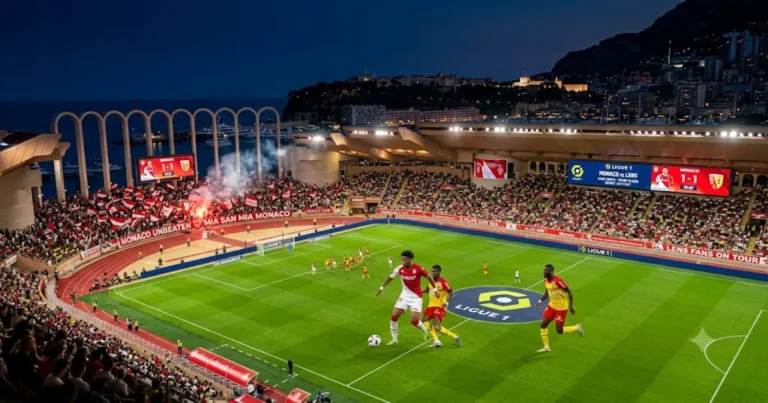
Monaco’s home ground occupies a genuinely unique position among Ligue 1’s stadiums, built directly into the principality’s dense urban landscape and doubling as a multi-purpose sporting complex that includes an athletics stadium and swimming facilities alongside its football pitch. The ground’s relatively modest crowds, a reflection of Monaco’s tiny resident population and the club’s historically smaller domestic fan base compared to clubs from France’s larger cities, mean the stadium rarely produces the kind of raw atmospheric intensity found at grounds like the Vélodrome or Bollaert-Delelis, even as the club’s continued European success has given the venue genuine continental football pedigree over the decades.
Football History’s Most Unforgettable Women’s World Cup Moments
WAFCON 2026: Cameroon Champions, Malawi Runners-Up and the Biggest Surprises
Stade Bollaert-Delelis (RC Lens)
Few stadiums anywhere in French football can match the industrial, working-class passion found at Lens’s Stade Bollaert-Delelis. Located in France’s historic mining region in the country’s north, the stadium’s fiercely loyal local support reflects the deep community identity the club has long represented for the surrounding towns, and the ground’s atmosphere during the club’s genuinely competitive 2025-26 title challenge became one of the most talked-about matchday experiences in French football that season. The stadium’s capacity, considerably larger than the town of Lens’s own modest population might suggest reasonable, speaks to just how much regional pride the club draws from well beyond its immediate municipal boundaries.
Stade Geoffroy-Guichard (AS Saint-Étienne)
Known affectionately as “Le Chaudron,” or “The Cauldron,” Saint-Étienne’s home ground carries some of the deepest historical significance of any stadium in French football, having hosted the club’s legendary European Cup run in the late 1970s that remains one of the most romanticized chapters in the country’s footballing history. Despite the club’s more recent struggles, including relegation from Ligue 1 in recent seasons, the stadium’s reputation for producing an intense, historically rooted matchday atmosphere has endured, and any Saint-Étienne return to France’s top flight is widely expected to restore one of Ligue 1’s most storied grounds to the division’s regular rotation.
Roazhon Park (Stade Rennais)
Rennes’s home ground has built a reputation as one of Ligue 1’s more consistently well-organized and atmospheric mid-sized stadiums, benefiting from the club’s sustained recent competitiveness in both domestic cup competition and European qualification. The ground’s relatively compact, steep-sided design helps generate a more concentrated atmosphere than its modest overall capacity might otherwise suggest, particularly for the club’s biggest domestic cup ties and occasional European nights.
Why These Grounds Matter Beyond the Football
What separates Ligue 1’s most memorable stadiums from simply large, modern venues is the same quality found in the sport’s greatest grounds anywhere in the world: a genuine, community-rooted connection between the stadium and the specific identity of the people who fill it. Lens’s Bollaert-Delelis draws its power from the region’s mining heritage and enduring working-class solidarity. The Vélodrome channels Marseille’s distinct Mediterranean cultural pride and its historic rivalry with the capital. And Saint-Étienne’s Chaudron carries the accumulated weight of the club’s most legendary European run, still referenced by supporters decades after the fact. These grounds matter not simply because of their capacity or architecture, but because of what they represent to the specific communities that have built their footballing identity around them across generations.
The History of the Premier League: 34 Years of the World’s Biggest Domestic League
Manchester United’s 1999 Treble: The Greatest Season in English Football History
Planning a Ligue 1 Stadium Visit
For visiting football fans hoping to experience French football’s most distinctive matchday atmospheres firsthand, prioritizing fixtures at Marseille, Lens, or a resurgent Saint-Étienne, should the club return to the top flight, typically offers a considerably more raw, passionate experience than a standard PSG home fixture at the Parc des Princes, even accounting for PSG’s own considerable recent European success and star-studded modern squad. Le Classique between PSG and Marseille remains the single must-see fixture for any visiting fan seeking to understand the full intensity of France’s biggest domestic rivalry, though tickets for that particular fixture, given its significance, are typically both scarce and considerably more expensive than a standard league match at either club’s home ground.
A League of Distinct Football Identities
Taken together, Ligue 1’s stadiums tell a broader story about French football’s own regional diversity, from the state-backed global ambition on display at the Parc des Princes to the deeply rooted, community-driven passion found in Lens’s industrial north or Marseille’s Mediterranean south. That variety, spanning wildly different capacities, architectural styles, and community identities, is precisely what gives Ligue 1’s matchday experience a genuine character distinct from the more commercially homogenized atmosphere increasingly found across several of Europe’s other major leagues, even as the division’s biggest club continues pursuing an entirely different, considerably more globally oriented model of football business and stadium development.
The Grounds That Didn’t Quite Make the List
A handful of other stadiums deserve at least brief mention for their own distinctive character. Toulouse’s Stadium Municipal, a genuinely grand, athletics-track-equipped venue that has hosted matches at multiple World Cups and European Championships, offers a scale of history few Ligue 1 grounds can match, even if the running track’s distance from the pitch dampens the atmosphere somewhat compared to more football-specific stadiums elsewhere in the division. Nice’s Allianz Riviera, opened in 2013 with a striking, undulating roof design, represents one of the more architecturally distinctive modern additions to Ligue 1’s stadium landscape, blending contemporary design with the club’s growing recent ambitions both domestically and in Europe. And Strasbourg’s Stade de la Meinau, though comparatively modest in size, has built a reputation for genuinely passionate home support that regularly punches above the stadium’s relatively limited capacity, a reminder that atmosphere in French football, much like elsewhere in the sport, doesn’t always correlate directly with a ground’s official seating figures.
How Stadium Investment Reflects Club Ambition
Looking across this full guide, a clear pattern emerges connecting stadium investment to each club’s broader institutional trajectory. PSG’s continued, if occasionally contentious, discussions about renovating or replacing the Parc des Princes reflect the club’s global commercial ambitions under Qatari ownership, while Lyon’s already-completed Groupama Stadium represented an earlier wave of similarly ambitious infrastructure investment tied to the club’s own significant European aspirations during the 2010s. By contrast, grounds like Bollaert-Delelis and the Stade Geoffroy-Guichard have remained comparatively unchanged in their essential character for decades, their continued significance rooted less in modern infrastructure investment and more in the deep, sustained community identity built up across generations of loyal local support, a reminder that a stadium’s importance to Ligue 1’s overall footballing culture isn’t always measured by the same metrics clubs use when planning their next major infrastructure investment.
🔹🔹 Follow us on Facebook 🔹🔹
From 1963 to Bayern’s 34th Title: The Full Bundesliga Story
Football’s Greatest Transfers of All Time: From Pele to Neymar to Mbappe
About the Author