Manuel Neuer FIFA World Cup 2026: At 40, the Greatest Goalkeeper in History Comes Out of Retirement for One Final Stand
By StrikerReport Editorial Team | June 2026
“He retired from international football in 2024. Then Germany needed him again, for a fifth World Cup, and on May 21, 2026 — at 40 years old — Manuel Neuer reversed his retirement and walked back into the squad. Germany’s response to the announcement was not surprise. It was relief.”
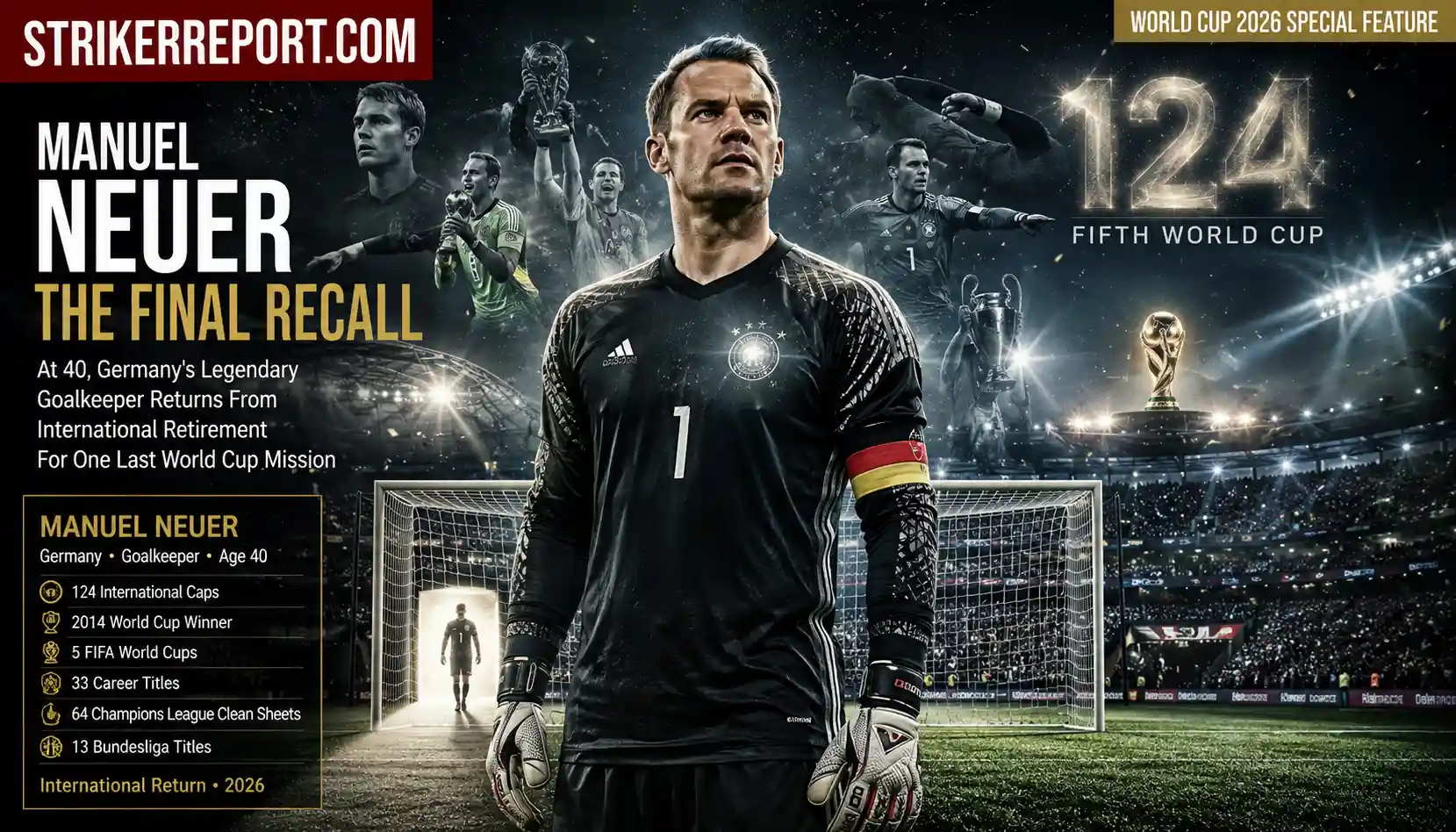
Manuel Neuer — FIFA World Cup 2026 Fast Profile
🇩🇪 Germany | Goalkeeper | Age at WC 2026: 40
⚽ Current Club: Bayern Munich | Jersey: #1
- 2025–26 Bundesliga: 22 appearances — 13 Bundesliga titles (equal record with Thomas Müller)
- 64 Champions League clean sheets — all-time record for the competition
- Reversed international retirement May 21, 2026 — 5th FIFA World Cup (2010–2026)
- 124 caps for Germany | 2014 World Cup winner | 33 career titles | Market Value: €3.9 million
Quick Facts: Manuel Neuer at FIFA World Cup 2026
| Full Name | Manuel Peter Neuer |
| Date of Birth | March 27, 1986 |
| Age at World Cup 2026 | 40 years old |
| Nationality | German 🇩🇪 |
| Place of Birth | Gelsenkirchen, West Germany |
| Height | 1.93 m (6′ 4″) |
| Current Club | FC Bayern Munich (Germany) |
| Professional Career | Schalke 04 (2005–2011), Bayern Munich (2011–present) |
| Transfer Fee (to Bayern) | €30 million (Schalke 04, July 2011) |
| Market Value | €3.9 million |
| Career Trophies | 33 (13 Bundesliga, 6 DFB Cup, 2 UCL, 2 Club World Cup, 2 UEFA Super Cup, 1 FIFA World Cup, more) |
| Net Worth (est.) | ~€80 million |
The Story: Why Manuel Neuer FIFA World Cup 2026 Is the Greatest Last-Act in Football History
Nobody in football retires and comes back quite like Manuel Neuer. After Euro 2024, he announced his retirement from international football — 124 caps, a World Cup winner’s medal, the Golden Glove from 2014, and a career so thoroughly dominant at the position that the entire concept of the sweeper-keeper, the goalkeeper who acts as an additional outfield player behind the defensive line, was named after and defined by his playing style. He was done. He had earned every right to be done.
Then Julian Nagelsmann called. Germany were preparing for a World Cup. Marc-André ter Stegen, Germany’s established first-choice, had suffered a serious injury. Oliver Baumann was capable but did not carry the commanding presence in a high defensive line that Nagelsmann’s system required. Neuer — who had been producing some of the most consistent club form of his late career, completing 22 Bundesliga appearances in 2025–26 and equalling Thomas Müller’s all-time record of 13 Bundesliga titles — was the obvious answer to a question Germany did not want to have to ask.
On May 21, 2026, Nagelsmann announced Germany’s World Cup squad. Manuel Neuer was in it. The announcement dominated every German sports headline for 24 hours. His statement was simple: “My heart beats for Germany. When the national team needs me, I am there.” At 40, heading into his fifth FIFA World Cup, the greatest goalkeeper in football history is writing his final chapter on the world stage.
Biography: From Schalke’s Gelsenkirchen Streets to the Pinnacle of the Position
Manuel Peter Neuer was born on March 27, 1986, in Gelsenkirchen — a Ruhr Valley city in North Rhine-Westphalia whose football identity is built around FC Schalke 04, one of Germany’s most supported clubs and the institution that shaped Neuer’s entire early career. He joined Schalke’s youth system in 1991 at five years old and spent fourteen years developing through every age group before breaking into the senior squad in 2005.
His parents, Klaus and Marita, were both involved in sport — his father a physical education teacher, his mother an athletic instructor. The household instilled the physical discipline and spatial awareness that became Neuer’s professional foundation. He grew up idolising Schalke’s previous legendary goalkeeper Jens Lehmann and the German goalkeeping tradition that stretches back through Oliver Kahn and Sepp Maier. By the time he was 18, Schalke’s senior coaches had identified him as the heir to that tradition.
His senior Schalke debut came in 2005. By 2009–10, he was Germany’s starting goalkeeper and had built a reputation across Europe as the most technically gifted keeper in the Bundesliga — quick off his line, comfortable with the ball at his feet, and capable of the kind of sweeping-up defensive actions that transformed the goalkeeper from a last-resort defender into a genuine tactical asset. Bayern Munich paid €30 million to prise him away in 2011, a transfer that was initially met with significant hostility from Bayern fans because of the historical rivalry between the clubs. Neuer’s response was to produce the most dominant goalkeeping career in the club’s history.
Club Career Highlights: The Numbers That Define a Legend
Manuel Neuer’s Bayern Munich career is a statistical monument to sustained excellence. Thirteen Bundesliga titles — equalling the all-time record shared with Thomas Müller. Two UEFA Champions League crowns. Six DFB Cup victories. Two FIFA Club World Cup wins. Two UEFA Super Cups. A total of 33 career titles across Schalke, Bayern, and the national team. These numbers represent the most decorated goalkeeper career in German football history and one of the most decorated in the history of the position globally.
The records extend beyond trophies. His 64 Champions League clean sheets are the most in the competition’s history — and this season, in a 2–0 league stage win over Union Saint-Gilloise, he extended that record further. His 48-game unbeaten run from November 2012 to March 2014 remains the longest consecutive unbeaten sequence any goalkeeper has produced in professional football. From 2013 to 2016, he was named World’s Best Goalkeeper four years in succession by the International Federation of Football History and Statistics — and then added a fifth such award in 2020.
In 2025–26, his final Bundesliga season before his contract expiry, Neuer made 22 appearances with a save percentage of 59.6% — modest by his historical standards, but in the context of a Bayern team that conceded regularly across the season, his command of his penalty area and decision-making in the sweeper role remained the clearest evidence that even at 40, his fundamental qualities have not deserted him. His injury history — thigh and calf issues in December 2025 and March 2026 — is the primary concern heading into the tournament, but he has been confirmed fully fit.
International Career: 124 Caps, a Golden Glove, a World Cup, and a Return
Neuer made his senior Germany debut in March 2009 against United Arab Emirates. He appeared at four consecutive World Cups — 2010 in South Africa, 2014 in Brazil, 2018 in Russia, and 2022 in Qatar — before announcing his international retirement after Euro 2024. His most celebrated tournament was 2014 in Brazil: Germany won the World Cup, and Neuer’s performances — particularly his extraordinary sweeping in the knockouts — were so dominant that he won the Golden Glove award as the tournament’s best goalkeeper, the first-ever instance of the award going to a goalkeeper from the winning team.
His return to the international setup at 40 was driven by Germany’s goalkeeper injury crisis and by the specific tactical demand that Nagelsmann’s high defensive line places on the goalkeeper position. The sweeper-keeper role that Neuer invented and perfected is the most demanding goalkeeping position in elite football — requiring exceptional footwork, reading of the game, and the psychological composure to act as an outfield player 25–30 metres from goal. No goalkeeper alive has produced more of that specific skill across a longer period than Manuel Neuer. At 40, with three injury interruptions behind him this season, the question is whether the legs that made the sweeping runs still have the explosion required.
Germany open Group E against Curaçao on June 14 in Houston. Nagelsmann’s squad has named Neuer, Oliver Baumann, and Alexander Nübel as the three goalkeepers. Neuer is first choice. The tournament begins, fittingly, with the question it has been asking about this goalkeeper for fifteen years: is there anything left that has not already been done?
2025–26 Season Stats
| Competition | Apps | Clean Sheets | Save % | Avg Rating |
|---|---|---|---|---|
| Bundesliga | 22 | 5 | 59.6% | 6.6 |
| Champions League | 8 | 2 | 78.4% | 7.0 |
| Career Club Total | 483 | 143 | — | — |
| Germany Career | 124 caps | ~60+ | — | — |
Career Timeline: 40 Years, One Position, Zero Compromise
📅 2005 — Senior Debut at Schalke 04
Began his professional journey at the club where he grew up — Schalke 04 in Gelsenkirchen. Spent six years building the technical and positional foundation that would make him the most influential goalkeeper in football history.
📅 2011 — €30m Move to Bayern Munich
Transferred to Bayern Munich in a move that generated hostility from some Bayern fans due to the Schalke rivalry. Responded by becoming the most decorated goalkeeper in the club’s history — 33 career titles and counting.
📅 2013 — First Champions League with Bayern
Won the first of his two Champions League titles with Bayern in the all-German final against Borussia Dortmund at Wembley. Produced 48 consecutive unbeaten games around this period — the longest such sequence any goalkeeper has managed.
📅 2014 — World Cup Winner, Golden Glove
Germany won the World Cup in Brazil. Neuer’s performances — including his extraordinary sweeper interventions against Algeria and France — were named the best individual goalkeeper tournament in the history of the competition by multiple analysts. Won the Golden Glove.
📅 2025–26 — 13th Bundesliga Title: Equals Müller’s All-Time Record
Won his 13th Bundesliga title with Bayern Munich in 2025–26 — equalling Thomas Müller’s all-time record for the competition. Also extended his own Champions League clean sheet record to 64 in the same season.
📅 May 21, 2026 — Reverses International Retirement for Fifth World Cup
Named in Germany’s World Cup squad on May 21, 2026 — five months after his most recent international retirement at Euro 2024. At 40, becoming one of the oldest goalkeepers ever to appear at a World Cup. The final chapter is being written.
Skill Ratings: Manuel Neuer at World Cup 2026
| Attribute | Rating / 100 | Assessment |
|---|---|---|
| 🧤 Shot Stopping | 88 | Still excellent reflexes; 64 UCL clean sheets speaks to career-long quality |
| 🏃 Sweeper-Keeper | 97 | Invented and perfected this position — still the global benchmark |
| 🎯 Distribution | 92 | Ball-playing goalkeeper; launches attacks with precision |
| 👁 Command of Area | 95 | Organises defence, claims crosses — total box authority |
| 💪 Physicality at 40 | 78 | Three injuries in 2025–26; fitness confirmed but monitoring required |
| 👑 Leadership | 98 | Germany’s psychological foundation — his presence alone transforms belief |
Manuel Neuer FIFA World Cup 2026 Preview: Germany’s Last Line, Germany’s First Voice
Germany need Manuel Neuer to do in North America what he has done at every World Cup since 2010: be the foundation on which everything else is built. In Nagelsmann’s high-line defensive system, the sweeper-keeper role is not optional — it is structural. The entire defensive shape is predicated on the goalkeeper acting as an additional outfield player 25–30 metres from goal, intercepting through balls and managing the space behind the defensive line. No goalkeeper at this tournament has as much experience of performing that specific function at the highest level as Neuer. His presence is not just about the saves he will make — it is about the collective confidence he transmits to every defender ahead of him.
The injury history from 2025–26 — thigh (December), general (February), calf (March) — is the tournament’s most discussed individual fitness subplot from the German perspective. Three separate injury interruptions in a single season, at 40, require careful monitoring. But Neuer has been through a broken leg (2017–18) and multiple physical setbacks in his career and returned at quality each time. His Bayern fitness levels entering the tournament are confirmed. The question is whether seven potential matches across a month test the physical resources that 40 years and 483 club appearances have been drawing on.
Germany face Curaçao, Ivory Coast, and Ecuador in Group E — a comfortable group that should see them progress without drama. The knockout rounds, against opposition of the quality Germany expects to encounter from the quarterfinals onward, are where Neuer’s physical and psychological resources will be most tested. If Germany reach the final — and their squad quality makes that a realistic ambition — it will be the stage on which Manuel Neuer’s World Cup career ends. Whether it ends with a second winner’s medal is the question that forty years of football have been building toward.
StrikerReport Verdict
9.2 / 10
StrikerReport World Cup 2026 Rating
Manuel Neuer at the FIFA World Cup 2026 is one of the most extraordinary things in this tournament. He is 40 years old. He has won 33 trophies. He invented the sweeper-keeper position that every modern goalkeeper now imitates. He won the World Cup Golden Glove. He holds the Champions League clean-sheet record. He retired from international football. Then Germany called, and he came back.
A 6.6 average FotMob rating in the Bundesliga this season reflects a player whose physical resources are being managed carefully at 40. But the leadership, the command, the psychological authority that Manuel Neuer brings to a dressing room and a defensive line — these are qualities that no rating system adequately captures. Germany’s chance of winning the World Cup is genuinely elevated by his presence. Not just because of the saves. Because of what he means.
The greatest goalkeeper in history. Five World Cups. Forty years old. One last chance to lift the trophy for Germany. Watch every single moment.
FIFA World Cup 2026 Winner Prediction: Why Spain Will Lift the Trophy
About the Author


