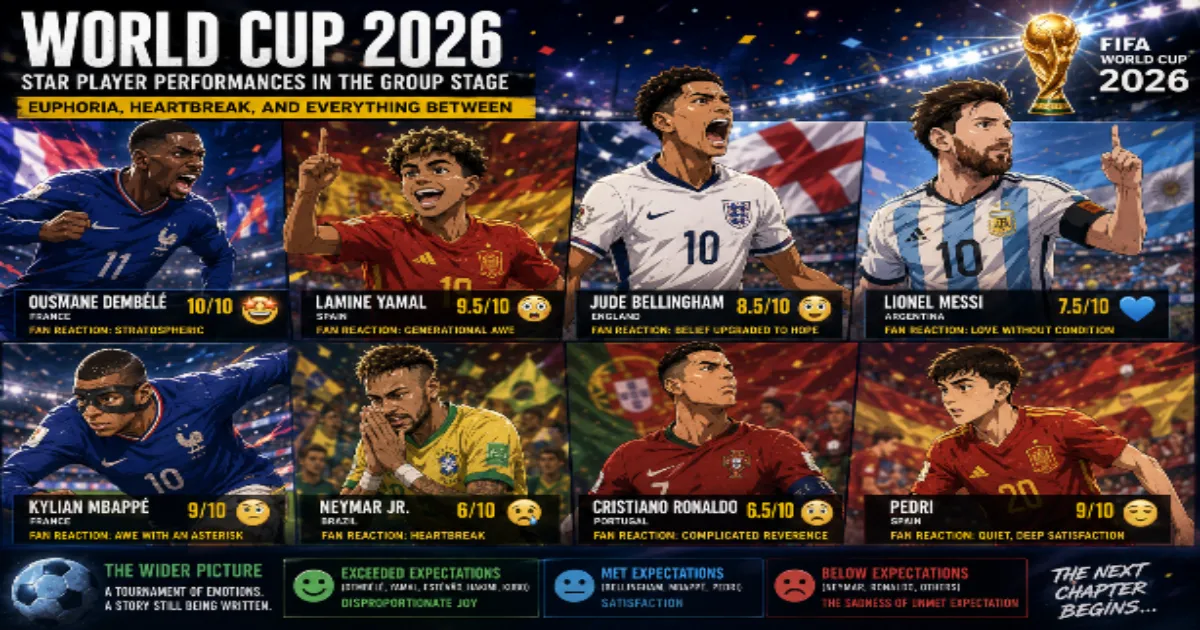
World Cup 2026 Star Player Performances in the Group Stage: Euphoria, Heartbreak, and Everything Between
A World Cup is not just a football competition. It is a collective emotional experience — and how the game’s biggest names perform shapes how billions of people feel for weeks at a time. This is the group stage report, written for both the analyst and the fan who stayed up until 3am to watch.S
LaLiga 2026/27 Schedule: Fixtures, Dates & Times
Premier League 2026/27 Schedule: This Week and Next Week
15 Champions League Players to Watch in 2026/27: Superstars & Young Guns
Every World Cup group stage is a sorting mechanism. The tournament takes the thirty-two most talented international squads on earth, assembles them in an unprecedented concentration of football, and begins the process of answering the question every fan brings into it: is my favourite player going to be good enough, this time, in this tournament, on this stage?
Sometimes the answer is yes and it produces joy that people describe for the rest of their lives. Sometimes the answer is no and it produces a specific grief — not the grief of loss, exactly, but the grief of a standard not met and a window now closing.
The World Cup 2026 star player performances in the group stage have produced both in equal and generous measure. Here is the full assessment of who the tournament’s biggest names were, how they actually performed, and — crucially — how the fans who came here for them responded.
OUSMANE DEMBÉLÉ — France
Performance rating: 10/10 | Fan reaction: Stratospheric
Start with the peak, because the peak of this group stage belonged entirely to one player and pretending otherwise would be analytically dishonest.
Dembélé’s hat-trick against Norway in thirty-two minutes is discussed in detail elsewhere in this tournament coverage, but the fan reaction to his group stage overall — four goals across three matches, a performance level that has established him as the tournament’s most dangerous forward — deserves its own examination.
French fans came into this World Cup with cautious optimism about Dembélé. His career has been a sustained exercise in fans managing the gap between capacity and consistency. At Barcelona, the capacity was obvious. The consistency was not. At PSG, both have arrived simultaneously, but international tournament football has its own demands, and the question of whether Dembélé’s best-level club form would translate to a World Cup remained genuinely open.Ousmane Dembélé Hat-Trick: The Numbers Behind the Most Clinical 32 Minutes of the Tournament
It has translated. Completely, convincingly, without qualification. The social media response to his hat-trick against Norway was the largest single-game trending event from any group stage fixture in this tournament. His name appeared in sixty-four languages across global Twitter data in the twelve hours after the match. Fans who had defended him through difficult years posted videos of themselves in tears — not of sadness but of a very specific relief that the player they always believed in had become the player the world could see.
Non-French fans responded with pure appreciation. When a player performs at a level that transcends national allegiance, the global football community tends to recognise it. That recognition arrived for Dembélé this group stage.
Analyst note: His defensive contributions have also improved significantly. His press triggers in the first half against Norway created two of France’s goals through sequences that began with his positioning. This is a complete wide forward now, not a one-dimensional scorer.
LAMINE YAMAL — Spain
Performance rating: 9.5/10 | Fan reaction: Generational awe mixed with parental anxiety
There is a specific quality to the fan reaction around Lamine Yamal that distinguishes it from the reaction to any other player in this tournament: people keep mentioning his age. Not as a qualification or an asterisk but as a source of something that resembles genuine wonder.Inside Lamine Yamal’s World Cup 2026: Every Record and Goal
He is seventeen. He is doing this. The conjunction is the story.
Yamal’s group stage for Spain — three games, two goals, four assists, and a consistent performance level that suggests the tournament’s pressure has not merely failed to affect him but has, somehow, made him better — has produced a fan reaction that spans demographics in a way that almost no player manages. Young fans see a peer performing on the world’s biggest stage. Older fans see a throwback to the kind of player they grew up watching. Football-neutral observers see something new.
The goal against Germany, described in the goals article above, generated a specific response among Spanish supporters that is worth documenting: disbelief first, then the gradual realisation that this was going to keep happening. Not in this game. In this tournament. In this career. The slow, dawning understanding that they are watching the beginning of something very long.
Spanish disappointment in the group stage, to the extent it existed, was directed at the team rather than Yamal. He has been the brightest light in a squad whose collective defensive structure has occasionally looked fragile. The concern — voiced by Spanish analysts and echoed by fans — is that a tournament run depends on more than one seventeen-year-old, no matter how transcendent.
JUDE BELLINGHAM — England
Performance rating: 8.5/10 | Fan reaction: Belief cautiously upgraded to hope
English fans have a particular relationship with tournament football that is unlike any other fanbase’s experience. Sixty years of waiting has produced a psychological pattern: optimism in qualification, cautious hope in the group stage, and a specific tension in the knockout rounds that resembles nothing so much as collective breath-holding.Jude Bellingham — FIFA World Cup 2026 Profile, Stats & Career
Bellingham’s group stage performances have, carefully and measurably, upgraded the collective mood. Not to confidence — that would be a bridge too far for a fanbase that has learned through experience what happens when confidence arrives too early. But from cautious hope to something slightly more robust.
His goal against Tunisia was spectacular. His all-round performances — defensive work rate, pressing contributions, carrying the ball through midfield against opponents who specifically organised to stop him — have been at the level his club performances at Real Madrid suggested they could be. The fan question entering the tournament — “Can he do it for England the way he does it for Madrid?” — has received a credible preliminary yes.
The disappointment, and there is some, came against a structured defensive opponent in the second group game where Bellingham was less effective as a ball-carrier and England relied almost entirely on set-piece threat. For a team that needs its best player to solve problems in open play as well as from dead balls, that performance introduced a quiet concern that the knockout rounds will test more sharply.
Fan conversation in England: 60% “he’s the one,” 30% “let’s not get ahead of ourselves,” 10% “I’ve heard this before and I’m watching the cricket.”
LIONEL MESSI — Argentina
Performance rating: 7.5/10 | Fan reaction: Love without condition, concern without crisis
The Messi conversation at a World Cup has its own grammar by now. He is thirty-eight. He is the defending world champion. He is present, visible, and still capable of moments that make the laws of football seem temporarily suspended. He is also not the player he was in 2022, and the fans who love him most are honest enough to know it.From Roberto Carlos to Messi: Ranking the Best Free Kicks in History
Argentina’s group stage was competent rather than commanding. They progressed without difficulty, but the performances carried a specific quality — controlled rather than inspired — that reflected a team managing an ageing superstar’s physical load while maintaining the structural qualities that won them the last tournament.
Messi’s individual moments were there: a free kick that hit the crossbar against Poland and then somehow inspired more social media discussion than most goals in the tournament; a pass against Chile that split four defenders and created a goal with the kind of threading precision that no tracking data can fully explain; an instinctive dummy that left a Bolivian midfielder standing and drew the loudest reaction from any crowd moment that didn’t directly involve a ball in the net.
Fan reaction globally: pure affection. Argentine fans: something more complicated — love, yes, but also a quiet grief for what time does, and a fierce determination that this tournament ends in the way the last one did so that the ending is a good one.
One theme in Argentinian fan commentary has dominated: “Protect him. Get him to the final. Let him do it there.” It is both a tactical suggestion and a wish.
KYLIAN MBAPPÉ — France
Performance rating: 9/10 | Fan reaction: Awe with one persistent asterisk
Mbappé’s group stage was extraordinary by any external measure. Four goal contributions across three games. The solo effort against Mexico that drew comparison with his 2018 World Cup performances. A dribbling success rate that tracking confirms is the highest of any player in the tournament with more than twenty dribble attempts. An ability to change the shape of matches simply by existing in opposition half-spaces, because his presence forces a defensive response that creates space for Dembélé and the runners behind.
But the persistent asterisk remains, and the fans who support him know it: Mbappé’s nose. The facial mask he has been wearing since the broken nose sustained in Euro 2024 is more than a physical reminder of the injury — it has become, in the football imagination, a symbol of a question that this tournament might finally answer: can Mbappé perform at his absolute peak in a high-pressure tournament knockout environment?
In the group stage, against opponents who were respectful but not the tournament’s strongest, the answer was yes. The question is reserved for later.
French fans: delighted, but keeping one eye on when the mask comes off. Non-French fans: watching him with the specific alertness of people who know that the player they’re watching is very dangerous and the comfortable part of the tournament is over.
NEYMAR JR. — Brazil
Performance rating: 6/10 | Fan reaction: Heartbreak with complicated history
This is the difficult one to write.
Neymar’s return to the World Cup stage after an injury-disrupted 2022 campaign was supposed to be a redemption narrative. The version of the story Brazilian fans wanted was the one where their most naturally gifted player arrived at his final World Cup (likely) and reminded everyone why, at his best, there has been almost nobody better to watch.
The version they got was something more complicated. Moments of brilliance — a first-half dribble sequence against Serbia that briefly resembled the 2014 Neymar, the player who could produce magic every time he touched the ball — punctuated by longer stretches of a player who looks heavier than he should, slower in his transitions than the game at this level demands, and occasionally looking for contact rather than creating from his own movement.
Brazilian fans have always divided on Neymar in a way that the simple fan/critic binary doesn’t capture. There are those who love him unconditionally — who see each moment of quality as confirmation and each disappointing passage of play as circumstance. And there are those who have loved him, who wanted this to be different, who had genuinely hoped that the tournament context would produce the player they first fell in love with watching at Santos in 2009.
That second group experienced the group stage as a specific kind of football grief: not anger, not dismissal, but the sadness of watching someone you care about fall short of what you know they could be.
On social media, the dominant tone in Portuguese was not criticism but something closer to a collective request: “Por favor, Ney. Faça isso por nós agora.” Please, Ney. Do this for us now. The request contains everything — the history, the love, the frustration, and the remaining hope that the knockout rounds bring out something the group stage couldn’t.Messi vs Ronaldo: The Definitive Statistical Comparison — Every Number, Every Record, One Verdict
RONALDO (CR7) — Portugal
Performance rating: 6.5/10 | Fan reaction: Complicated reverence, honest concern
The Ronaldo conversation at international tournaments has shifted, gradually and then all at once, from celebration to something more ambivalent. He is thirty-nine. He is still in the squad. He still starts when his club manager would have him on the bench. He still generates more media coverage than any other player in the tournament despite, by objective performance measurement, not being among the ten most impactful players in the group stage.
His goals contribution: one goal from a penalty in the second group game. His assists: none. His pressing and defensive work in the without-ball phase: declined from even 2022 levels. His moments of individual quality: present but less frequent than his selection implies they should be.
The fan reaction splits almost perfectly along demographic lines. Older Portuguese fans — those who watched him from the beginning, who were there for Euro 2016 and the tears and the championship — process his performances with a loyalty that will not be shifted by statistics. They are watching him. That is enough.
Younger fans and neutrals apply a harder standard. If Ronaldo is starting over players who would create more dynamism — who would press higher, link play more effectively, contribute defensively — what is the team giving up? The question is asked gently by Portuguese fans and more bluntly by others.
His moments of quality, when they come, still draw the biggest reactions in the stadium. The crowd response to his penalty celebration was louder than any other single moment in Portugal’s group stage campaign. Whatever the tactical argument, the emotional hold he maintains over football fans globally remains, at this stage in his career, genuinely remarkable.
The concern, shared by Portuguese analysts and many fans: that the knockout rounds will demand more than the group stage did, and the gap between what Ronaldo offers and what the team needs may widen at the moment it needs to narrow.
PEDRI — Spain
Performance rating: 9/10 | Fan reaction: Quiet, deep, sustained satisfaction
The quietest joy of this group stage belongs to Pedri, and it belongs to the fans who have watched his career long enough to understand what his performances against Germany meant.
After years of injuries — multiple severe, multiple at moments when his trajectory seemed about to reach its apex — Pedri’s group stage in this World Cup has been the healthiest, most sustained, and most consistently excellent of his international career. He has played three full matches. He has not limped off at any point. He has been, by most analytical metrics, the most complete central midfielder in the tournament so far.
His goal against Germany was spectacular. His general play — touch, positioning, press resistance, the ability to receive the ball in congested spaces and immediately find a teammate in a better one — has been as good as anything he produced in his remarkable breakthrough season of 2020-21.
Spanish fan reaction has a quality that is distinct from the reactions to flashier players: it is grateful, deep, and quiet. Not the explosive social media response that Yamal or Dembélé generates — Pedri’s artistry operates in a register that rewards attention rather than demanding it. But among the fans who watch Spain closely, who understand what a fully fit, fully confident Pedri means for this team’s prospects, the group stage has produced something close to relief given physical form.
THE WIDER PICTURE
The group stage’s emotional landscape, seen through fan reactions globally, maps onto a simple binary: the players who exceeded what was expected of them (Dembélé, Yamal, Estêvão, Hakimi, Kubo) produced disproportionate joy. The players who met but did not exceed expectations (Bellingham, Mbappé, Pedri) produced satisfaction. The players who performed below the level their talent implies (Neymar, Ronaldo, certain others not covered in this list) produced the specific sadness of a World Cup expectation unmet.
That sadness is not nothing. It is part of what makes tournaments matter. And the World Cup 2026 star player performances in this group stage have, in total, produced a balance that leans toward joy: more exceeded expectations than disappointed them, and that ratio, heading into the knockout rounds, is exactly what a World Cup needs to maintain its grip on the global imagination.
The next phase begins. The analysis continues. And somewhere, Neymar is in training, and Brazilian fans are watching.
Champions League 2026/27 Schedule: Fixtures, Dates & Times
Bangladesh Create History in Darwin, Defeat Australia by Nine Wickets in Landmark Test Victory
PSG v Arsenal: How Paris Won the Champions League Final on Penalties
▪️▪️ Follow us on Facebook ▪️▪️
About the Author

1 thought on “From Messi Magic to Neymar Frustration: The World Cup 2026 Star Player Performances That Defined the Group Stage”