 How Luis de la Fuente Built World Champions Out of Spain
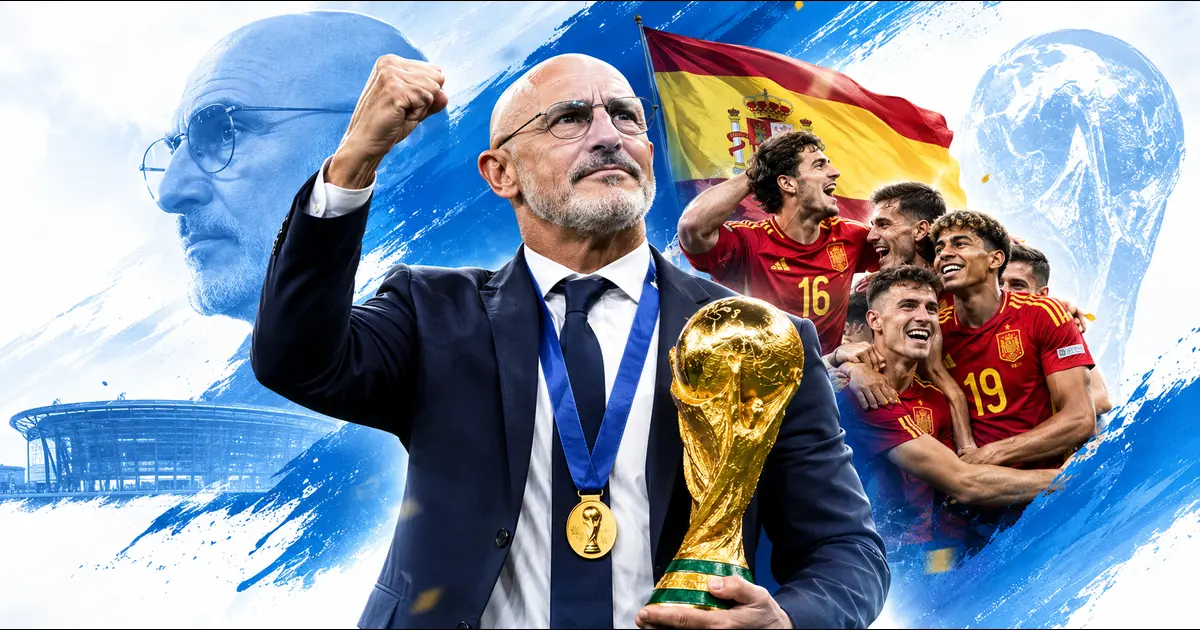
Three years and seven months. That’s how long it took Luis de la Fuente to go from an emergency federation appointment nobody outside Spain had heard of to a World Cup-winning manager standing at the center of MetLife Stadium. This is the Luis de la Fuente masterclass behind Spain’s second world title — the ideas, the decisions, and the philosophy that turned a talented squad into genuine champions.
Spain’s Best XI from FIFA World Cup 2026
We Called It: How Our Spain World Cup Prediction Came True
The Unlikely Beginning
De la Fuente’s appointment in December 2022 was, by most accounts at the time, a continuity pick rather than an inspired gamble. He took over immediately after Luis Enrique’s resignation, following Spain’s penalty shootout exit to Morocco at the 2022 World Cup, and the federation’s decision to promote from within reflected caution as much as ambition. What made De la Fuente different, even then, was the sheer depth of institutional knowledge he brought with him — nearly a decade spent developing Spain’s youth national teams, winning European titles at both Under-19 and Under-21 level, and guiding the Olympic side to a silver medal in Tokyo.
That background mattered more than it initially appeared to. De la Fuente wasn’t inheriting a golden generation he’d need to manage delicately around egos and reputations. He was inheriting, in large part, players he had personally developed and coached through Spain’s youth pyramid — a level of familiarity with the player pool that few senior national team managers ever get to start with.
The First Trophy, and the Real Statement
Spain’s 2023 Nations League title was the first sign the appointment was working, but the true statement came at Euro 2024 in Germany. Spain won every single one of their seven matches at that tournament, including a 2-1 final victory over England, to lift a record fourth European Championship. It was, by any measure, one of the most dominant continental campaigns in the competition’s history — and it established the template De la Fuente would refine, rather than reinvent, for the World Cup two years later.
The Euro 2024 version of this Spain side leaned heavily on Lamine Yamal and Nico Williams as explosive, direct wingers, stretching defenses vertically and relying on individual brilliance in wide areas to break down deeper blocks. It won a tournament. But De la Fuente clearly understood it wasn’t the finished product for the different demands of a World Cup, where opponents would have longer to prepare and a wider range of tactical approaches to throw at Spain across a longer, more physically demanding run.
The Evolution for 2026
What separated the World Cup-winning version of this Spain side from its Euro 2024 predecessor was a deliberate tactical tweak: a shift toward press-and-possession football built around cohesion and collective discipline rather than individual wing play alone. Spain still built from a 4-3-3 base, with Rodri anchoring a holding midfield role and short distances maintained between every defensive line to enable rapid counter-pressing the instant possession was lost.
The result was a system that didn’t discard Spain’s technical identity but made it far more practical and repeatable under pressure. Keep the ball, force the opponent to chase it, and exploit the fatigue and disorganization that naturally follows. The moment possession is lost, engage immediately and aggressively to win it back high up the pitch before the opponent can settle into their own attacking shape. It was, in the words of several pundits who covered the tournament closely, a clear evolution of the pressing principles pioneered by early Pep Guardiola sides — adapted for international football’s more limited training time and less individually gifted squads than an elite club side might field.
Dani Olmo, in particular, became the living embodiment of this dual identity — a player equally comfortable dictating possession in tight spaces and pressing relentlessly the instant the ball was lost. Multiple pundits argued, in the tournament’s aftermath, that Olmo’s complete two-way contribution made him a genuinely defensible alternative choice for the Golden Ball that ultimately went to Rodri.
The Defensive Record That Defined the Tournament
The single most remarkable statistic of De la Fuente’s entire World Cup campaign is almost hard to process: Spain conceded just one goal across eight matches, the fewest ever by a team en route to winning the World Cup. That defensive record wasn’t built on a passive, low-block approach — it was the direct product of the aggressive pressing system described above, denying opponents clean service in the first place rather than absorbing pressure once it arrived.
Unai Simón’s Golden Glove-winning tournament, Pau Cubarsí’s Best Young Player-winning composure, and the collective discipline of a back line that faced just ten shots on target across the entire competition are not the product of individual quality alone. They reflect a manager who built an entire structural identity capable of neutralizing attacking talent as varied as Kylian Mbappé, Cristiano Ronaldo, and Kevin De Bruyne without conceding more than a single goal to any of them across the whole tournament.
The Substitution Management That Won the Final
De la Fuente’s in-game management in the final itself deserves specific credit. With the match goalless deep into normal time against a resilient, ten-man Argentina side, De la Fuente’s decision to remove top scorer Mikel Oyarzabal in the 62nd minute in search of fresh legs and new attacking angles was a bold call that could easily have backfired. Instead, it set the stage for substitutes Nico Williams and Ferran Torres to combine for the winning goal in the second half of extra time — Torres finishing brilliantly from a Williams assist in the 106th minute, just 39 seconds into the additional period.
That willingness to make decisive changes rather than protect what he had, even in a scoreless World Cup final, reflects a manager trusting the squad depth he had spent years building rather than simply hoping his starting XI would eventually find a way through.
[link to: Lamine Yamal’s World Cup 2026 legacy feature]
What This Win Means for De la Fuente’s Legacy
De la Fuente now owns a genuinely remarkable managerial record in under four years in charge: a Nations League title, a European Championship won without dropping a single match, and now a World Cup, won with the meanest defensive record the tournament has ever produced. Since taking over, his Spain side has won the overwhelming majority of its matches across all competitions, losing barely any at all — a level of consistency matched by very few international managers in the sport’s history.
What makes the achievement more remarkable still is the manner of it. This wasn’t a golden generation stumbling into a title through favorable draws or opposition errors. It was a carefully constructed system, built on defensive discipline and collective effort as much as individual brilliance, that proved capable of shutting down every attacking style the tournament’s best sides could throw at it — culminating in a final where Spain out-shot Argentina 20 attempts to 2, and needed just one moment of substitute quality to turn total control into the trophy itself. Four years ago, few outside Spain would have predicted this. Now, De la Fuente has built, unambiguously, world champions.
About the Author



2 thoughts on “Luis de la Fuente Masterclass: How He Built World Champions”